. 2009 Jul 20:9:145.
doi: 10.1186/1471-2180-9-145.

MLVA-16 typing of 295 marine mammal Brucella isolates from different animal and geographic origins identifies 7 major groups within Brucella ceti and Brucella pinnipedialis

Affiliations

MLVA-16 typing of 295 marine mammal Brucella isolates from different animal and geographic origins identifies 7 major groups within Brucella ceti and Brucella pinnipedialis

Marianne Maquart et al. BMC Microbiol. .

Abstract

Background: Since 1994, Brucella strains have been isolated from a wide range of marine mammals. They are currently recognized as two new Brucella species, B. pinnipedialis for the pinniped isolates and B. ceti for the cetacean isolates in agreement with host preference and specific phenotypic and molecular markers. In order to investigate the genetic relationships within the marine mammal Brucella isolates and with reference to terrestrial mammal Brucella isolates, we applied in this study the Multiple Loci VNTR (Variable Number of Tandem Repeats) Analysis (MLVA) approach. A previously published assay comprising 16 loci (MLVA-16) that has been shown to be highly relevant and efficient for typing and clustering Brucella strains from animal and human origin was used.

Results: 294 marine mammal Brucella strains collected in European waters from 173 animals and a human isolate from New Zealand presumably from marine origin were investigated by MLVA-16. Marine mammal Brucella isolates were shown to be different from the recognized terrestrial mammal Brucella species and biovars and corresponded to 3 major related groups, one specific of the B. ceti strains, one of the B. pinnipedialis strains and the last composed of the human isolate. In the B. ceti group, 3 subclusters were identified, distinguishing a cluster of dolphin, minke whale and porpoise isolates and two clusters mostly composed of dolphin isolates. These results were in accordance with published analyses using other phenotypic or molecular approaches, or different panels of VNTR loci. The B. pinnipedialis group could be similarly subdivided in 3 subclusters, one composed exclusively of isolates from hooded seals (Cystophora cristata) and the two others comprising other seal species isolates.

Conclusion: The clustering analysis of a large collection of marine mammal Brucella isolates from European waters significantly strengthens the current view of the population structure of these two species, and their relative position with respect to the rest of the Brucella genus. MLVA-16 is confirmed as being a rapid, highly discriminatory and reproducible method to classify Brucella strains including the marine mammal isolates. The Brucella2009 MLVA-16 genotyping database available at http://mlva.u-psud.fr/ is providing a detailed coverage of all 9 currently recognized Brucella species.


Figures
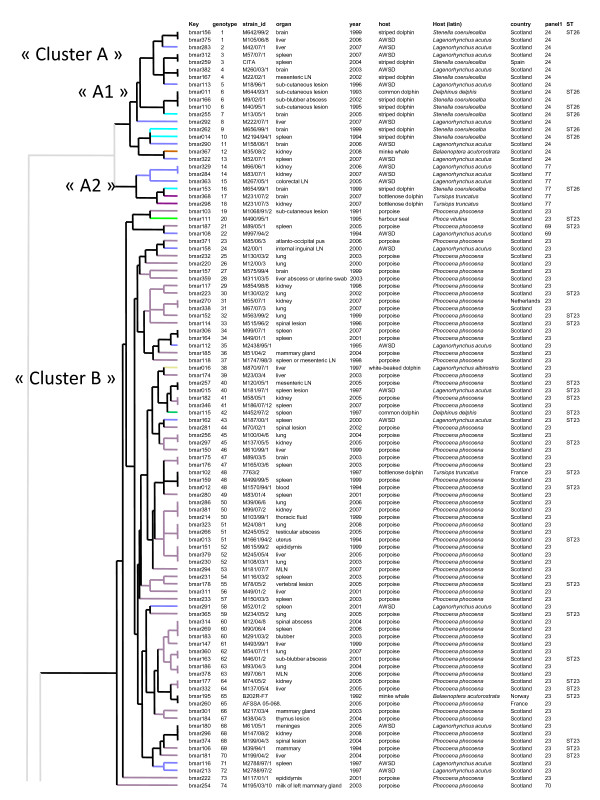
Figure 1
Figure 1
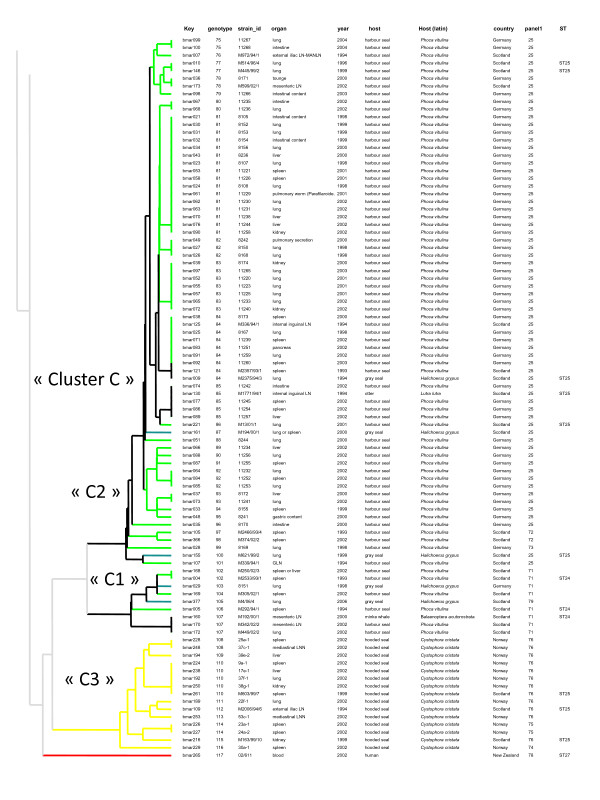
MLVA-16 clustering analysis of 102 B. ceti strains defines three groups of strains. All B. ceti isolates cluster into a first part (genotypes 1 to 74) of the dendogram constructed from MLVA-16 testing of 294 Brucella strains obtained from 173 marine mammals (pinnipeds, otter and cetaceans) and one human patient from New Zealand. One strain per genotype and per animal is included (consequently some animals are represented by more than one strain), 196 entries are listed corresponding to 117 genotypes. In the columns, the following data are presented: DNA batch (key), genotype, strain identification, organ, year of isolation, host (AWSD: Atlantic White Sided Dolphin), host (Latin name), geographic origin, MLVA panel 1 genotype, sequence type when described by Groussaud et al. [25]. The colour code reflects the host species (see Figure 3 for detailed correspondence). No colour was used when identical genotypes were observed in different host species. The letter nomenclature proposed by Groussaud et al. is used (B. ceti, cluster A (ST26) further subdivided into A1 and A2 and cluster B (ST23)).
Figure 2
Figure 2
MLVA-16 clustering analysis of 93 B. pinnipedialis strains defines 3 groups of strains. All B. pinnipedialis isolates cluster together in the second part (genotypes 75 to 117) of the dendogram constructed from MLVA-16 testing of 294 Brucella isolates obtained from 173 marine mammals (pinnipeds, otter and cetaceans) and one human patient from New Zealand. In the columns, the following data are presented: DNA batch (key), genotype, strain identification, organ, year of isolation, host (AWSD: Atlantic White Sided Dolphin), host (Latin name), geographic origin, MLVA panel 1 genotype, sequence type when described by Groussaud et al. [25]. The colour code reflects the host species (see Figure 3 for detailed correspondence). No colour was used when identical genotypes were observed in different host species. The red branch (genotype 117) corresponds to the human isolate (ST27). The letter nomenclature proposed by Groussaud et al. is used (B. pinnipedialis, cluster C, including C1 (ST24), C2 (ST25) and C3 (ST25)).
Figure 3
Figure 3
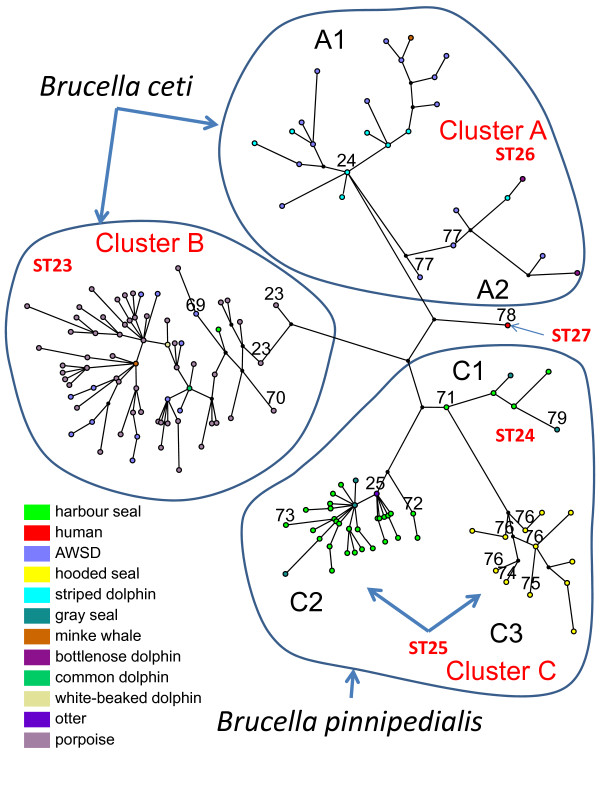
Maximum parsimony analysis on 117 marine mammal Brucella genotypes. Each coloured circle corresponds to one MLVA-16 genotype from a marine mammal species. Numbers in black (23, 24, 25, 69 to 79) indicate the MLVA the panel 1 genotype for the colour circle below. The panel 1 genotype along daughter branches is indicated only when it is different from the proposed parent node (i.e. in cluster A, all strains are panel 1 genotype 24 in subcluster A1 or 77 in subcluster A2). The tentative MLST sequence type (ST23 to ST27) as predicted from strains shared between this study and [25] is indicated, together with species assignment. The host species colour code indicated is the same as in Figures 1 and 2 (AWSD: Atlantic White Sided Dolphin).
Figure 4
Figure 4
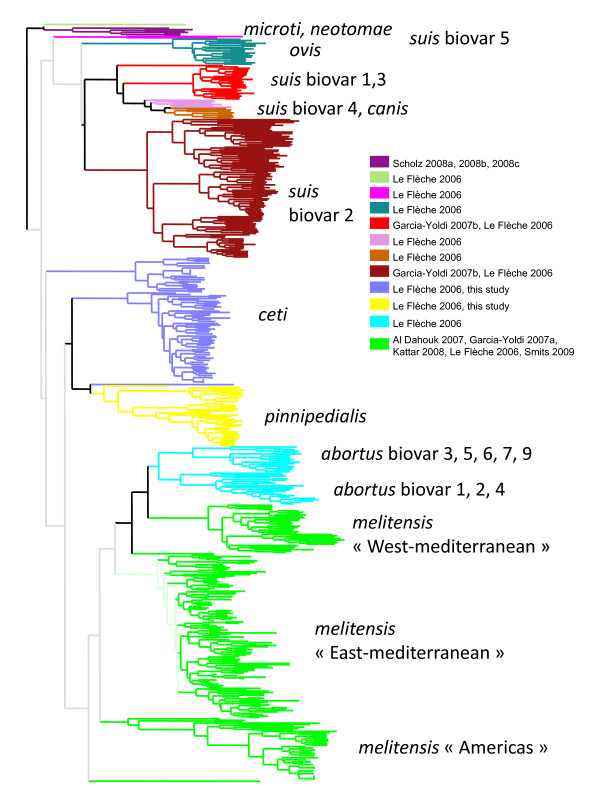
Current view of the global population structure of the Brucella genus. Clustering was done using the Neighbor Joining (NJ) algorithm. The microti/neotomae cluster was used to root the tree. The dendrogram is based upon more than 500 genotypes, observed by typing more than 750 strains [see Additional file 1]. The terrestrial mammal strains data were compiled from [5,17,19-23,37]. The colour code reflects the Brucella species (or some highly specific biovars). The publications from which the data were derived are indicated. The long blue branch close to the B. pinnipedialis cluster represents the human isolate from New Zealand (MLST ST27).

References

    1. Corbel MJ, Brinley Morgan WJ. In: Bergey's Manual of Systematic Bacteriology. Krieg NR, Holt JG, editor. Vol. 1. Baltimore: Williams and Wilkins; 1984. Genus Brucella Meyer and Shaw 1920, 173AL; pp. 377–390.
    1. Moreno E, Cloeckaert A, Moriyón I. Brucella evolution and taxonomy. Vet Microbiol. 2002;90:209–227. doi: 10.1016/S0378-1135(02)00210-9. - DOI - PubMed
    1. Alton GG, Jones LM, Angus RD, Verger JM. Techniques for the brucellosis laboratory. Paris, France: INRA; 1988.
    1. Foster G, Osterman BS, Godfroid J, Jacques I, Cloeckaert A. Brucella ceti sp. nov. and Brucella pinnipedialis sp. nov. for Brucella strains with cetaceans and seals as their preferred hosts. Int J Syst Evol Microbiol. 2007;57:2688–2693. doi: 10.1099/ijs.0.65269-0. - DOI - PubMed
    1. Scholz HC, Hubálek Z, Sedlácek I, Vergnaud G, Tomaso H, Al Dahouk S, Melzer F, Kämpfer P, Neubauer H, Cloeckaert A. Brucella microti sp. nov., isolated from the common vole Microtus arvalis. Int J Syst Evol Microbiol. 2008;58:375–382. doi: 10.1099/ijs.0.65356-0. - DOI - PubMed

Publication types

LinkOut - more resources