


Insights into the mechanisms and mediators of the effects of air pollution exposure on blood pressure and vascular function in healthy humans
- PMID: 19620518
- PMCID: PMC3706996
- DOI: 10.1161/HYPERTENSIONAHA.109.130237
Insights into the mechanisms and mediators of the effects of air pollution exposure on blood pressure and vascular function in healthy humans
Abstract
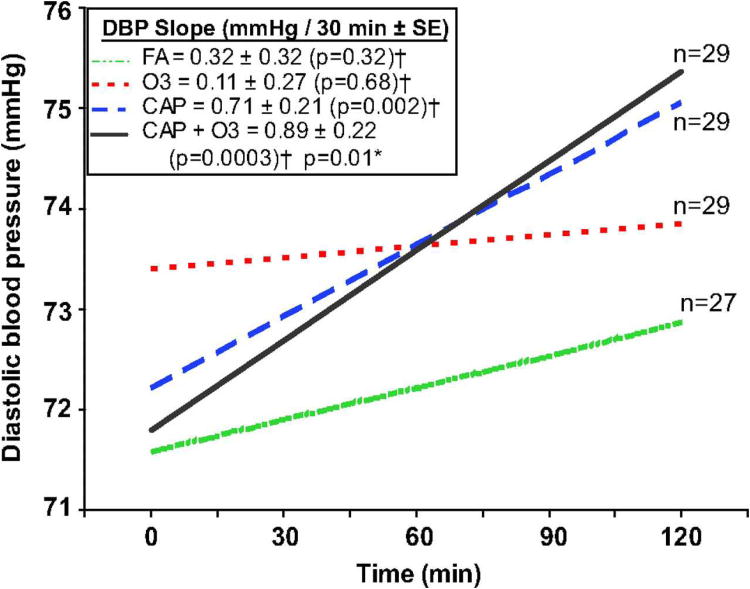
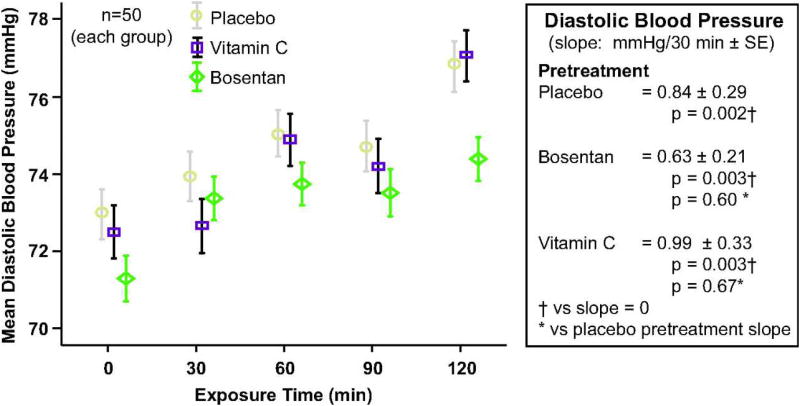
Fine particulate matter air pollution plus ozone impairs vascular function and raises diastolic blood pressure. We aimed to determine the mechanism and air pollutant responsible. The effects of pollution on heart rate variability, blood pressure, biomarkers, and brachial flow-mediated dilatation were determined in 2 randomized, double-blind, crossover studies. In Ann Arbor, 50 subjects were exposed to fine particles (150 microg/m(3)) plus ozone (120 parts per billion) for 2 hours on 3 occasions with pretreatments of an endothelin antagonist (Bosentan, 250 mg), antioxidant (Vitamin C, 2 g), or placebo. In Toronto, 31 subjects were exposed to 4 different conditions (particles plus ozone, particles, ozone, and filtered air). In Toronto, diastolic blood pressure significantly increased (2.9 and 3.6 mm Hg) only during particle-containing exposures in association with particulate matter concentration and reductions in heart rate variability. Flow-mediated dilatation significantly decreased (2.0% and 2.9%) only 24 hours after particle-containing exposures in association with particulate matter concentration and increases in blood tumor necrosis factor alpha. In Ann Arbor, diastolic blood pressure significantly similarly increased during all of the exposures (2.5 to 4.0 mm Hg), a response not mitigated by pretreatments. Flow-mediated dilatation remained unaltered. Particulate matter, not ozone, was responsible for increasing diastolic blood pressure during air pollution inhalation, most plausibly by instigating acute autonomic imbalance. Only particles from urban Toronto additionally impaired endothelial function, likely via slower proinflammatory pathways. Our findings demonstrate credible mechanisms whereby fine particulate matter could trigger acute cardiovascular events and that aspects of exposure location may be an important determinant of the health consequences.
Figures
References
-
- Pope CA, Dockery DW. Health effects of fine particulate air pollution: Lines that connect. J Air Waste Manage Assoc. 2006;56:709–42. - PubMed
-
- Brook RD, Franklin B, chair, Cascio W, Hong Y, Howard G, Lipsett M, Luepker R, Mittleman M, Samet J, Smith SC, Jr, Tager I. Air Pollution and Cardiovascular Disease: A Statement for Healthcare Professionals from the Expert Panel on Population and Prevention Science of the American Heart Association. Circulation. 2004;109:2655–2671. - PubMed
-
- Riudavets JB, Cournot M, Cassadou S, Giroux M, Meybeck M, Ferrieres J. Ozone air pollution is associated with acute myocardial infarction. Circulation. 2005;111:563–9. - PubMed
-
- Peters A, Dockery DW, Muller JE, Mittleman MA. Increased particulate air pollution and the triggering of myocardial infarction. Circulation. 2001;103:2810–2815. - PubMed
Publication types
MeSH terms
Substances
Grants and funding
LinkOut - more resources
Full Text Sources
Medical
