An activating mutation in the CSF3R gene induces a hereditary chronic neutrophilia
- PMID: 19620628
- PMCID: PMC2722170
- DOI: 10.1084/jem.20090693
An activating mutation in the CSF3R gene induces a hereditary chronic neutrophilia
Abstract
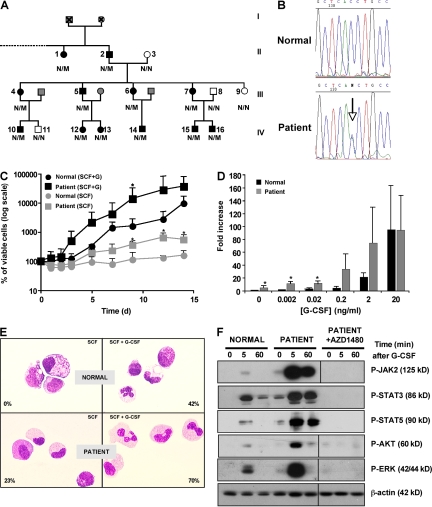
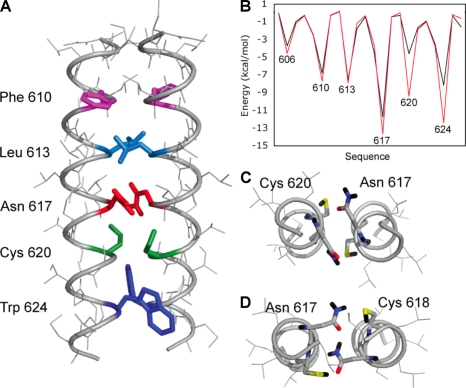
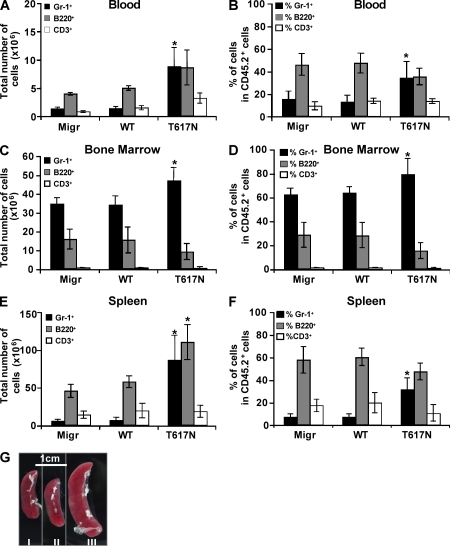
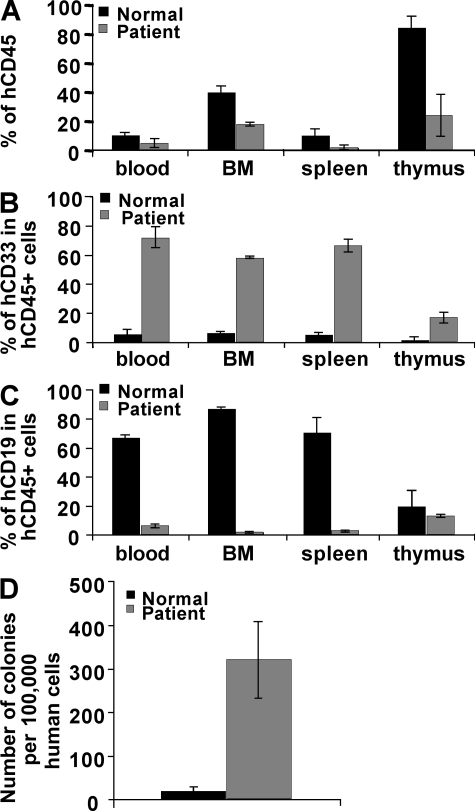
We identify an autosomal mutation in the CSF3R gene in a family with a chronic neutrophilia. This T617N mutation energetically favors dimerization of the granulocyte colony-stimulating factor (G-CSF) receptor transmembrane domain, and thus, strongly promotes constitutive activation of the receptor and hypersensitivity to G-CSF for proliferation and differentiation, which ultimately leads to chronic neutrophilia. Mutant hematopoietic stem cells yield a myeloproliferative-like disorder in xenotransplantation and syngenic mouse bone marrow engraftment assays. The survey of 12 affected individuals during three generations indicates that only one patient had a myelodysplastic syndrome. Our data thus indicate that mutations in the CSF3R gene can be responsible for hereditary neutrophilia mimicking a myeloproliferative disorder.
Figures
References
-
- Adams P.D., Engelman D.M., Brunger A.T. 1996. Improved prediction for the structure of the dimeric transmembrane domain of glycophorin A obtained through global searching.Proteins. 26:257–261 - PubMed
-
- Chaligne R., Tonetti C., Besancenot R., Roy L., Marty C., Mossuz P., Kiladjian J.J., Socie G., Bordessoule D., Le Bousse-Kerdiles M.C., et al. 2008. New mutations of MPL in primitive myelofibrosis: only the MPL W515 mutations promote a G1/S-phase transition.Leukemia. 22:1557–1566 - PubMed
-
- De Melo V., Vetter M., Mazzullo H., Howard J.D., Betts D.R., Nacheva E.P., Apperley J.F., Reid A.G. 2008. A simple FISH assay for the detection of 3q26 rearrangements in myeloid malignancy.Leukemia. 22:434–437 - PubMed
Publication types
MeSH terms
Substances
LinkOut - more resources
Full Text Sources
Other Literature Sources
Molecular Biology Databases