


Socioeconomic position, macroeconomic environment and overweight among adolescents in 35 countries
- PMID: 19621018
- PMCID: PMC3421462
- DOI: 10.1038/ijo.2009.128
Socioeconomic position, macroeconomic environment and overweight among adolescents in 35 countries
Abstract
Objective: It is important to understand levels and social inequalities in childhood overweight within and between countries. This study examined prevalence and social inequality in adolescent overweight in 35 countries, and associations with macroeconomic factors.
Design: International cross-sectional survey in national samples of schools.
Subjects: A total of 11-, 13- and 15-year-olds from 35 countries in Europe and North America in 2001-2002 (N=162 305).
Measurements: The main outcome measure was overweight based on self-reported height and weight (body mass index cut-points corresponding to body mass index of 25 kg/m(2) at the age of 18 years). Measures included family and school affluence (within countries), and average country income and economic inequality (between countries).
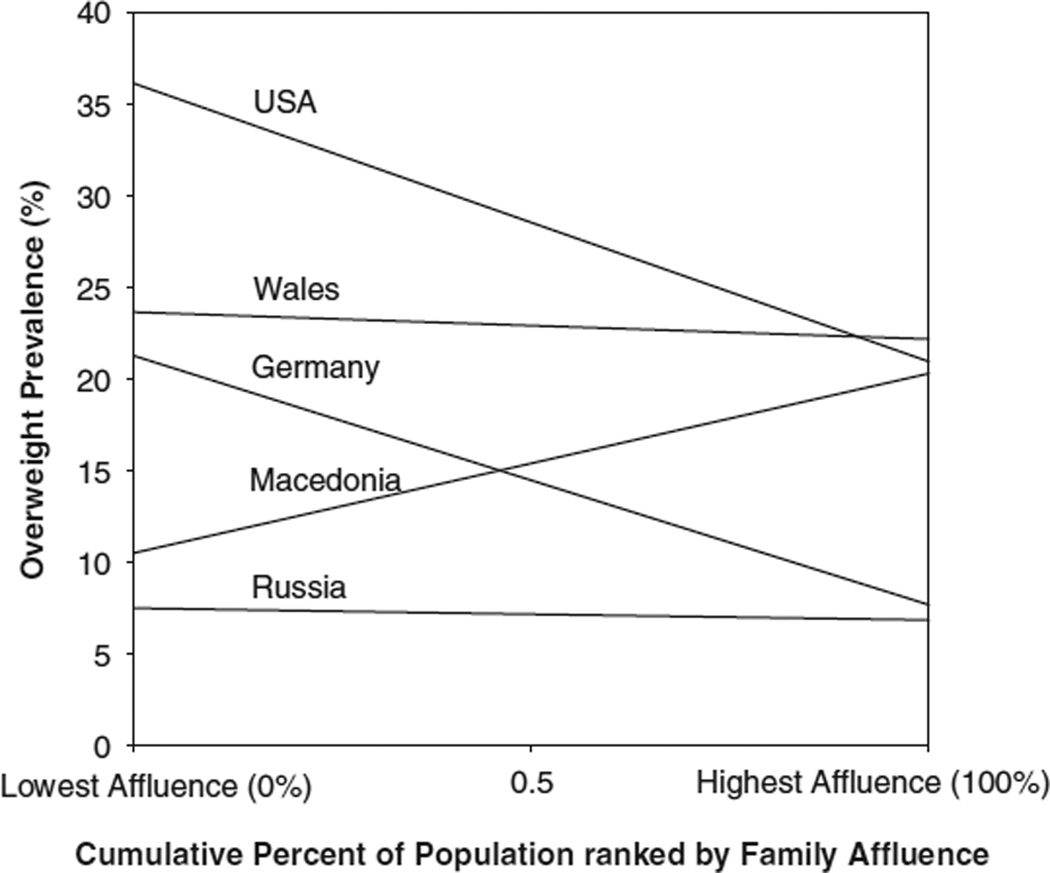
Results: There were large variations in adolescent overweight, from 3.5% in Lithuanian girls to 31.7% in boys from Malta. Prevalence of overweight was higher among children from less affluent families in 21 of 24 Western and 5 of 10 Central European countries. However, children from more affluent families were at higher risk of overweight in Croatia, Estonia and Latvia. In Poland, Lithuania, Macedonia and Finland, girls from less affluent families were more overweight whereas the opposite was found for boys. Average country income was associated with prevalence and inequality in overweight when considering all countries together. However, economic inequality as measured by the Gini coefficient was differentially associated with prevalence and socioeconomic inequality in overweight among the 23-high income and 10-middle income countries, with a positive relationship among the high income countries and a negative association among the middle income countries.
Conclusion: The direction and magnitude of social inequality in adolescent overweight shows large international variation, with negative social gradients in most countries, but positive social gradients, especially for boys, in some Central European countries. Macroeconomic factors are associated with the heterogeneity in prevalence and social inequality of adolescent overweight.
Conflict of interest statement
The authors declare no conflict of interest.
Figures
References
-
- Lobstein T, Baur L, Uauy R. Obesity in children and young people: a crisis in public health. Obes Rev. 2004;5:4–85. - PubMed
-
- Strauss RS, Pollack HA. Epidemic increase in childhood overweight, 1986–1998. JAMA. 2001;286:2845–2848. - PubMed
-
- Wang Y, Monteiro C, Popkin BM. Trends of obesity and underweight in older children and adolescents in the United States, Brazil, China and Russia. Am J Clin Nutr. 2002;75:971–977. - PubMed
-
- Swallen KC, Reither EN, Haas SA, Meier AM. Overweight, obesity, and health-related quality of life among adolescents: the national longitudinal study of adolescent health. Pediatrics. 2005;115:340–347. - PubMed
-
- Strauss RS. Childhood obesity and self esteem. Pediatrics. 2000;105:e15. - PubMed
Publication types
MeSH terms
Grants and funding
LinkOut - more resources
Full Text Sources
