. 2009 Jul 21;3(7):e481.
doi: 10.1371/journal.pntd.0000481.

The role of human movement in the transmission of vector-borne pathogens

Affiliations

The role of human movement in the transmission of vector-borne pathogens

Steven T Stoddard et al. PLoS Negl Trop Dis. .

Abstract

Background: Human movement is a key behavioral factor in many vector-borne disease systems because it influences exposure to vectors and thus the transmission of pathogens. Human movement transcends spatial and temporal scales with different influences on disease dynamics. Here we develop a conceptual model to evaluate the importance of variation in exposure due to individual human movements for pathogen transmission, focusing on mosquito-borne dengue virus.

Methodology and principal findings: We develop a model showing that the relevance of human movement at a particular scale depends on vector behavior. Focusing on the day-biting Aedes aegypti, we illustrate how vector biting behavior combined with fine-scale movements of individual humans engaged in their regular daily routine can influence transmission. Using a simple example, we estimate a transmission rate (R(0)) of 1.3 when exposure is assumed to occur only in the home versus 3.75 when exposure at multiple locations--e.g., market, friend's--due to movement is considered. Movement also influences for which sites and individuals risk is greatest. For the example considered, intriguingly, our model predicts little correspondence between vector abundance in a site and estimated R(0) for that site when movement is considered. This illustrates the importance of human movement for understanding and predicting the dynamics of a disease like dengue. To encourage investigation of human movement and disease, we review methods currently available to study human movement and, based on our experience studying dengue in Peru, discuss several important questions to address when designing a study.

Conclusions/significance: Human movement is a critical, understudied behavioral component underlying the transmission dynamics of many vector-borne pathogens. Understanding movement will facilitate identification of key individuals and sites in the transmission of pathogens such as dengue, which then may provide targets for surveillance, intervention, and improved disease prevention.


Conflict of interest statement

The authors have declared that no competing interests exist.

Figures

Figure 1
Figure 1. A framework for human movements and their relevance to vector-borne pathogen transmission.
Movements are characterized in terms of their spatial and temporal scale, which are defined in terms of physical displacement (Δxy) and time spent (Δt, frequency and duration). Generally, movements of greater spatial displacement involve more time, but this is not necessarily always the case.
Figure 2
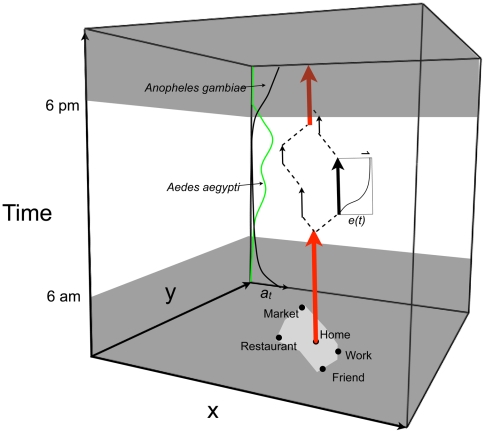
Figure 2. The activity space model.
Space is plotted in the xy plane and time on the z axis. In this example daily movements for a week are represented. Points in the xy plane are sites visited and the polygon depicts the activity area. Vertical arrows indicate time spent at a site. Thickness of arrows indicates frequency of visitation and length shows duration. Red arrows are for the home and here we assume a person is in the home every night of the week. Dashed lines represent movement between sites with velocity indicated by the angle of the line. Grayed-out regions of the cube represent night-time. Not shown is variation in vector abundance among sites. Plotted along the back axis for time are representative curves of biting rates, a(t), for Ae. aegypti (green), a day biting mosquito, and Anopheles gambiae (black), a night biting mosquito. Plotted to the right of the large black arrow is a cumulative biting probability, e(t), as a function of time spent in the location. See text for more detail.
Figure 3
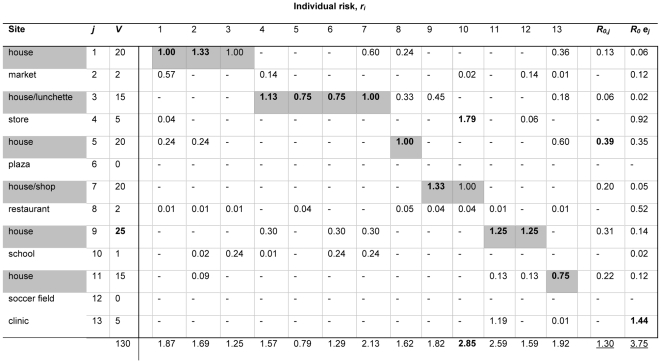
Figure 3. Example scenario of risk of exposure due to individual movements.
Individuals (i, represented by columns) live in and visit a number of sites (j, rows) for different durations and frequencies during a regular week. Each site is infested with a number of female mosquitoes, V. Grey shading indicates the home of each individual. Risk of a mosquito bite, ri, is calculated as described in the text and is presented here for each individual given the number of visits and time spent at different locations during a typical week. Numbers in bold are maxima for each column. Here the probability of a mosquito bite at night (in the home) is assumed to be 10% of all other times. The sum of individual risk is shown along the bottom of the figure. Overall transmission rate estimated without, R0, and with exposure, R0 e, considered are shown in the bottom-right and underlined. See Text S1 and Table S1 for further details.
Figure 4
Figure 4. Estimates of R0 plotted against vector density at sites.
R0 is calculated assuming exposure occurs only within homes, R0 e is calculated taking exposure rates into account based on representative activity patterns of several hypothetical individuals living in a community like Iquitos, Peru, where we are studying dengue transmission (Figure 3).

References

    1. Galvani AP, May RM. Epidemiology: dimensions of superspreading. Nature. 2005;438:293–295. - PMC - PubMed
    1. Shaw DJ, Grenfell BT, Dobson AP. Patterns of macroparasite aggregation in wildlife host populations. Parasitology. 1998;117 (Pt 6):597–610. - PubMed
    1. Woolhouse ME, Dye C, Etard JF, Smith T, Charlwood JD, et al. Heterogeneities in the transmission of infectious agents: implications for the design of control programs. Proc Natl Acad Sci U S A. 1997;94:338–342. - PMC - PubMed
    1. Anderson RM, May RM. Infectious Diseases of Humans: Dynamics and Control. Oxford University Press; 1991.
    1. May RM. Network structure and the biology of populations. Trends in Ecology and Evolution. 2006;21:394–399. - PubMed

Publication types