


Synthetic and mechanistic studies of Pd-catalyzed C-H arylation with diaryliodonium salts: evidence for a bimetallic high oxidation state Pd intermediate
- PMID: 19621899
- PMCID: PMC2737073
- DOI: 10.1021/ja904116k
Synthetic and mechanistic studies of Pd-catalyzed C-H arylation with diaryliodonium salts: evidence for a bimetallic high oxidation state Pd intermediate
Abstract
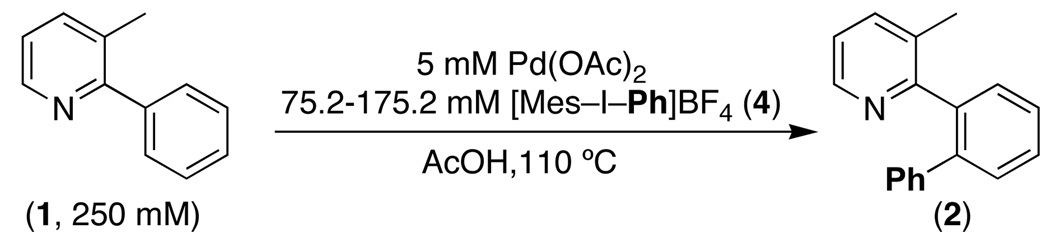
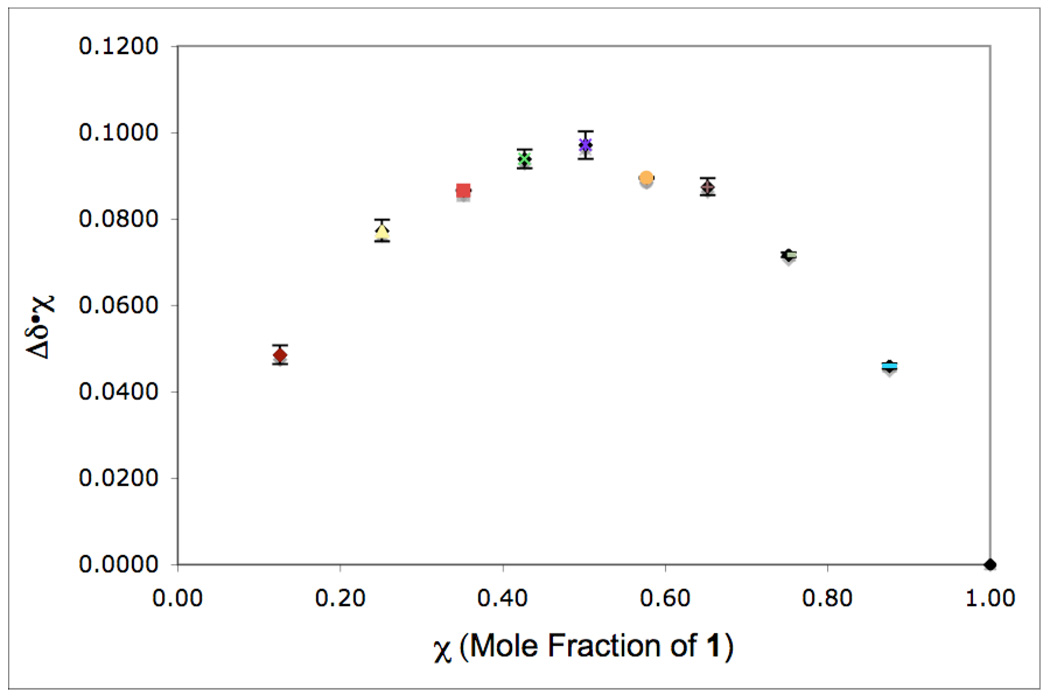
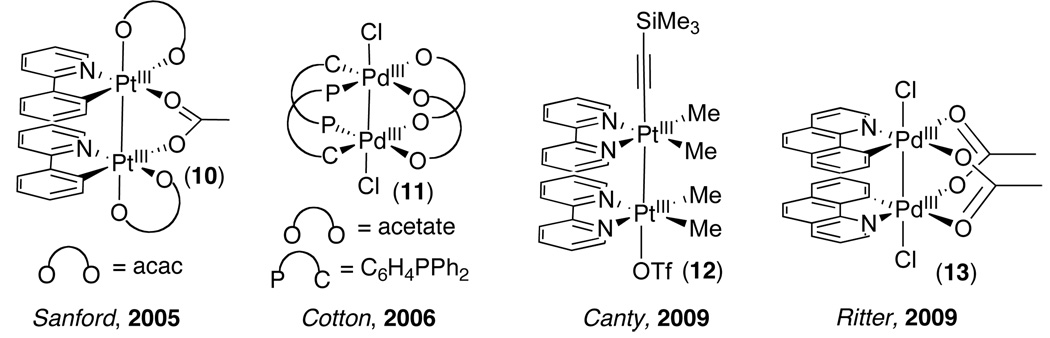
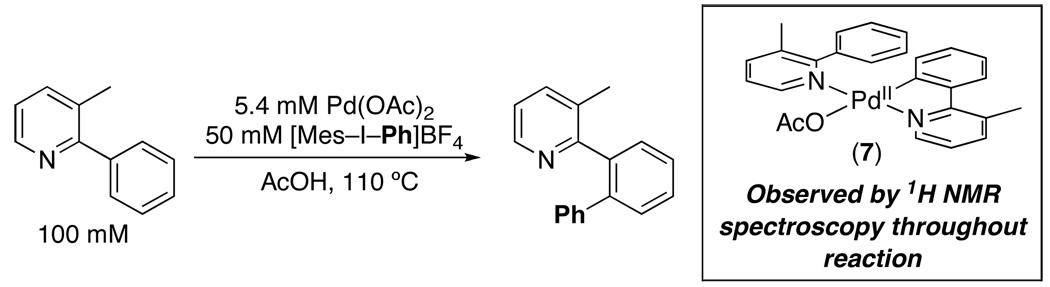
This contribution describes the substrate scope and mechanism of Pd-catalyzed ligand-directed C-H arylation with diaryliodonium salts. This transformation was applied to the synthesis of a variety of different biaryl products, using directing groups including pyridines, quinolines, pyrrolidinones, and oxazolidinones. Electronically and sterically diverse aryl groups (Ar) were transferred in high yield using iodine(III) reagents of general structure [Mes-I-Ar]BF(4). Mechanistic investigations have been conducted that establish the kinetic order of the catalytic reaction in each component, determine the resting state of the catalyst and the iodine(III) reagent, quantify the electronic influence of the arylating reagent on the reaction rate, and establish the intra- and intermolecular 1 degree H/D kinetic isotope effect. On the basis of these studies, this transformation is proposed to proceed via turnover-limiting oxidation of the Pd dimer [Pd(N~C)(OAc)](2) (N~C = 3-methyl-2-phenylpyridine) by [Mes-I-Ph]BF(4). This mechanism implicates a bimetallic high oxidation state Pd species as a key catalytic intermediate. The significance of this and other aspects of the proposed mechanism are discussed in detail.
Figures






References
-
- Stille JK. Angew. Chem., Int. Ed. Engl. 1986:508.
- Farina V, Krishnamurthy V, Scott WJ. Org. React. 1997;50:1.
- Miyaura N, Suzuki A. Chem. Rev. 1995;95:2457.
- Suzuki AJ. Organomet. Chem. 1999;576:147.
- Beletskaya IP, Cheprakov AV. Chem. Rev. 2000;100:3009. - PubMed
- Kotha S, Lahiri K, Kashinath D. Tetrahedron. 2002;58:9633.
- Denmark SE, Sweis RF. Acc. Chem. Res. 2002;35:835. - PubMed
- Muci AR, Buchwald SL. Top. Curr. Chem. 2002;219:131.
- Negishi E, Anastasia L. Chem. Rev. 2003;103:1979. - PubMed
-
-
For recent reviews that discuss C–H arylation, see: Campeau LC, Fagnou K. Chem. Commun. 2006:1253. Daugulis O, Zaitsev VG, Shabashov D, Pham QN, Lazareva A. Synlett. 2006:3382. Yu JQ, Giri R, Chen X. Org. Biomol. Chem. 2006;4:4041. Godula K, Sames D. Science. 2006;312:67. Alberico D, Scott ME, Lautens M. Chem. Rev. 2007;107:174. Beccalli EM, Broggini G, Martinelli M, Sottocornola S. Chem. Rev. 2007;107:5318. Ackermann L. Synlett. 2007:507. Fairlamb IJS. Chem. Soc. Rev. 2007;36:1036. Campeau LC, Fagnou K. Chem. Soc. Rev. 2007;36:1058. Catellani M, Motti E, Della Ca N. Acc. Chem. Res. 2008;41:1512. Kakiuchi F, Kochi T. Synthesis. 2008:3013. Li BJ, Yand SD, Shi ZJ. Synlett. 2008:949. McGlacken GP, Bateman LM. Chem. Soc. Rev. 2009
-
-
-
For examples of ligand-directed Ar–H oxidative coupling, see: Hull KL, Lanni EL, Sanford MSJ. Am. Chem. Soc. 2006;128:14047. Xia JB, You SL. Organometallics. 2007;26:4869. Hull KL, Sanford MSJ. Am. Chem. Soc. 2007;129:11904. Li BJ, Tian LS, Fang Z, Shi ZJ. Angew. Chem., Int. Ed. 2008;47:1115. Brasche G, García-Fortanet J, Buchwald SL. Org. Lett. 2008;10:2207.
-
-
-
For other proposals of Pd-catalyzed ligand-directed C–H arylation via a PdII/IV mechanism, see ref. 5a, and: Shabashov D, Daugulis O. Org. Lett. 2005;7:3657. Zaitsev VG, Shabashov D, Daugulis OJ. Am. Chem. Soc. 2005;127:13154. Reddy BVS, Reddy LR, Corey EJ. Org. Lett. 2006;8:3391. Giri R, Maugel N, Li JJ, Wang DH, Breazzano SP, Saunders LB, Yu JQ. J. Am. Chem. Soc. 2007;129:3510. Chiong HA, Pham QN, Daugulis O. J. Am. Chem. Soc. 2007;129:9879. Thirunavukkarasu VS, Parthasarathy K, Cheng CH. Angew. Chem., Int. Ed. 2008;47:9462. Yang F, Wu Y, Zhu Z, Zhang J, Li Y. Tetrahedron. 2008;64:6782. Yang F, Wu Y, Li Y, Wang B, Zhang J. Tetrahedron. 2009;65:914.
-
Publication types
MeSH terms
Substances
Grants and funding
LinkOut - more resources
Full Text Sources
Other Literature Sources
Research Materials
Miscellaneous
