


The transition from fetal growth restriction to accelerated postnatal growth: a potential role for insulin signalling in skeletal muscle
- PMID: 19622603
- PMCID: PMC2754360
- DOI: 10.1113/jphysiol.2009.173161
The transition from fetal growth restriction to accelerated postnatal growth: a potential role for insulin signalling in skeletal muscle
Abstract
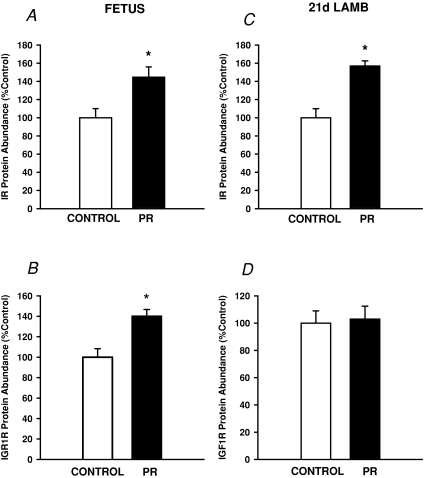
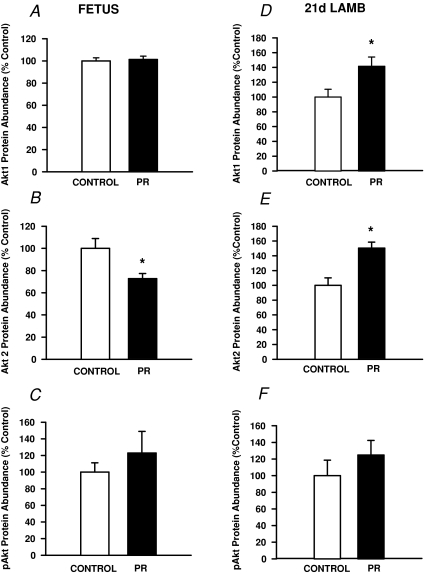
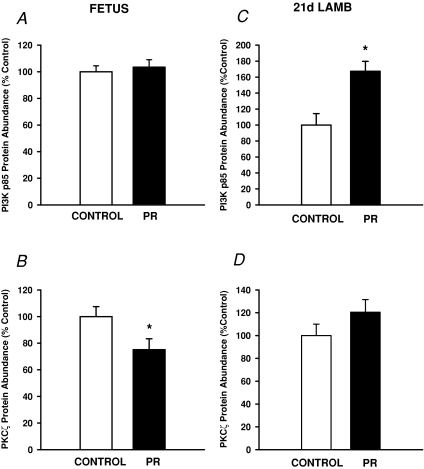
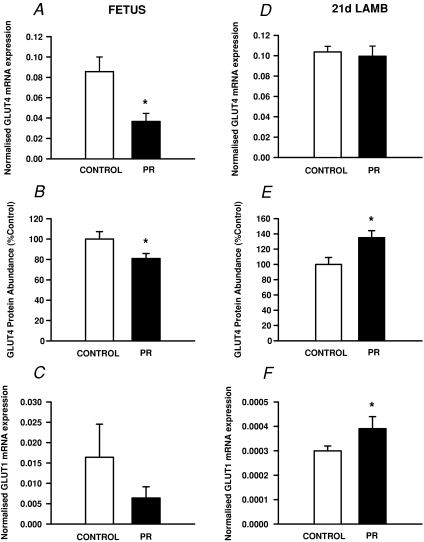
A world-wide series of epidemiological and experimental studies have demonstrated that there is an association between being small at birth, accelerated growth in early postnatal life and the emergence of insulin resistance in adult life. The aim of this study was to investigate why accelerated growth occurs in postnatal life after in utero growth restriction. Samples of quadriceps muscle were collected at approximately 140 days gestation (term approximately 150 days gestation) from normally grown fetal lambs (Control, n = 7) and from growth restricted fetal lambs (placentally restricted: PR, n = 8) and from Control (n = 14) and PR (n = 9) lambs at 21 days after birth. The abundance of the insulin and IGF1 receptor protein was higher in the quadriceps muscle of the PR fetus, but there was a lower abundance of the insulin signalling molecule PKC, and GLUT4 protein in the PR group. At 21 days of postnatal age, insulin receptor abundance remained higher in the muscle of the PR lamb, and there was also an up-regulation of the insulin signalling molecules, PI3Kinase p85, Akt1 and Akt2 and of the GLUT4 protein in the PR group. Fetal growth restriction therefore results in an increased abundance of the insulin receptor in skeletal muscle, which persists after birth when it is associated with an upregulation of insulin signalling molecules and the glucose transporter, GLUT4. These data provide evidence that the origins of the accelerated growth experienced by the small baby after birth lie in the adaptive response of the growth restricted fetus to its low placental substrate supply.
Figures
References
-
- Albertsson-Wikland K, Wennergren G, Wennergren M, Vilbergsson G, Rosberg S. Longitudinal follow-up of growth in children born small for gestational age. Acta Paediatr. 1993;82:438–443. - PubMed
-
- Aldermann GA, Morgan DE, Harvard A, Edwards RE, Todd JR. Ministry of Agriculture, Fisheries and Food: Technical Bulletin 33. London: Her Majesty's Stationery Office; 1975. Energy allowances and feeding systems for ruminants; pp. 34–36.
-
- Arai T, Washizu T, Sagara M, Sako T, Nigi H, Matsumoto H, Sasaki M, Tomoda I. D-Glucose transport and glycolytic enzyme activities in erythrocytes of dogs, pigs, cats, horses, cattle and sheep. Res Vet Sci. 1995;58:195–196. - PubMed
-
- Barker DJP. Fetal and Infant Origins of Adult Disease. London: British Medical Journal Publishing Group; 1992.
-
- Bavdekar A, Yajnik C, Fall C, Bapat S, Pandit A, Deshpande V, Bhave S, Kellingray S, Joglekar C. Insulin resistance syndrome in 8-year-old Indian children: small at birth, big at 8 years, or both? Diabetes. 1999;48:2422–2429. - PubMed
Publication types
MeSH terms
Substances
Grants and funding
LinkOut - more resources
Full Text Sources
Medical
Research Materials
Miscellaneous
