


Fuel selection in Wistar rats exposed to cold: shivering thermogenesis diverts fatty acids from re-esterification to oxidation
- PMID: 19622609
- PMCID: PMC2754371
- DOI: 10.1113/jphysiol.2009.175331
Fuel selection in Wistar rats exposed to cold: shivering thermogenesis diverts fatty acids from re-esterification to oxidation
Abstract
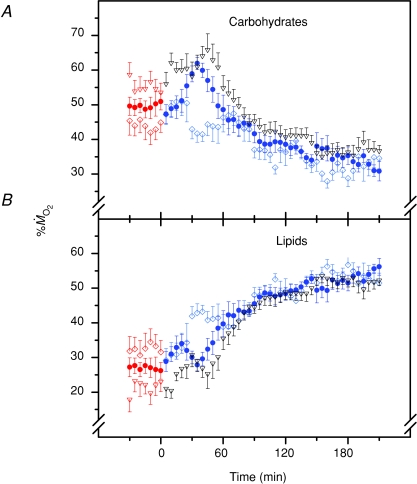
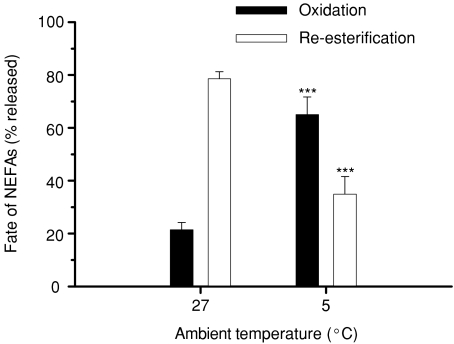
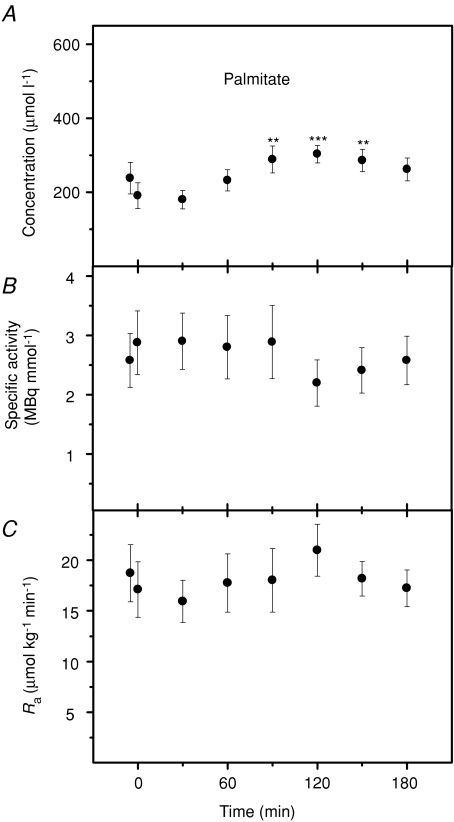
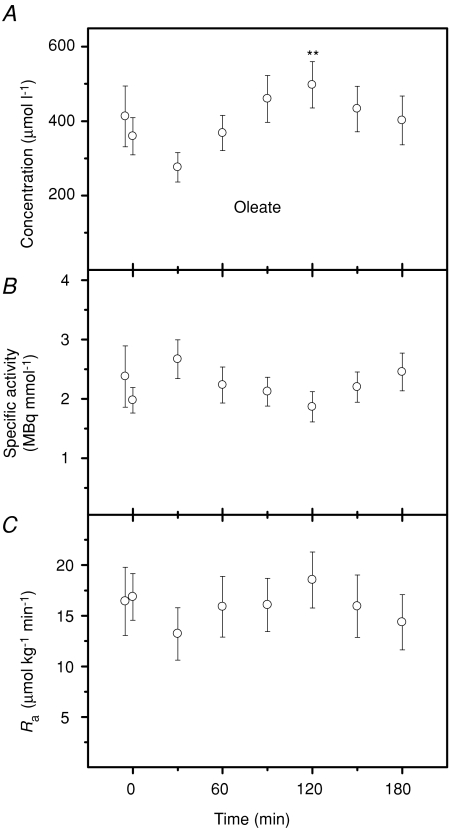
This study characterizes the effects of shivering thermogenesis on metabolic fuel selection in Wistar rats. Because lipids account for most of the heat produced, we have investigated: (1) whether the rate of appearance of non-esterified fatty acids (R(a) NEFAs) is stimulated by shivering, (2) whether mono-unsaturated (oleate) and saturated fatty acids (palmitate) are affected similarly, and (3) whether the partitioning between fatty acid oxidation and re-esterification is altered by cold exposure. Fuel oxidation was measured by indirect calorimetry and fatty acid mobilization by continuous infusion of 9,10-[(3)H]oleate and 1-[(14)C]palmitate. During steady-state cold exposure, results show that total heat production is unequally shared by the oxidation of lipids (52% of metabolic rate), carbohydrates (35%) and proteins (13%), and that the same fuel selection pattern is observed at all shivering intensities. All previous research shows that mammals stimulate R(a) NEFA to support exercise or shivering. In contrast, results reveal that the R(a) NEFA of the rat remains constant during cold exposure (55 micromol kg(1) min(1)). No preferential use of mono-unsaturated over saturated fatty acids could be demonstrated. The rat decreases its rate of fatty acid re-esterification from 48.4 +/- 6.4 to 19.6 +/- 6.3 micromol kg(1) min(1) to provide energy to shivering muscles. This study is the first to show that mammals do not only increase fatty acid availability for oxidation by stimulating R(a) NEFA. Reallocation of fatty acids from re-esterification to oxidation is a novel, alternative strategy used by the rat to support shivering.
Figures
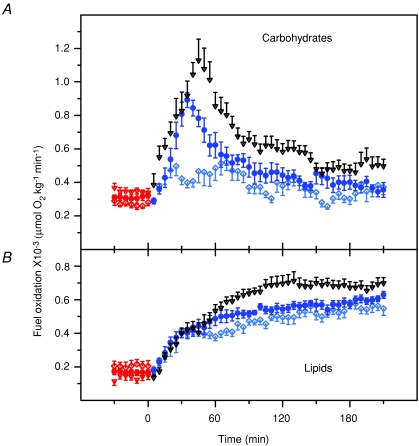
 ) accounted for by carbohydrate (A) and lipid (B) oxidation in male Wistar rats before (27°C, thermoneutral control) and during cold exposure (15°C, ◊; 10°C, •; 5°C, ▿). Values are means ±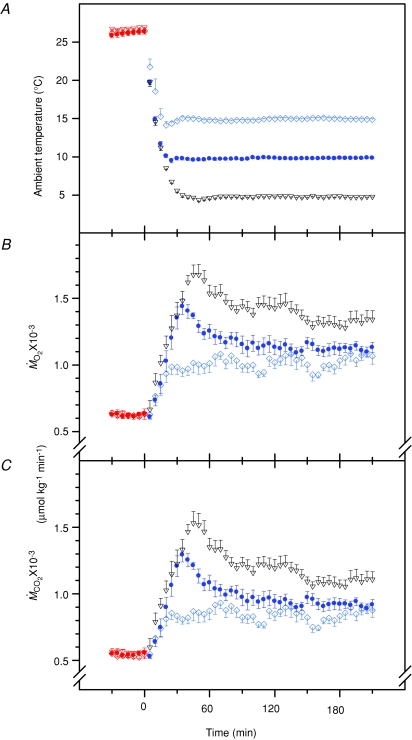
 ) (B) and carbon dioxide production (
 ) (C) of male Wistar rats before (27°C, thermoneutral control) and during cold exposure (15°C, ◊; 10°C, •; 5°C, ▿). Values are means ±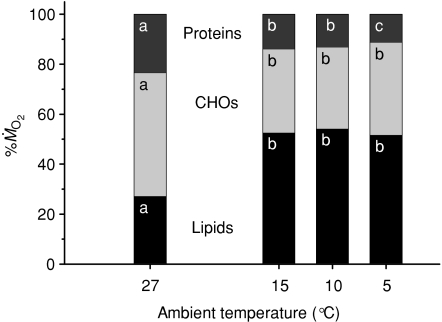
References
-
- Abdul-Malak N, Brichon G, Meister R, Zwingelstein G. Environmental temperature and metabolism of molecular species of phosphatidylcholine in the tissues of the rainbow trout. Lipids. 1989;24:318–324.
-
- Adán C, Ardévol A, Remesar X, Alemany M, Fernández-López JA. Hindleg muscle energy and substrate balances in cold-exposed rats. J Exp Biol. 1995;198:1243–1251. - PubMed
-
- Arola L, Herrera E, Alemany M. A method for the estimation of striated muscle mass in small laboratory animals. Rev Esp Fisiol. 1979;35:215–218. - PubMed
-
- Blem CR. Avian energy storage. Curr Ornithol. 1990;7:59–113.
Publication types
MeSH terms
Substances
LinkOut - more resources
Full Text Sources
Miscellaneous
