How citation distortions create unfounded authority: analysis of a citation network
- PMID: 19622839
- PMCID: PMC2714656
- DOI: 10.1136/bmj.b2680
How citation distortions create unfounded authority: analysis of a citation network
Abstract
Objective: To understand belief in a specific scientific claim by studying the pattern of citations among papers stating it.
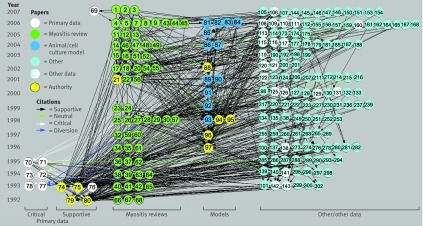
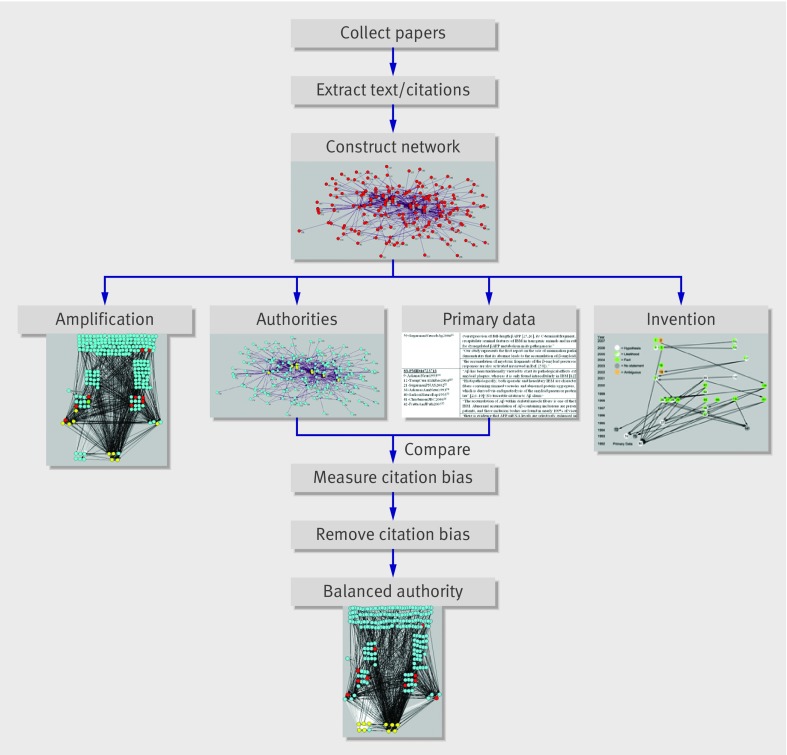
Design: A complete citation network was constructed from all PubMed indexed English literature papers addressing the belief that beta amyloid, a protein accumulated in the brain in Alzheimer's disease, is produced by and injures skeletal muscle of patients with inclusion body myositis. Social network theory and graph theory were used to analyse this network.
Main outcome measures: Citation bias, amplification, and invention, and their effects on determining authority.
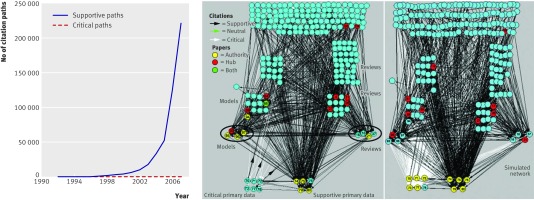
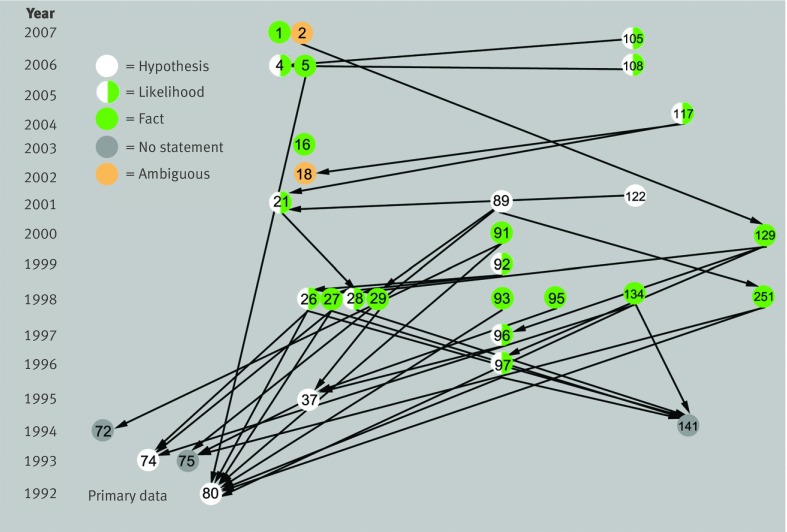
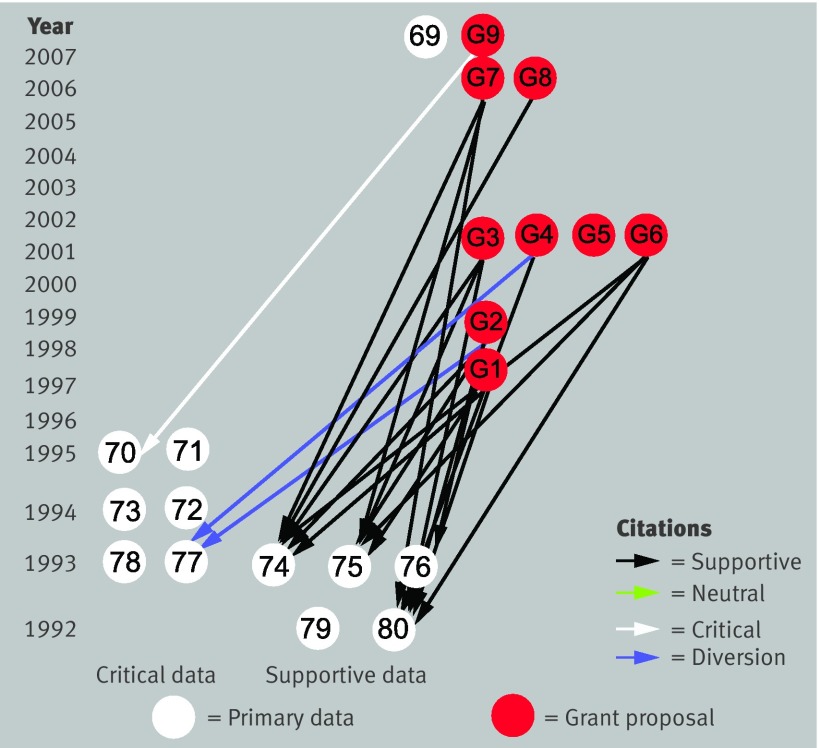
Results: The network contained 242 papers and 675 citations addressing the belief, with 220,553 citation paths supporting it. Unfounded authority was established by citation bias against papers that refuted or weakened the belief; amplification, the marked expansion of the belief system by papers presenting no data addressing it; and forms of invention such as the conversion of hypothesis into fact through citation alone. Extension of this network into text within grants funded by the National Institutes of Health and obtained through the Freedom of Information Act showed the same phenomena present and sometimes used to justify requests for funding.
Conclusion: Citation is both an impartial scholarly method and a powerful form of social communication. Through distortions in its social use that include bias, amplification, and invention, citation can be used to generate information cascades resulting in unfounded authority of claims. Construction and analysis of a claim specific citation network may clarify the nature of a published belief system and expose distorted methods of social citation.
Conflict of interest statement
Competing interests: SAG had full access to all of the data in the study and takes responsibility for the integrity of the data and the accuracy of the data analysis.
Figures
Comment in
-
Inappropriate referencing in research.BMJ. 2009 Jul 20;339:b2049. doi: 10.1136/bmj.b2049. BMJ. 2009. PMID: 19622838 No abstract available.
-
Medical literature and Chinese whispers.Natl Med J India. 2009 Sep-Oct;22(5):249-51. Natl Med J India. 2009. PMID: 20334048 No abstract available.
References
-
- Needham M, Mastaglia FL. Inclusion body myositis: current pathogenetic concepts and diagnostic and therapeutic approaches. Lancet Neurol 2007;6:620-631. - PubMed
-
- Needham M, Mastaglia FL, Garlepp MJ. Genetics of inclusion-body myositis. Muscle Nerve 2007;35:549-561. - PubMed
-
- Askanas V, Engel WK. Inclusion-body myositis, a multifactorial muscle disease associated with aging: current concepts of pathogenesis. Curr Opin Rheumatol 2007;19:550-559. - PubMed
-
- Askanas V, Engel WK. Inclusion-body myositis: a myodegenerative conformational disorder associated with Abeta, protein misfolding, and proteasome inhibition. Neurology 2006;66(2 Suppl 1):S39-48. - PubMed
-
- Murphy MP, Golde TE. Inclusion-body myositis and Alzheimer disease: two sides of the same coin, or different currencies altogether? Neurology 2006;66(2 Suppl 1):S65-68. - PubMed
Publication types
MeSH terms
Grants and funding
LinkOut - more resources
Full Text Sources
Other Literature Sources