


Relationship between vasospasm, cerebral perfusion, and delayed cerebral ischemia after aneurysmal subarachnoid hemorrhage
- PMID: 19623472
- PMCID: PMC2773037
- DOI: 10.1007/s00234-009-0575-y
Relationship between vasospasm, cerebral perfusion, and delayed cerebral ischemia after aneurysmal subarachnoid hemorrhage
Abstract
Introduction: Vasospasm after aneurysmal subarachnoid hemorrhage (SAH) is thought to cause ischemia. To evaluate the contribution of vasospasm to delayed cerebral ischemia (DCI), we investigated the effect of vasospasm on cerebral perfusion and the relationship of vasospasm with DCI.
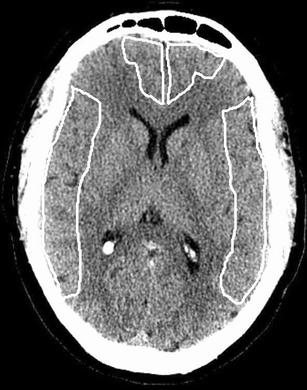
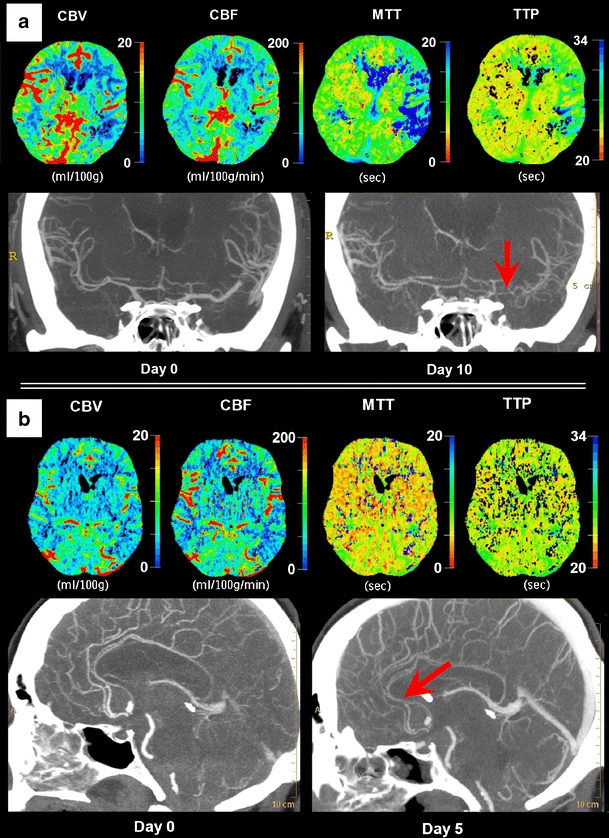
Methods: We studied 37 consecutive SAH patients with CT angiography (CTA) and CT perfusion (CTP) on admission and within 14 days after admission or at time of clinical deterioration. CTP values (cerebral blood volume, cerebral blood flow (CBF) and mean transit time), degree of vasospasm on CTA, and occurrence of DCI were recorded. Vasospasm was categorized as follows: no spasm (0-25% decrease in vessel diameter), moderate spasm (25-50% decrease), and severe spasm (>50% decrease). The correspondence of the flow territory of the most spastic vessel with the least perfused region was evaluated, and differences in perfusion values and occurrence of DCI between degrees of vasospasm were calculated with 95% confidence intervals (95% CI).
Results: Fourteen patients had no vasospasm, 16 were moderate, and seven were severe. In 65% of patients with spasm, the flow territory of the most spastic vessel corresponded with the least perfused region. There was significant CBF (milliliters per 100 g per minute) difference (-21.3; 95% CI, -37 <--> -5.3) between flow territories of severe and no vasospasm. Four of seven patients with severe, six of 16 with moderate, and three of 14 patients with no vasospasm had DCI.
Conclusion: Vasospasm decreases cerebral perfusion, but corresponds with the least perfused region in only two thirds of our patients. Furthermore, almost half of patients with severe vasospasm do not have DCI. Thus, although severe vasospasm can decrease perfusion, it may not result in DCI.
Figures
References
-
- Myburgh JA. “Triple h” therapy for aneurysmal subarachnoid haemorrhage: real therapy or chasing numbers? Crit Care Resusc. 2005;7:206–212. - PubMed
-
- Qureshi AI, Suarez JI, Bhardwaj A, Yahia AM, Tamargo RJ, Ulatowski JA. Early predictors of outcome in patients receiving hypervolemic and hypertensive therapy for symptomatic vasospasm after subarachnoid hemorrhage. Crit Care Med. 2000;28:824–829. doi: 10.1097/00003246-200003000-00035. - DOI - PubMed
MeSH terms
LinkOut - more resources
Full Text Sources
