. 2009 Aug 15;183(4):2565-74.
doi: 10.4049/jimmunol.0901443. Epub 2009 Jul 22.

A molecular insight into complement evasion by the staphylococcal complement inhibitor protein family

Affiliations

A molecular insight into complement evasion by the staphylococcal complement inhibitor protein family

Daniel Ricklin et al. J Immunol. .

Abstract

Staphylococcus aureus possesses an impressive arsenal of complement evasion proteins that help the bacterium escape attack of the immune system. The staphylococcal complement inhibitor (SCIN) protein exhibits a particularly high potency and was previously shown to block complement by acting at the level of the C3 convertases. However, many details about the exact binding and inhibitory mechanism remained unclear. In this study, we demonstrate that SCIN directly binds with nanomolar affinity to a functionally important area of C3b that lies near the C terminus of its beta-chain. Direct competition of SCIN with factor B for C3b slightly decreased the formation of surface-bound convertase. However, the main inhibitory effect can be attributed to an entrapment of the assembled convertase in an inactive state. Whereas native C3 is still able to bind to the blocked convertase, no generation and deposition of C3b could be detected in the presence of SCIN. Furthermore, SCIN strongly competes with the binding of factor H to C3b and influences its regulatory activities: the SCIN-stabilized convertase was essentially insensitive to decay acceleration by factor H and the factor I- and H-mediated conversion of surface-bound C3b to iC3b was significantly reduced. By targeting a key area on C3b, SCIN is able to block several essential functions within the alternative pathway, which explains the high potency of the inhibitor. Our findings provide an important insight into complement evasion strategies by S. aureus and may act as a base for further functional studies.


Conflict of interest statement

Disclosures

The authors have no financial conflict of interest.

Figures
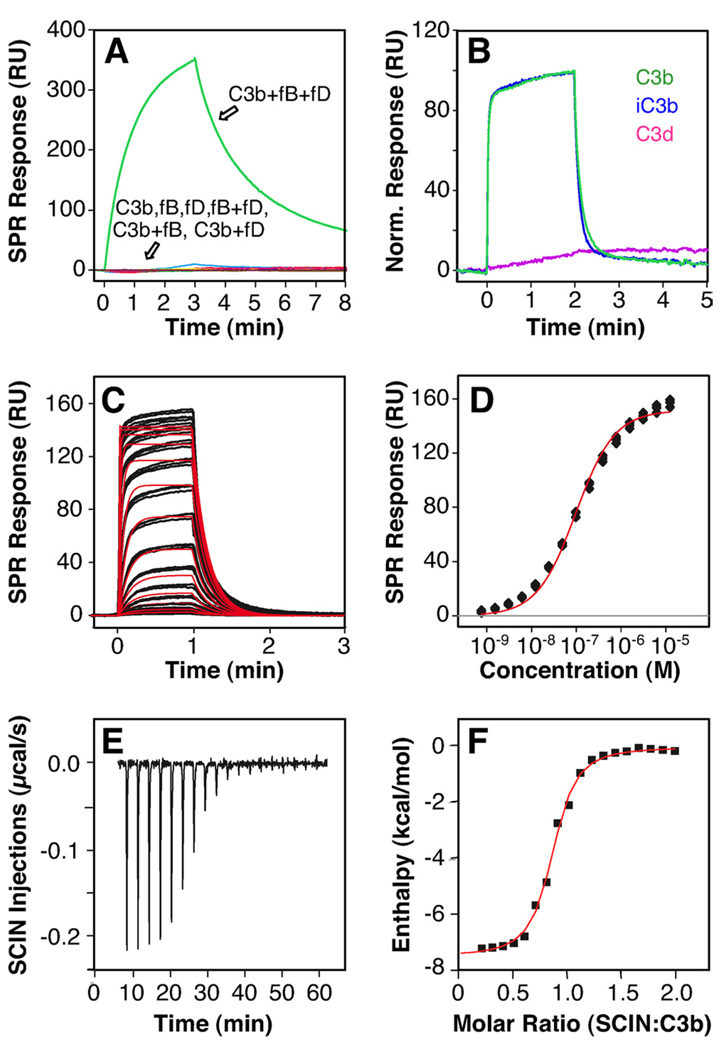
FIGURE 1
FIGURE 1
SCIN binds to both surface-bound and solution-based C3b with nanomolar affinity. A, When SCIN was immobilized on a SPR chip surface, only the convertase mix (C3b plus fB plus fD) showed significant affinity. B, In contrast, solution-based SCIN (1 µM) bound with similar activity to C3b (green) and iC3b (blue) that have been immobilized via their thioester moiety to the SPR sensor chip. No significant binding was observed for C3d (magenta). C, The binding mode and affinity of SCIN was further elucidated using SPR by injecting a dilution series of SCIN (0.8 nM–12.5 µM) to site-specifically immobilized C3b. Despite some heterogeneity at higher concentrations, the interaction featured reproducible triplicate injections (black SPR signals) and fitted reasonably well to a Langmuir 1:1 kinetic model (red fitting curves). D, In agreement with the kinetic analysis, the steady state signals (black filled symbols) could be fitted to a single-binding site model and showed clear signs of saturation (red fitting curve). A direct interaction between SCIN and C3b was also detected in solution using ITC. E, Injection of SCIN (120 µM) into C3b (12 µM) produced a dose-dependent, exothermic response. F, The integrated data (filled black symbols) could be fitted to a single set of sites (red fitting curve). RU, Resonance units. A schematic representation of the assays is available (see supplemental Fig. S6, A–C).
FIGURE 2
FIGURE 2
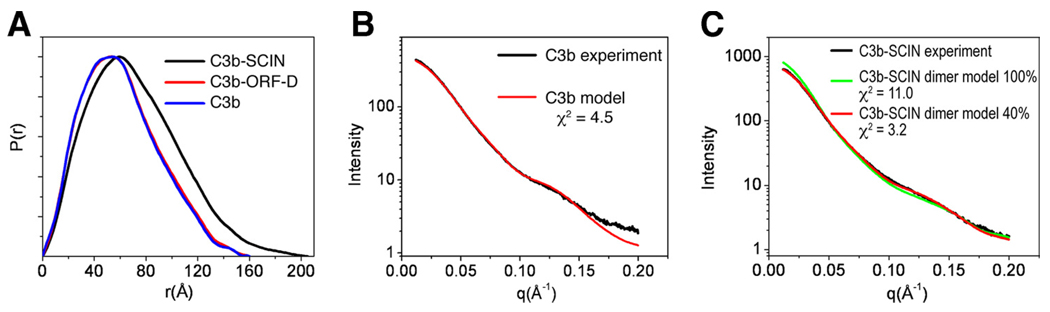
SCIN and C3b form a mixture of monomeric and dimeric complexes when analyzed by SAXS. A, Pair-distance distribution function (P(r)) calculated for scattering data collected on solutions of C3b-SCIN (black), C3b-ORF-D (red), and C3b alone (blue). Note the shift in r(Å) value, where pair-distance distribution function is maximal and the long-tailing pair-distance distribution function curve for C3b-SCIN relative to the control samples. B, Experimental scattering curve of unliganded C3b observed in solution (black) compared with the theoretical scattering curve for an unliganded C3b crystal structure (PDB code 2I07 (29)). C, Guinier analysis of the C3b-SCIN experimental data as compared with theoretical scattering curves for a sample comprised entirely of C3b dimer (green) or 40/60 percentage C3b dimer to C3b monomer (red), as determined by the program OLIGOMER (28). The value for the quality of fit parameter (χ2) is shown in B and C.
FIGURE 3
FIGURE 3
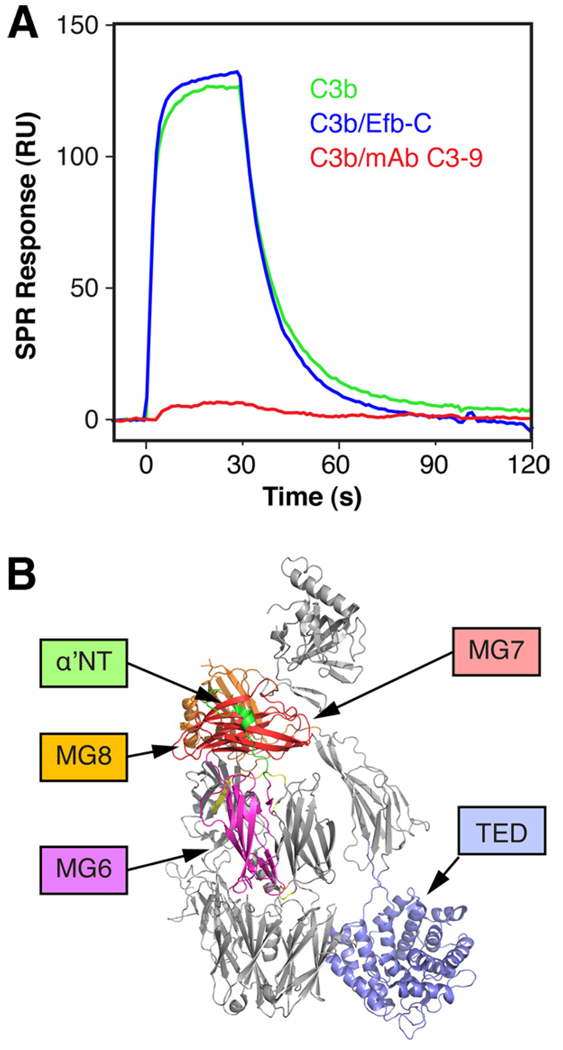
The SCIN binding site can be localized at a functionally important area on C3b. A, The binding of SCIN to immobilized C3b was compared in the presence or absence of mAb C3–9 (anti-C3c) and the bacterial complement inhibitor Efb-C. Whereas SCIN bound similarly well to the C3b-Efb-C complex (blue) compared with free C3b (green), mAb C3–9 led to a significant decrease in binding activity (red). B, The domains involved in binding of mAb C3–9 (MG7, MG8 (32)), Efb-C (TED (10)), and the fragment fH(1–2), and Ba (α′NT, MG6, MG7 (18)) have been highlighted on the crystal structure of C3b (PBD code 2I07 (29)). A schematic representation of the assays is available (see supplemental Fig. S6D).
FIGURE 4
FIGURE 4
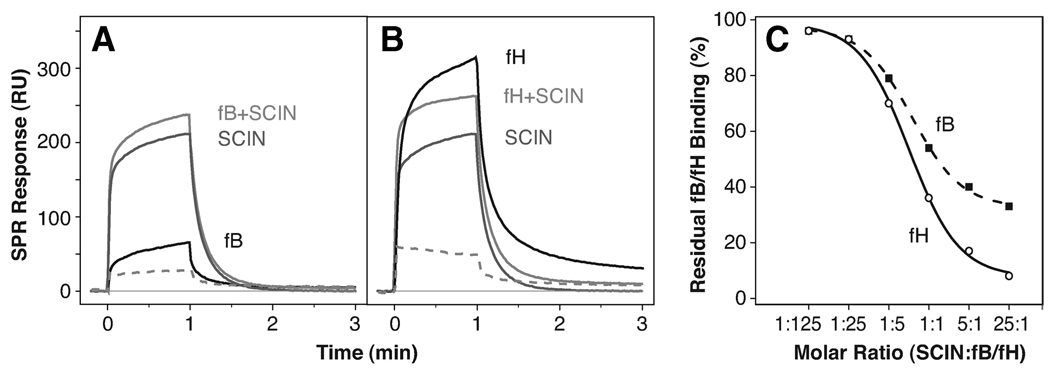
SCIN competes with fB and fH for binding to C3b. In an SPR experiment, constant concentrations (500 nM) of either fB (A) or fH (B) in HBS-Mg buffer were injected to immobilized C3b either alone (black line) or as mixtures with increasing concentrations (20 nM–12.5 µM) of SCIN (light gray line). The same dilution series of SCIN alone (dark gray line) was injected and subtracted from the corresponding signal of the fB plus SCIN mixture (dashed curve). For reasons of simplicity, the plots show only one concentration of SCIN (2.5 µM) and fB or fH (500 nM). C, The residual signals for both competition series were divided by the uninhibited fB or fH response and plotted against the molar ratio between SCIN and fH or fB concentrations. Although both complement factors compete with SCIN for binding to C3b, the effect is significantly more pronounced for fH than fB. A schematic representation of the assays is available (see supplemental Fig. S6, E and F).
FIGURE 5
FIGURE 5
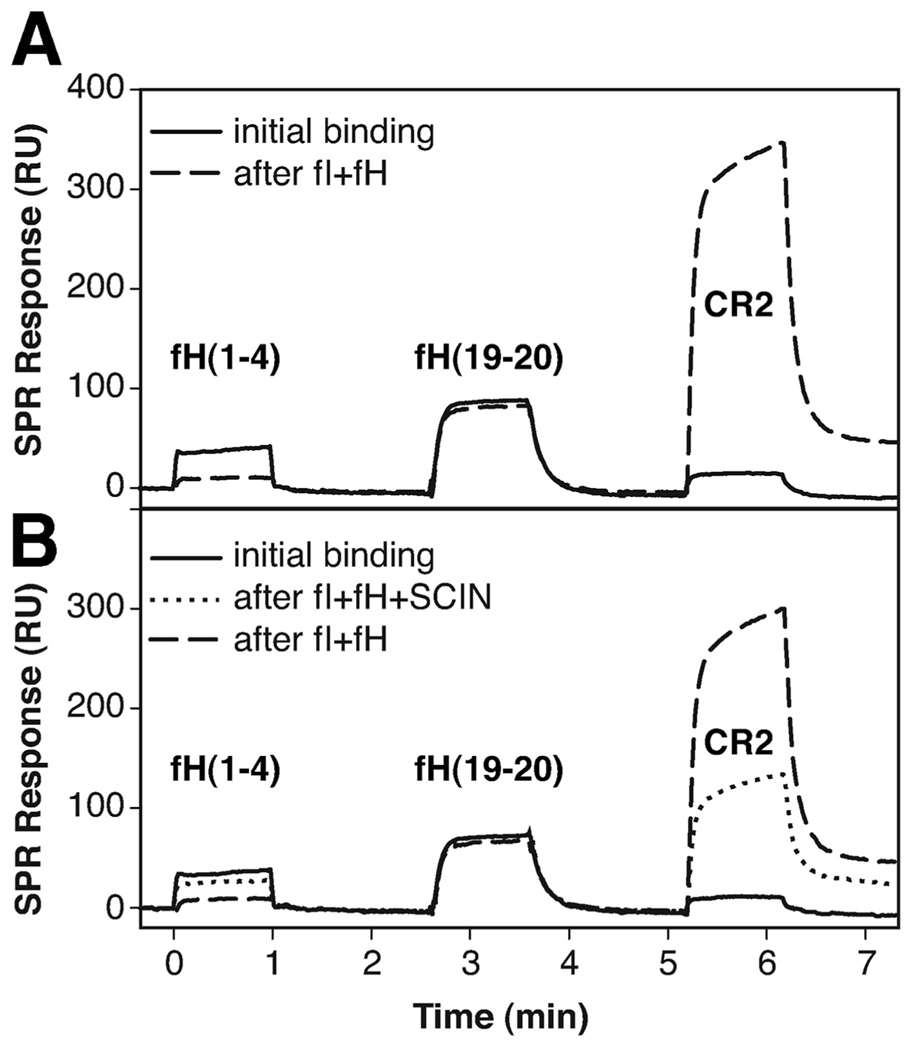
SCIN inhibits the cofactor activity of fH. A, The fI-mediated degradation of surface-bound C3b by fI was observed by using SPR with fH(1–4) as a probe for intact C3b and CR2 for degraded C3b (i.e., iC3b). fH(19–20) was used as a control that is not affected by the cleavage. After sequential injection of the three probes over intact C3b (solid curve), a degradation mixture of fI plus fH was injected, and the probes were assessed again (dashed curve): degradation of C3b to iC3b was manifested in an impairment of fH(1–4) binding with a simultaneous increase in CR2 activity. B, The SPR experiment in A was repeated with the same degradation mixture in presence of SCIN. Injection of this mixture led only to a partial degradation with significantly lower effects on fH(1–4) and CR2 (dotted curve). When the degradation mixture was injected in absence of SCIN, full degradation could be achieved again (dashed curve). A schematic representation of the assays is available (see supplemental Fig. S6G).
FIGURE 6
FIGURE 6
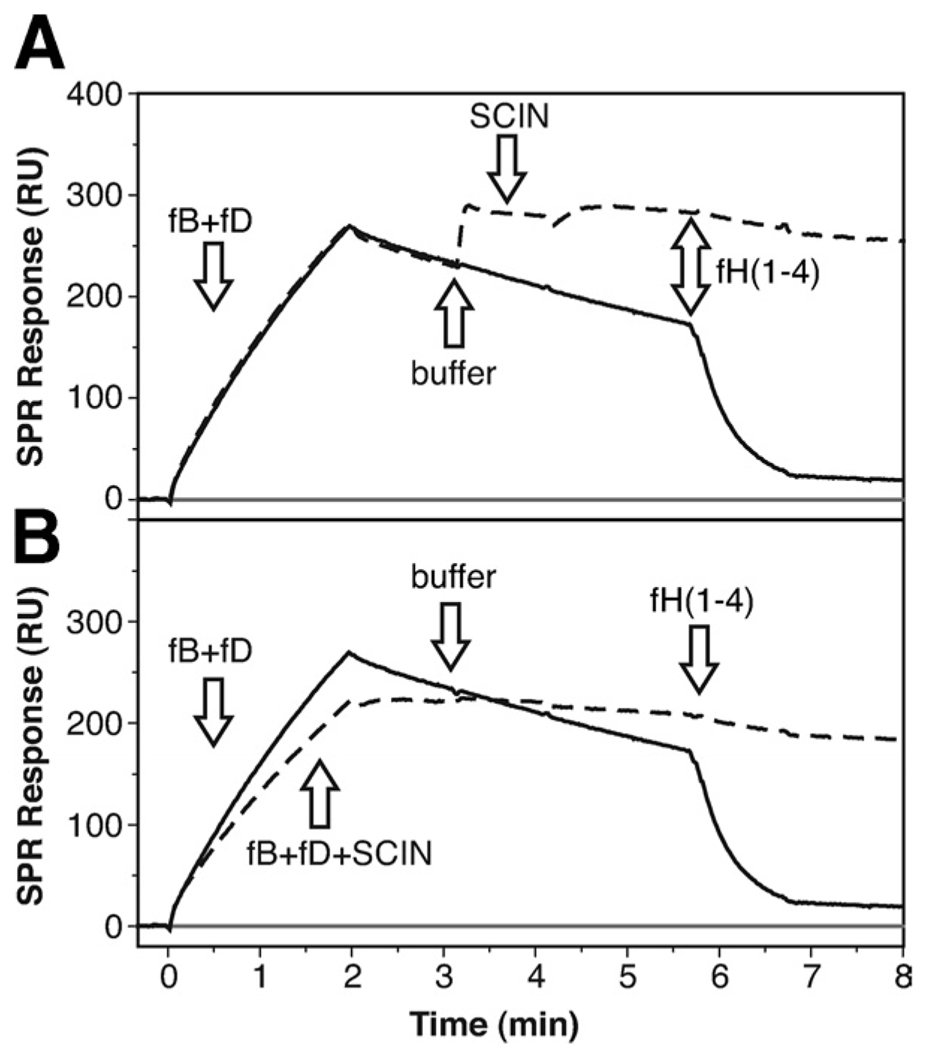
SCIN influences the formation, decay, and stability of the alternative pathway C3 convertase. A, The on-chip formation and decay of the C3 convertase was established by injecting a 1:1 mixture of fB and fD (100 nM each) onto immobilized C3b using SPR (solid curve). After injection end (2 min), a moderate decay of the convertase could be observed, which was greatly accelerated upon injection of fH(1–4) (1 µM). When SCIN (1 µM) was injected after formation of the convertase (dashed curve), the inhibitor bound to the complex, slowed the decay rate, and impaired the decay accelerating action of fH(1–4). B, When SCIN (1 µM) was added to the fB plus fD mixture, it partially reduced the formation of the C3bBb complex, and showed the same effect on the stability and fH(1–4) resistance as in A. A schematic representation of the assays is available (see supplemental Fig. S6H).
FIGURE 7
FIGURE 7
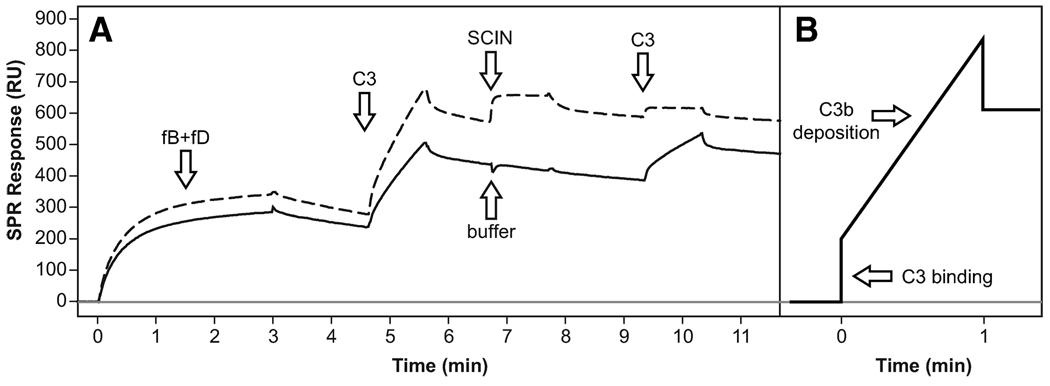
SCIN prevents C3 cleavage and C3b deposition by the C3 convertase. A, In a first cycle (solid curve), the C3 convertase was formed by injecting fB plus fD over immobilized C3b. When native C3 was injected, an initial sharp signal increase corresponding to C3 binding to the convertase and a slower binding slope representing deposition of cleaved C3b on the sensor chip surface could be observed (see schematic representation in panel B). After a buffer injection, C3 was injected again and a similar yet smaller slope could be detected (due to the regular decay of the convertase). In a subsequent cycle (dashed curve), a higher convertase formation rate was observed due to the previously deposited C3b. Again, injection of C3 led to binding of C3 and deposition of cleaved C3b. However, after SCIN was injected to the convertase, only C3 binding but no deposition of cleaved C3b was detected, therefore indicating that SCIN prevented the activation of C3 to C3b by the convertase. A schematic representation of the assays is available (see supplemental Fig. S6I).
FIGURE 8
FIGURE 8
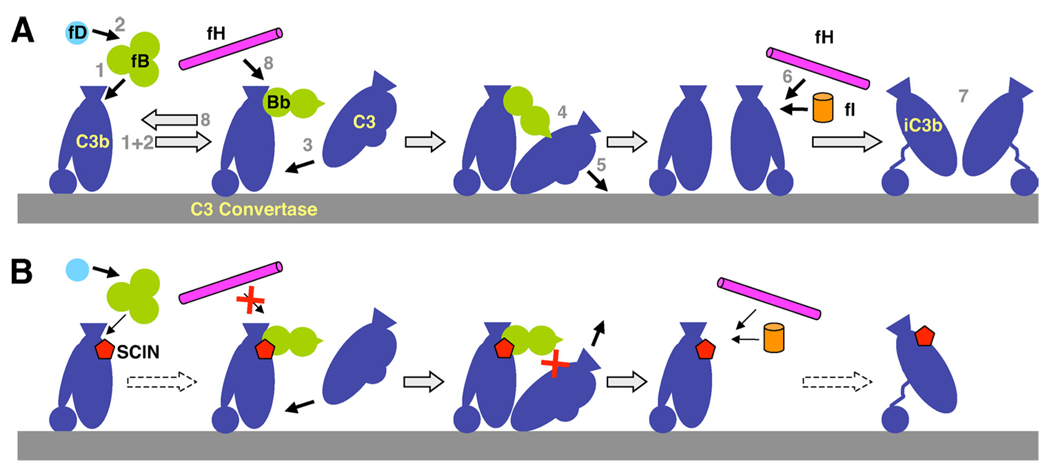
Potential effects of SCIN on complement activation and regulation. A, During normal complement activation, fB binds to C3b (1) and is converted to the C3 convertase (C3bBb) by fD (2). Native C3 binds to the convertase complex (3), becomes cleaved by Bb (4), and the resulting C3b is deposited on the surface (5). Surface-bound C3b can again participate in convertase formation (self-amplification) or can be degraded by fI and fH (6) to iC3b, which does not bind fB but is still involved in signaling (7). Finally, fH also regulates complement activity by accelerating the decay of the C3 convertase (8). B, By binding at a focal point on C3b, SCIN seems to interfere with this response in various ways: it slows down convertase formation but kinetically stabilizes the convertase complex in a state in which C3 can still bind but does not get cleaved. It also impairs the actions of fH by preventing decay acceleration and potentially decelerating the degradation to iC3b.

References

    1. Lowy FD. Staphylococcus aureus infections. N. Engl. J. Med. 1998;339:520–532. - PubMed
    1. Lee LY, Hook M, Haviland D, Wetsel RA, Yonter EO, Syribeys P, Vernachio J, Brown EL. Inhibition of complement activation by a secreted Staphylococcus aureus protein. J. Infect. Dis. 2004;190:571–579. - PubMed
    1. Lee LY, Miyamoto YJ, McIntyre BW, Hook M, McCrea KW, McDevitt D, Brown EL. The Staphylococcus aureus map protein is an immunomodulator that interferes with T cell-mediated responses. J. Clin. Invest. 2002;110:1461–1471. - PMC - PubMed
    1. Lambris JD, Ricklin D, Geisbrecht BV. Complement evasion by human pathogens. Nat. Rev. Microbiol. 2008;6:132–142. - PMC - PubMed
    1. Chavakis T, Preissner KT, Herrmann M. The anti-inflammatory activities of Staphylococcus aureus. Trends Immunol. 2007;28:408–418. - PubMed

Publication types

MeSH terms

Substances