


Review
doi: 10.1016/j.imbio.2009.06.009.
Epub 2009 Jul 22.
Wiskott-Aldrich Syndrome: Immunodeficiency resulting from defective cell migration and impaired immunostimulatory activation
Affiliations
- PMID: 19628299
- PMCID: PMC2738782
- DOI: 10.1016/j.imbio.2009.06.009
Item in Clipboard
Review
Wiskott-Aldrich Syndrome: Immunodeficiency resulting from defective cell migration and impaired immunostimulatory activation
Immunobiology.
2009.
Abstract
Regulation of the actin cytoskeleton is crucial for many aspects of correct and cooperative functioning of immune cells, such as migration, antigen uptake and cell activation. The Wiskott-Aldrich Syndrome protein (WASp) is an important regulator of actin cytoskeletal rearrangements and lack of this protein results in impaired immune function. This review discusses recent new insights of the role of WASp at molecular and cellular level and evaluates how WASp deficiency affects important immunological features and how defective immune cell function contributes to compromised host defence.
Figures
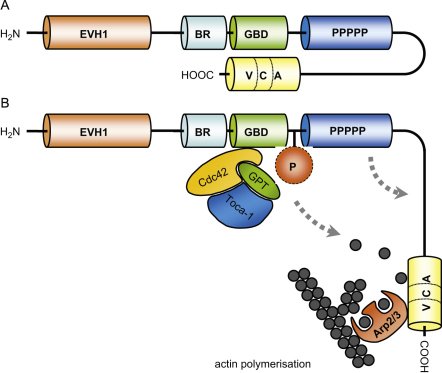
Schematic representation of regulation of WASp activity. Cytosolic WASp exists in an autoinhibited conformation in which the VCA domain is bound to the GBD (A). Activation of WASp by the Cdc42-GTP/Toca-1 complex or by phosphorylation of tyrosine 291 disrupts the autoinhibited conformation, enabling Arp2/3 binding and actin polymerization (B).
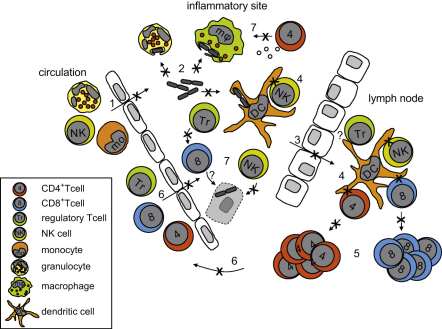
WASp deficiency impairs the mounting of the immune response. In response to invading pathogens, cells of the innate arm of the immune system, such as neutrophils and monocytes, will leave circulation and enter the inflamed tissue. Migration is impaired in WAS and this will likely result in defective extravasation of monocytes and neutrophils (1). Inside the tissue, pathogens will be phagocytosed by neutrophils, macrophages and DC (2), which is reduced in WASp-deficient cells. DC will migrate with the processed pathogen antigens to the draining lymph node (3), where they will present the antigens to lymphocytes (4). Both migration of DC and priming of T cells by DC is defective in WAS. Primed lymphocytes will proliferate (5), home to the inflamed tissue (6) and exert their effector function (7). WASp-deficient lymphocytes are impaired in proliferation and homing, and several effector functions are defective, such as suppressor function of regulatory T cells, lytic function of NK cells and cytokine production of CD4+ T cells. See text for references.
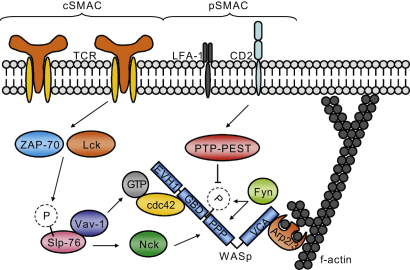
WASp recruitment and activation at the immunological synapse. TCR engagement initiates a signalling cascade involving the kinases ZAP-70 and Lck, which are involved in the phosphorylation of the adaptor molecule Slp-76. Phosphorylated Slp-76 interacts with WASp via Nck and recruits the GTPase Vav-1, which mediates activation of the Rho-GTPase Cdc42 and subsequently activates WASp. Another mechanism of WASp activation is proposed to be independent of Cdc42. The Fyn kinase binds to the polyproline domain (PPP) of WASp and phosphorylates tyrosine 291 to activate WASp. Regulation of this mechanism may be through dephosphorylation by PTP-PEST, which is recruited to the synapse by CD2. See text for references.
References
-
- Al-Alwan M.M., Rowden G., Lee T.D., West K.A. The dendritic cell cytoskeleton is critical for the formation of the immunological synapse. J. Immunol. 2001;166:1452–1456. - PubMed
-
- Ancliff P.J., Blundell M.P., Cory G.O., Calle Y., Worth A., Kempski H., Burns S., Jones G.E., Sinclair J., Kinnon C., Hann I.M., Gale R.E., Linch D.C., Thrasher A.J. Two novel activating mutations in the Wiskott–Aldrich syndrome protein result in congenital neutropenia. Blood. 2006;108:2182–2189. - PubMed
-
- Andreansky S., Liu H., Turner S., McCullers J.A., Lang R., Rutschman R., Doherty P.C., Murray P.J., Nienhuis A.W., Strom T.S. WASP-mice exhibit defective immune responses to influenza A virus, Streptococcus pneumoniae, and Mycobacterium bovis BCG. Exp. Hematol. 2005;33:443–451. - PubMed
Publication types
MeSH terms
Substances
Grants and funding
LinkOut - more resources
Full Text Sources
