


Ethnicity and risk factors for change in the ankle-brachial index: the Multi-Ethnic Study of Atherosclerosis
- PMID: 19628357
- PMCID: PMC2783523
- DOI: 10.1016/j.jvs.2009.05.061
Ethnicity and risk factors for change in the ankle-brachial index: the Multi-Ethnic Study of Atherosclerosis
Abstract
Background: The aim of this study was to determine the risk factors for conversion from a normal to either a low or high ankle-brachial index (ABI).
Methods: Participants in the Multi-Ethnic Study of Atherosclerosis who had two separate measurements of the ABI over a 3-year time period were assessed.
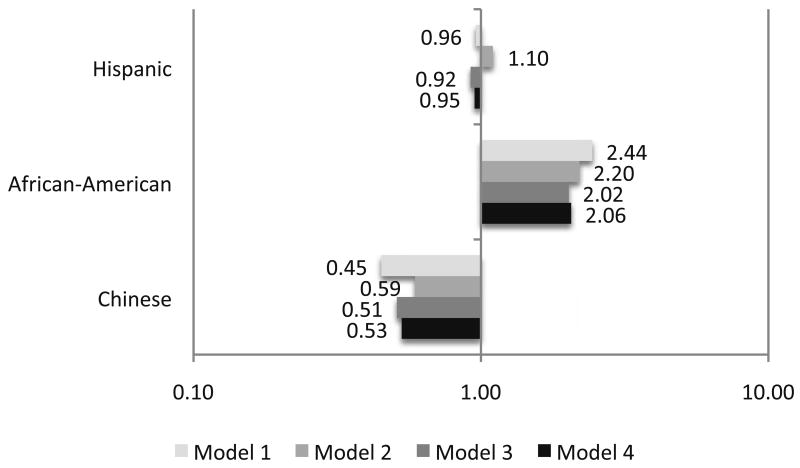
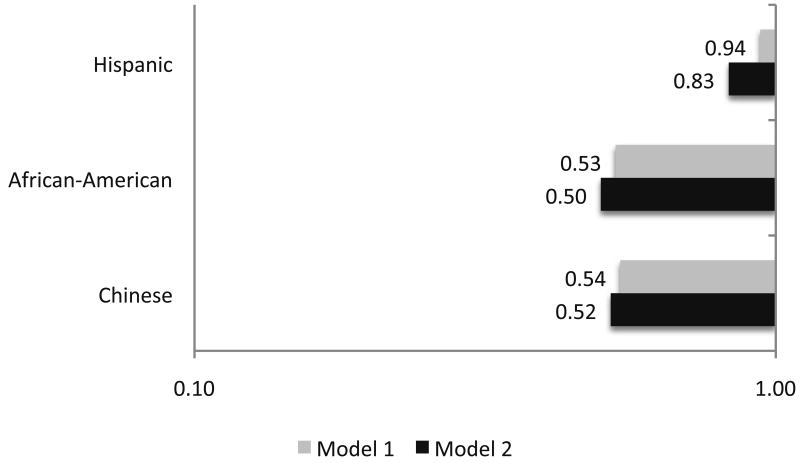
Results: At baseline, the mean age was 62 years and 50% were women, 28% African American, 12% Chinese, 22% Hispanic and 38% non-Hispanic White. Of the 5514 participants with a baseline ABI between 0.90 and 1.40, 89 (1.6%) had an ABI < or = 0.90 ("low ABI group") and 71 (1.3%) had an ABI > or = 1.40 ("high ABI group") 3 years later. On multivariable analysis, the odds for having progressed into the low ABI group were significantly increased for higher baseline age, hypertension, diabetes, greater pack-years of cigarette smoking, and homocysteine levels. The odds for progression into the high ABI group were increased for male gender and higher body mass index. Compared with non-Hispanic Whites, African Americans had a significantly higher odds for progression to the low ABI group (odds ratio [OR]: 2.24, 95% confidence interval [CI]: 1.29-3.88) while having a reduced odds for progression to the high ABI group (OR: 0.50, 95% CI: 0.24-1.00). Neither Chinese nor Hispanic ethnicity was significantly associated with progression to either ABI group.
Conclusions: The risk factors for progression to a low or high ABI were distinct and African Americans were at increased risk for progression to a low ABI but at decreased risk for progression into the high ABI group.
Figures
Comment in
-
Invited commentary.J Vasc Surg. 2009 Nov;50(5):1056. doi: 10.1016/j.jvs.2009.06.001. J Vasc Surg. 2009. PMID: 19878786 No abstract available.
References
-
- Ouriel K, McDonnell AE, Metz CE, Zarins CK. Critical evaluation of stress testing in the diagnosis of peripheral vascular disease. Surgery. 1982;91:686–93. - PubMed
-
- Osmundson PJ, O'Fallon WM, Clements IP, Kazmier FJ, Zimmerman BR, Palumbo PJ. Reproducibility of noninvasive tests of peripheral occlusive arterial disease. J Vasc Surg. 1985;2:678–83. - PubMed
-
- Eguchi K, Yacoub M, Jhalani J, Gerin W, Schwartz JE, Pickering TG. Consistency of Blood Pressure Differences Between the Left and Right Arms. Arch Intern Med. 2007;167:388–93. - PubMed
-
- Allison MA, Ho E, Denenberg JO, et al. Ethnic-Specific Prevalence of Peripheral Arterial Disease in the United States. American Journal of Preventive Medicine. 2007;32:328–33. - PubMed
-
- Diehm C, Schuster A, Allenberg JR, et al. High prevalence of peripheral arterial disease and co-morbidity in 6880 primary care patients: cross-sectional study. Atherosclerosis. 2004;172:95–105. - PubMed
Publication types
MeSH terms
Grants and funding
LinkOut - more resources
Full Text Sources
Medical
Molecular Biology Databases
