


Genetic enhancement of calcitonin gene-related Peptide-induced central sensitization to mechanical stimuli in mice
- PMID: 19628434
- PMCID: PMC2752439
- DOI: 10.1016/j.jpain.2009.03.018
Genetic enhancement of calcitonin gene-related Peptide-induced central sensitization to mechanical stimuli in mice
Abstract
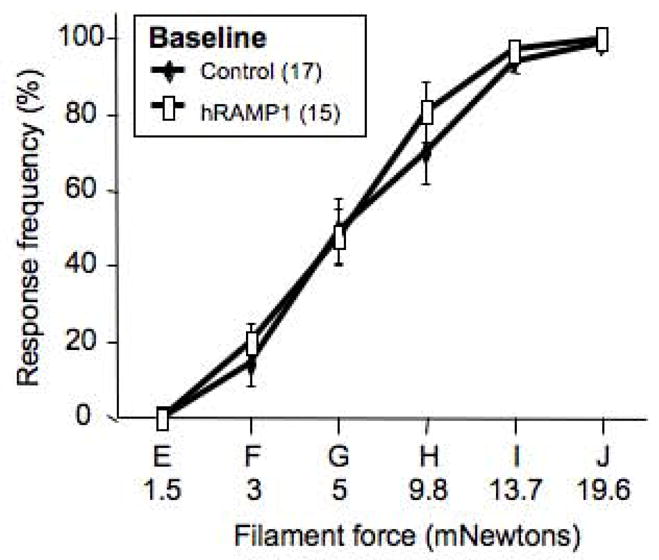
Calcitonin gene-related peptide (CGRP) is a key player in migraine. To address the role of CGRP in mechanical allodynia, which is a common feature of migraine, we used CGRP-sensitized transgenic mice. These mice have elevated nervous-system expression of the human receptor activity-modifying protein-1 (hRAMP1) subunit of the CGRP receptor. Under baseline conditions, the nestin/hRAMP1 mice and control littermates had similar hindpaw withdrawal thresholds to von Frey filaments. The effect of CGRP was tested using a filament that elicited a withdrawal response on 20% of its presentations. Following intrathecal injection of 1 nmol CGRP in the nestin/hRAMP1 mice, the response frequency was 80% within 30 minutes. The antagonist CGRP(8-37) blocked the increased response. In control littermates, a 5-fold higher dose of CGRP was required to elicit a similar response. In contrast to intrathecal injection, peripheral CGRP did not increase the mechanical responses. Intraplantar injection of capsaicin was used to test the efficacy of endogenous CGRP. Capsaicin increased mechanical responses in the nestin/hRAMP1 and control mice, although a higher dose was required in controls. In contrast to control mice, there was also a contralateral paw response in nestin/hRAMP1 mice, which is consistent with central sensitization.
Perspective: In this study we show central CGRP-induced mechanical allodynia that is enhanced by overexpression of RAMP1 in nervous system. These data suggest that hypersensitivity to CGRP could be a potential mechanism underlying central sensitization in migraine and point to CGRP-receptor antagonists as a possible therapy for other pain disorders.
Figures



References
-
- Allen GV, Barbrick B, Esser MJ. Trigeminal-parabrachial connections: possible pathway for nociception-induced cardiovascular reflex responses. Brain Res. 1996;715:125–135. - PubMed
-
- Ashina M, Bendtsen L, Jensen R, Schifter S, Olesen J. Evidence for increased plasma levels of calcitonin gene-related peptide in migraine outside of attacks. Pain. 2000;86:133–138. - PubMed
-
- Bennett AD, Chastain KM, Hulsebosch CE. Alleviation of mechanical and thermal allodynia by CGRP(8-37) in a rodent model of chronic central pain. Pain. 2000;86:163–175. - PubMed
-
- Bereiter DA, Benetti AP. Microinjections of calcitonin gene-related peptide within the trigeminal subnucleus caudalis of the cat affects adrenal and autonomic function. Brain Res. 1991;558:53–62. - PubMed
Publication types
MeSH terms
Substances
Grants and funding
LinkOut - more resources
Full Text Sources
Molecular Biology Databases
Research Materials
