. 2009 Aug 11;106(32):13535-40.
doi: 10.1073/pnas.0906822106. Epub 2009 Jul 23.

High efficiency of HIV-1 genomic RNA packaging and heterozygote formation revealed by single virion analysis

Affiliations

High efficiency of HIV-1 genomic RNA packaging and heterozygote formation revealed by single virion analysis

Jianbo Chen et al. Proc Natl Acad Sci U S A. .

Abstract

A long-standing question in retrovirus biology is how RNA genomes are distributed among virions. In the studies presented in this report, we addressed this issue by directly examining HIV-1 RNAs in virions using a modified HIV-1 genome that contained recognition sites for BglG, an antitermination protein in the Escherichia coli bgl operon, which was coexpressed with a fragment of BglG RNA binding protein fused to a fluorescent protein. Our results demonstrate that the majority of virions (>90%) contain viral RNAs. We also coexpressed HIV-1 genomes containing binding sites for BglG or the bacteriophage MS2 coat protein along with 2 fluorescent protein-tagged RNA binding proteins. This method allows simultaneously labeling and discrimination of 2 different RNAs at single-RNA-detection sensitivity. Using this strategy, we obtained physical evidence that virions contain RNAs derived from different parental viruses (heterozygous virion) at ratios expected from a random distribution, and we found that this ratio can be altered by changing the dimerization sequences. Our studies of heterozygous virions also support a generally accepted but unproven assumption that most particles contain 1 dimer. This study provides answers to long-standing questions in HIV-1 biology and illustrates the power and sensitivity of the 2-RNA labeling method, which can also be adapted to analyze various issues of RNA biogenesis including the detection of different RNAs in live cell imaging.


Conflict of interest statement

The authors declare no conflict of interest.

Figures
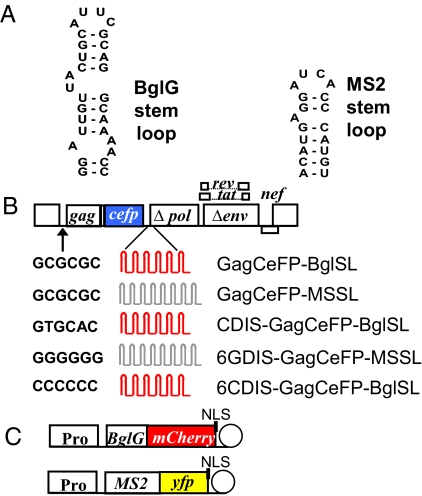
Fig. 1.
Fig. 1.
A bgl operon-based system for labeling RNA. (A) Sequence of the stem-loop used by the BglG antitermination protein and a modified stem-loop that can be bound by MS2 coat protein. (B) General structure of modified HIV-1 genomes used in the study. The DIS sequence is GCGCGC unless otherwise specified; 18 copies of BglG stem-loops (in red) or 24 copies of MS2 stem-loops (in gray) were inserted into the HIV-1 genome, although fewer copies are illustrated. For each HIV-1 genome illustrated in the figure, a partner genome lacking the cefp gene was also generated. In all of the transfection experiments, a mixture of plasmids containing the specified HIV-1 genome and its partner genome was used. (C) General structure of plasmids for expression of RNA-binding proteins. The circle represents the termination signal from the β-globin 3′ UTR polyadenylation site. Pro, promoter from the gene encoding the large subunit of RNA polymerase II; NLS, nuclear localization signal.
Fig. 2.
Fig. 2.
Detection of HIV-1 RNA with the BglG or MS2 system. Representative images of virions labeled with Gag-CeFP as detected by the BglG (A) or MS2 (C) system. Channels detecting CeFP or mCherry signals are indicated (Top). In the “Merged and shifted” panels, images of the CeFP signals and mCherry (A) or YFP (C) signals were merged, and the mCherry or YFP image was shifted to the right by 4 pixels to allow easy identification of colocalization. (B) Representative images of virions containing the MS2 stem-loops produced by cells expressing the BglG fusion protein. (D) Representative images of virions containing the BglG stem-loops produced by cells expressing the MS2 fusion protein.
Fig. 3.
Fig. 3.
Detection of the homozygous and heterozygous HIV-1 particles at single-RNA-molecule sensitivity. All particles were produced by cells transfected with Bgl-mCherry and MS2-YFP. (A) Images of particles generated from coexpression of 2 HIV-1 genomes, 1 containing MS2 stem-loops and the other containing BglG stem-loops. Both genomes contained GCGCGC in the dimerization initialization signal (DIS). (B) Particles generated by coexpression of an HIV-1 genome with GCGCGC in the DIS and an HIV-1 genome with GTGCAC in the DIS. (C) Particles generated by coexpression of an HIV-1 genome with GGGGGG in the DIS and CCCCCC in the DIS. Abbreviations are the same as in Fig. 2.

References

    1. Goff S. Retroviridae: The retroviruses and their replication. In: Knipe DM, Howley PM, editors. Fields Virology. vol II. Philadelphia, PA: Lippincott, Williams & Wilkins; 2007. pp. 1999–2069.
    1. Rulli SJ, Jr, et al. Selective and nonselective packaging of cellular RNAs in retrovirus particles. J Virol. 2007;81:6623–6631. - PMC - PubMed
    1. Muriaux D, Mirro J, Harvin D, Rein A. RNA is a structural element in retrovirus particles. Proc Natl Acad Sci USA. 2001;98:5246–5251. - PMC - PubMed
    1. Gorelick RJ, Chabot DJ, Rein A, Henderson LE, Arthur LO. The two zinc fingers in the human immunodeficiency virus type 1 nucleocapsid protein are not functionally equivalent. J Virol. 1993;67:4027–4036. - PMC - PubMed
    1. Piatak M, Jr, et al. High levels of HIV-1 in plasma during all stages of infection determined by competitive PCR. Science. 1993;259:1749–1754. - PubMed

Publication types

MeSH terms

LinkOut - more resources
