


Biodistribution of a bispecific single-chain diabody and its half-life extended derivatives
- PMID: 19628871
- PMCID: PMC2757963
- DOI: 10.1074/jbc.M109.027078
Biodistribution of a bispecific single-chain diabody and its half-life extended derivatives
Abstract
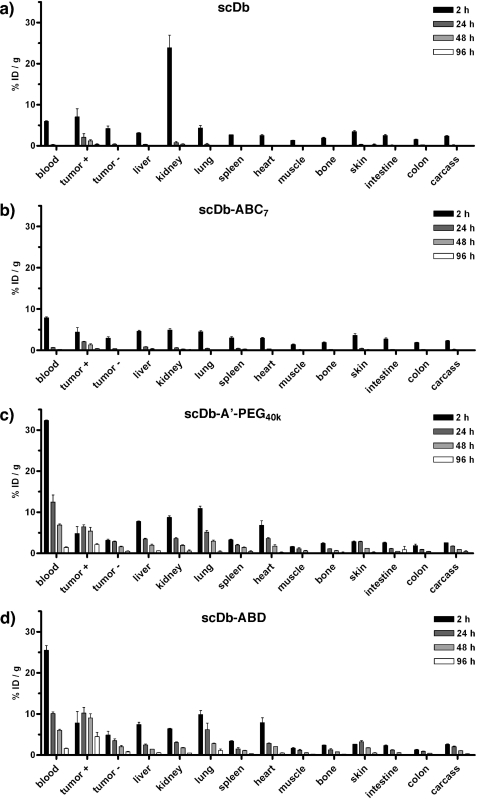
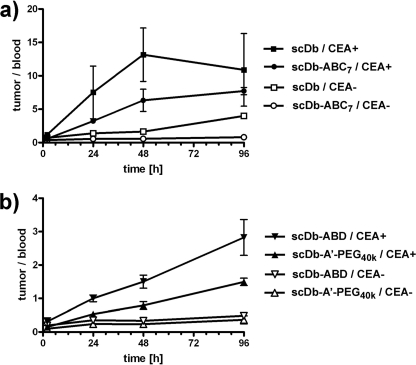
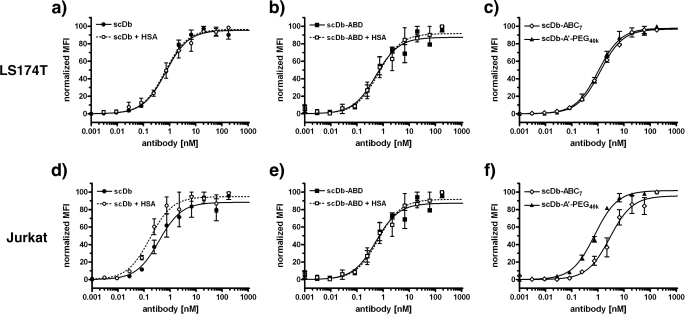
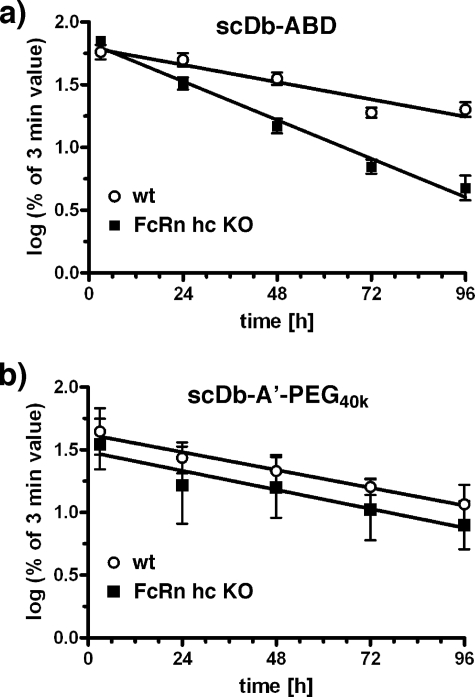
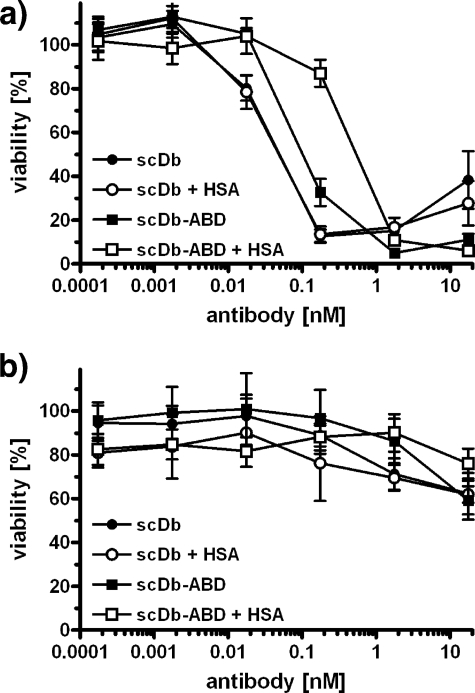
Small recombinant antibody molecules such as bispecific single-chain diabodies (scDb) possessing a molecular mass of approximately 55 kDa are rapidly cleared from circulation. We have recently extended the plasma half-life of scDb applying various strategies including PEGylation, N-glycosylation and fusion to an albumin-binding domain (ABD) from streptococcal protein G. Here, we further analyzed the influence of these modifications on the biodistribution of a scDb directed against carcinoembryonic antigen (CEA) and CD3 capable of retargeting T cells to CEA-expressing tumor cells. We show that a prolonged circulation time results in an increased accumulation in CEA+ tumors, which was most pronounced for scDb-ABD and PEGylated scDb. Interestingly, tumor accumulation of the scDb-ABD fusion protein was approximately 2-fold higher compared with PEGylated scDb, although both molecules exhibit similar plasma half-lives and similar affinities for CEA. Comparing half-lives in neonatal Fc receptor (FcRn) wild-type and FcRn heavy chain knock-out mice the contribution of the FcRn to the long plasma half-life of scDb-ABD was confirmed. The half-life of scDb-ABD was approximately 2-fold lower in the knock-out mice, while no differences were observed for PEGylated scDb. Binding of the scDb derivatives to target and effector cells was not or only marginally affected by the modifications, although, compared with scDb, a reduced cytotoxic activity was observed for scDb-ABD, which was further reduced in the presence of albumin. In summary, these findings demonstrate that the extended half-life of a bispecific scDb translates into improved accumulation in antigen-positive tumors but that modifications might also affect scDb-mediated cytotoxicity.
Figures
References
-
- Kontermann R. E. (2005) Acta Pharmacol. Sin. 26, 1–9 - PubMed
-
- Müller D., Kontermann R. E. (2007) Curr. Opin. Mol. Ther. 9, 319–326 - PubMed
-
- Müller D., Karle A., Meissburger B., Höfig I., Stork R., Kontermann R. E. (2007) J. Biol. Chem. 282, 12650–12660 - PubMed
-
- Stork R., Müller D., Kontermann R. E. (2007) Protein Eng. Des. Sel. 20, 569–576 - PubMed
-
- Batra S. K., Jain M., Wittel U. A., Chauhan S. C., Colcher D. (2002) Curr. Opin. Biotechnol. 13, 603–608 - PubMed
Publication types
MeSH terms
Substances
LinkOut - more resources
Full Text Sources
Other Literature Sources
