


Stereogenic-at-metal Zn- and Al-based N-heterocyclic carbene (NHC) complexes as bifunctional catalysts in Cu-free enantioselective allylic alkylations
- PMID: 19630406
- PMCID: PMC2761703
- DOI: 10.1021/ja904654j
Stereogenic-at-metal Zn- and Al-based N-heterocyclic carbene (NHC) complexes as bifunctional catalysts in Cu-free enantioselective allylic alkylations
Abstract
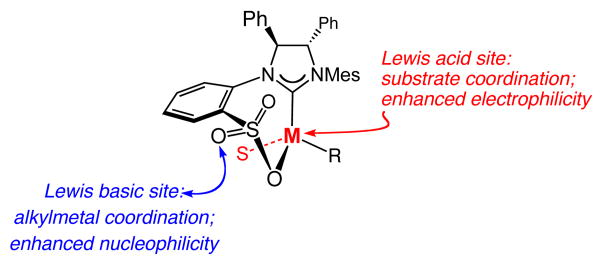
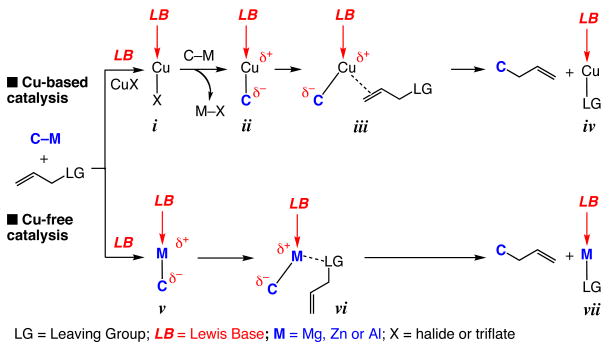
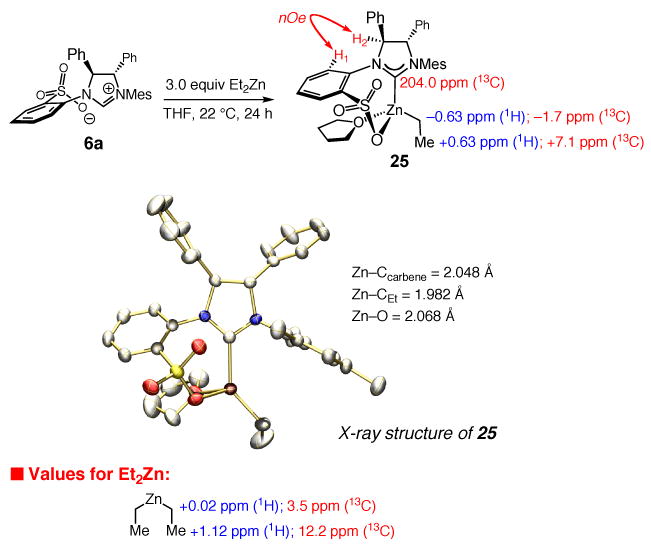
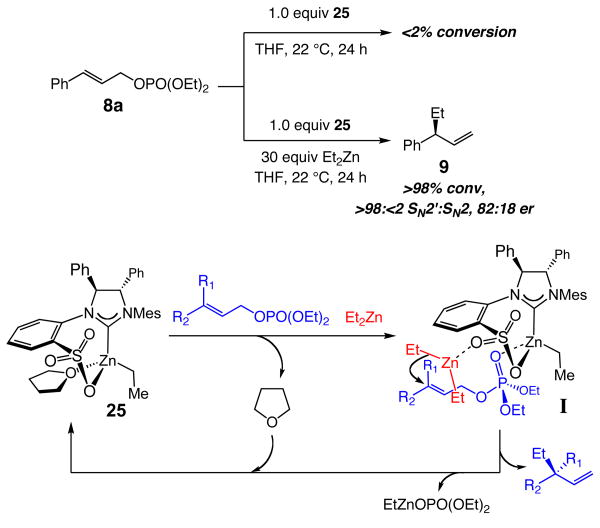
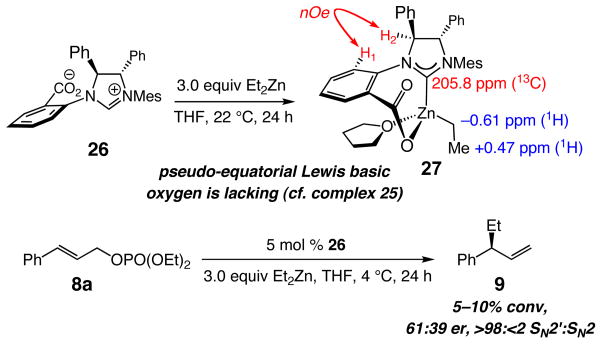
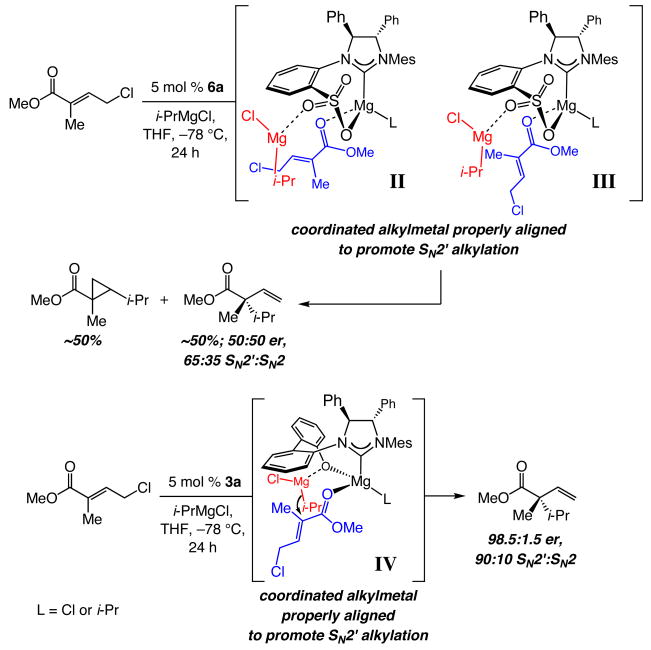
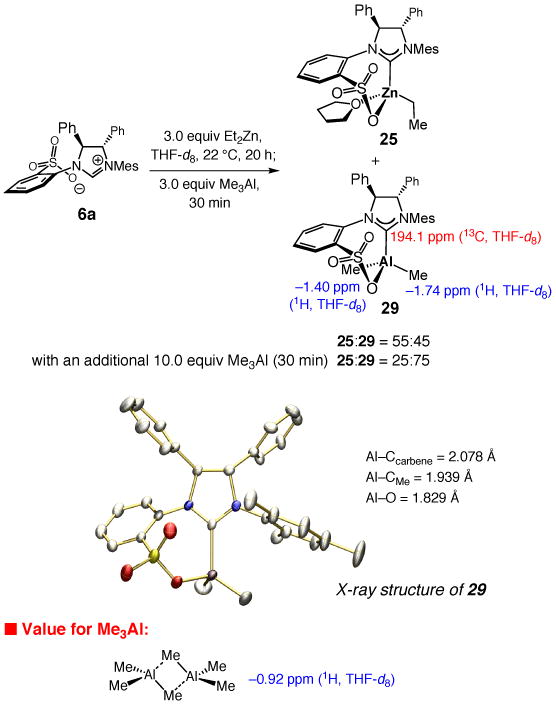
Investigations detailed herein demonstrate the ability of chiral bidentate N-heterocyclic carbenes to promote directly-without the need for a Cu salt-site- and enantioselective C-C bond forming reactions. Within this context, catalytic allylic alkylations of various allylic phosphates with dialkylzinc and trialkylaluminum reagents, performed with chiral bidentate imidazolinium salts and in the absence of a Cu salt, are described. The Cu-free transformations deliver products bearing tertiary or (all-carbon) quaternary stereogenic centers with exceptional site- (>98:<2 S(N)2':S(N)2) and high enantioselectivity [up to 97.5:2.5 enantiomer ratio (er)]. A chiral Zn-based N-heterocyclic carbene (NHC) complex, which serves as the catalyst for the enantioselective allylic alkylation reactions, is isolated and fully characterized. Spectroscopic and X-ray crystallographic studies indicate that the sulfonate group within the stereogenic-at-Zn bidentate complexes coordinates syn to the proximal phenyl substituent of the NHC backbone (vs the initially expected anti). Investigations regarding a related NHC-Al complex reveal similar structural attributes. The studies outlined provide a plausible rationale regarding the mechanism of Cu-free allylic alkylation reactions that involve dialkylzinc or trialkylaluminum reagents as well as the previously reported alkylmagnesium halides. On the basis of the research disclosed, it is proposed that bidentate metal-carbene complexes can serve as effective bifunctional catalysts, a critical attribute that differentiates such NHC-based complexes from the corresponding monodentate variants.
Figures
References
-
-
For reviews on N-heterocyclic carbenes as ligands in metal-catalyzed processes, see: Kantchev EAB, O'Brien CJ, Organ MG. Angew Chem, Int Ed. 2007;46:2768–2813.Gade LH, Bellemin-Laponnaz S. Top Organomet Chem. 2007;21:117–157.Tekavec TN, Louie J. Top Organomet Chem. 2007;21:159–192.Glorius F, editor. N-Heterocyclic Carbenes in Transition Metal Catalysis. Springer-Verlag; Berlin, Heidelberg: 2007.
-
-
-
For Cu-free (non-enantioselective) conjugate addition and/or intramolecular allylic alkylation processes involving organozinc reagents, see: Komanduri V, Pedraza F, Krische MJ. Adv Synth Catal. 2008;350:1569–1576.Kobayashi K, Ueno M, Naka H, Kondo Y. Chem Commun. 2008:3780–3782.
-
-
-
For a report regarding Cu-free enantioselective allylic alkylation reactions promoted by Mg-based chiral bidentate NHC complexes and involving alkylmagnesium halides, see: Lee Y, Hoveyda AH. J Am Chem Soc. 2006;128:15604–15605.
-
-
-
For Cu-free catalytic enantioselective conjugate addition reactions involving dialkylzinc reagents, see: Bräse S, Höfener S. Angew Chem, Int Ed. 2005;44:7879–7881.
-
-
-
For overviews regarding stereogenic-at-metal complexes, see: Brunner H. Angew Chem, Int Ed. 1999;38:1194–1208.Fontecave M, Hamelin O, Ménage S. Top Organomet Chem. 2005;15:271–288.For a recent example, see: Malcolmson SJ, Meek SJ, Sattely ES, Schrock RR, Hoveyda AH. Nature. 2008;456:933–937.
-
Publication types
MeSH terms
Substances
Grants and funding
LinkOut - more resources
Full Text Sources
Other Literature Sources
Miscellaneous
