


From QTL to candidate gene: a genetic approach to alcoholism research
- PMID: 19630743
- PMCID: PMC4455875
- DOI: 10.2174/1874473710902020127
From QTL to candidate gene: a genetic approach to alcoholism research
Abstract
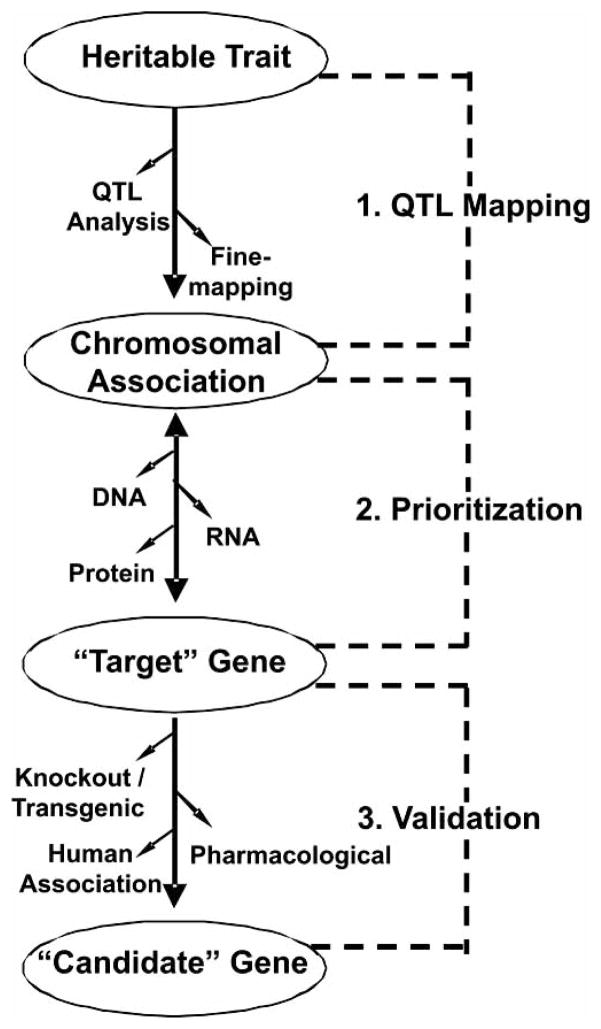
A major focus of research in alcohol-related disorders is to identify the genes and pathways that modulate alcohol-seeking behavior. In light of this, animal models have been established to study various aspects of alcohol dependence. The selectively bred alcohol-preferring (P) and -nonpreferring (NP) lines were developed from Wistar rats to model high and low voluntary alcohol consumption, respectively. Using inbred P and NP strains, a strong QTL (LOD-9.2) for alcohol consumption was identified on rat chromosome 4. To search for candidate genes that underlie this chromosomal region, complementary molecular-based strategies were implemented to identify genetic targets that likely contribute to the linkage signal. In an attempt to validate these genetic targets, corroborative studies have been utilized including pharmacological studies, knock-out/transgenic models as well as human association studies. Thus far, three candidate genes, neuropeptide Y (Npy), alpha-synuclein (Snca), and corticotrophin-releasing factor receptor 2 (Crhr2), have been identified that may account for the linkage signal. With the recent advancements in bioinformatics and molecular biology, QTL analysis combined with molecular-based strategies provides a systematic approach to identify candidate genes that contribute to various aspects of addictive behavior.
Figures

References
-
- Flint J, Valdar W, Shifman S, Mott R. Strategies for mapping and cloning quantitative trait genes in rodents. Nat Rev Genet. 2005;6:271–86. - PubMed
-
- Carr LG, Foroud T, Bice P, et al. A quantitative trait locus for alcohol consumption in selectively bred rat lines. Alcohol Clin Exp Res. 1998;22:884–7. - PubMed
-
- Li TK, Lumeng L, Doolittle DP, Carr LG. Molecular associations of alcohol-seeking behavior in rat lines selectively bred for high and low voluntary ethanol drinking. Alcohol Alcohol Suppl. 1991;1:121–4. - PubMed
-
- Cicero TJ. In: Biochemistry and Pharmacology of Ethanol, Vol 2. A critique of animal analogues of alcoholism. Majchrowicz E, Noble EP, editors. New York: Plenum Press; 1979. pp. 533–60.
Publication types
MeSH terms
Substances
Grants and funding
LinkOut - more resources
Full Text Sources
Medical
Miscellaneous