


The Individual and Family Self-Management Theory: background and perspectives on context, process, and outcomes
- PMID: 19631064
- PMCID: PMC2908991
- DOI: 10.1016/j.outlook.2008.10.004
The Individual and Family Self-Management Theory: background and perspectives on context, process, and outcomes
Abstract
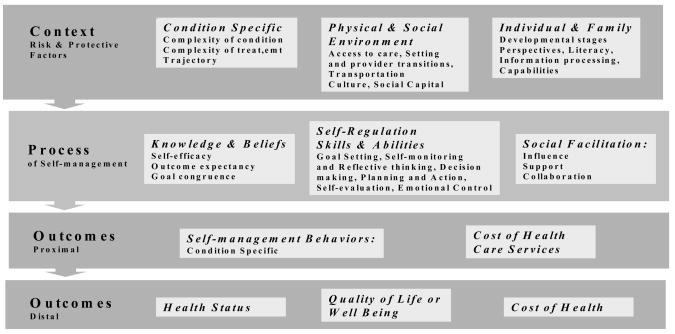
Current evidence indicates that individuals and families who engage in self-management (SM) behaviors improve their health outcomes. While the results of these studies are promising, there is little agreement as to the critical components of SM or directions for future study. This article offers an organized perspective of similar and divergent ideas related to SM. Unique contributions of prior work are highlighted and findings from studies are summarized. A new descriptive mid-range theory, Individual and Family Self-management Theory, is presented; assumptions are identified, concepts defined, and proposed relationships are outlined. This theory adds to the literature on SM by focusing on individuals, dyads within the family, or the family unit as a whole; explicating process components of SM; and proposing use of proximal and distal outcomes.
Figures
References
-
- Center For Disease Control: Chronic Disease Program. Chronic Disease Overview. [Accessed March 28, 2008]. http://www.cdc.gov/print.do?url=http://www.cdc.gov/nccdphp/overview.htm.
-
- Speaking of Health: Assessing Health Communitions Strategies for Diverse Populations. Washington, D.C: The National Academies Press; 2002. Institute of Medicine: Committee on Communication for Behavior Change in the 21st Century. - PubMed
-
- van Dyck PC, Kogan MD, McPherson MG, Weissman GR, Newacheck PW. Prevalence and characteristics of children with special health care needs. Archives of Pediatrics & Adolescent Medicine. 2004;158:884–890. - PubMed
-
- Institute of Medicine. Health and Behavior: The Interplay of Biological, Behavioral, and Societal Influences: Committee on Health and Behavior: Research, Practice and Policy Board on Neuroscience and Behavioral Health. Washington, D.C: National Academy Press; 2001.
-
- Agency for Healthcare Research and Quality. Preventing disability in the elderly with chronic disease. [Accessed March 27, 2008]. http://www.ahrq.gov/research/elderdis.htm.
Publication types
MeSH terms
Grants and funding
LinkOut - more resources
Full Text Sources
Medical
