


Involvement of Akt, Ras and cell cycle regulators in the potential development of endometrial hyperplasia in women with polycystic ovarian syndrome
- PMID: 19631369
- PMCID: PMC3441142
- DOI: 10.1016/j.ygyno.2009.06.033
Involvement of Akt, Ras and cell cycle regulators in the potential development of endometrial hyperplasia in women with polycystic ovarian syndrome
Abstract
Objective: To examine whether the abundance, localization, and/or activity of cell cycle regulators CDK2, Cyclin E, p27, and survival proteins AKT and Ras in PCOS-associated endometria (with and without hyperplasia) differ from non-PCOS endometria.
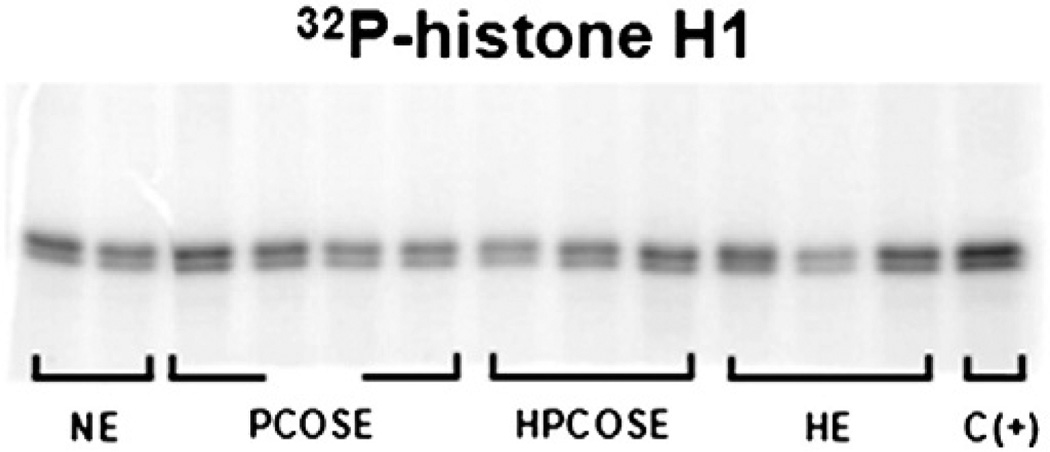
Methods: The expression of CDK2, Cyclin E, p27, AKT and Ras was measured by immunohistochemistry and/or Western blot in 9 normal endometria (NE), 12 endometria from PCOS patients without endometrial hyperplasia (PCOSE), 7 endometria from PCOS women with endometrial hyperplasia (HPCOSE), and 9 endometria from patients with endometrial hyperplasia (HE). The activity of CDK2 was assessed by an in vitro kinase assay.
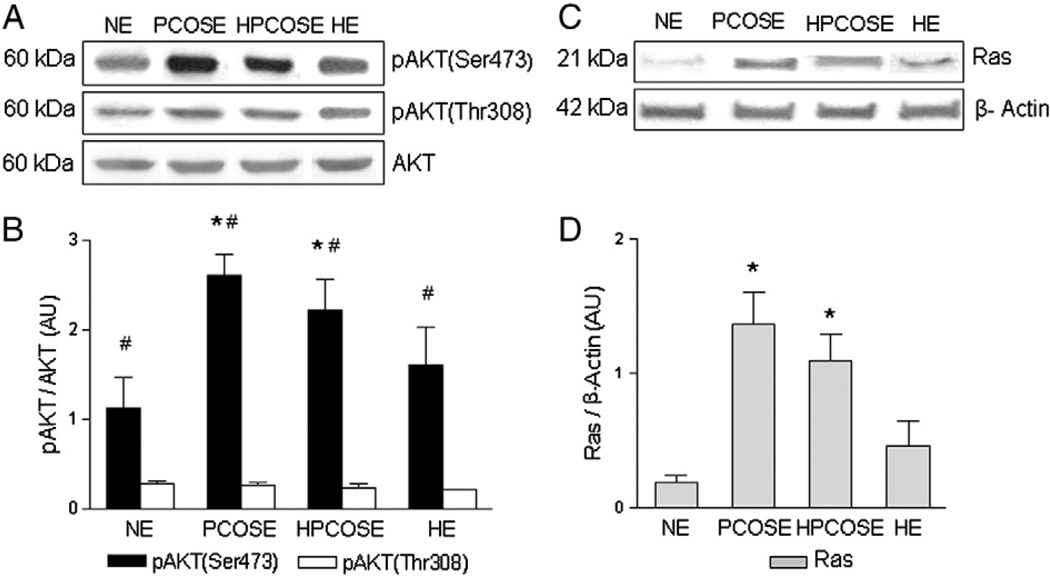
Results: CDK2, Cyclin E and p27 proteins were expressed mainly in the endometrial epithelial cells of the studied groups. No change in the activity of CDK2 was observed in total extracts obtained from the tissue samples. However, the nuclear expression of CDK2 in epithelial cells was slightly elevated in PCOSE and significantly increased in HPCOSE when compared to NE. Higher expression of p27 was detected in the cytoplasm of epithelial cells of PCOSE and HPCOSE when compared to NE. Also, we found an increment in Ser473-AKT phosphorylation and an over-expression of the Ras oncogene in endometria of patients with PCOS.
Conclusion: The PCOS condition is associated with increased Ser473-AKT phosphorylation, elevated expression of Ras, increased cytoplasmic abundance of p27, and increased nuclear abundance of CDK2 in the endometrial epithelial cells. These biological events could potentially provide a chance for endometrial cells from PCOS patients to exit the controlled cell cycle and become hyperplastic at a later stage.
Conflict of interest statement
The authors declare that there are no conflicts of interest.
Figures


References
-
- Nardo LG, Patchava S, Laing I. Polycystic ovary syndrome: pathophysiology, molecular aspects and clinical implications. Panminerva Med. 2008;50:267–278. - PubMed
-
- Hart R. PCOS and infertility. Panminerva Med. 2008;50:305–314. - PubMed
-
- Balen A. Polycystic ovary syndrome and cancer. Hum Reprod Update. 2001;7:522–525. - PubMed
-
- Schmeler KM, Soliman PT, Sun CC, Slomovitz BM, Gershenson DM, Lu KH. Endometrial cancer in young, normal-weight women. Gynecol Oncol. 2005;99:388–392. - PubMed
-
- Pillay OC, Te Fong LF, Crow JC, Benjamin E, Mould T, Atiomo W, et al. The association between polycystic ovaries and endometrial cancer. Hum Reprod. 2006;21:924–929. - PubMed
Publication types
MeSH terms
Substances
Grants and funding
LinkOut - more resources
Full Text Sources
Medical
Miscellaneous
