


Extended urinary Delta9-tetrahydrocannabinol excretion in chronic cannabis users precludes use as a biomarker of new drug exposure
- PMID: 19631478
- PMCID: PMC2763020
- DOI: 10.1016/j.drugalcdep.2009.05.027
Extended urinary Delta9-tetrahydrocannabinol excretion in chronic cannabis users precludes use as a biomarker of new drug exposure
Abstract
Background: Generally, urinary 11-nor-9-carboxy-Delta9-tetrahydrocannabinol (THCCOOH) after alkaline hydrolysis is monitored to detect cannabis exposure, although last use may have been weeks prior in chronic cannabis users. Delta9-Tetrahydrocannabinol (THC) and 11-hydroxy-THC (11-OH-THC) concentrations in urine following Escherichia coli beta-glucuronidase hydrolysis were proposed as biomarkers of recent (within 8h) cannabis use.
Objective: To test the validity of THC and 11-OH-THC in urine as indicators of recent cannabis use.
Methods: Monitor urinary cannabinoid excretion in 33 chronic cannabis smokers who resided on a secure research unit under 24h continuous medical surveillance. All urine specimens were collected individually ad libidum for up to 30 days, were hydrolyzed with a tandem E. coli beta-glucuronidase/base procedure, and analyzed for THC, 11-OH-THC and THCCOOH by one- and two-dimensional-cryotrap gas chromatography mass spectrometry (2D-GCMS) with limits of quantification of 2.5 ng/mL.
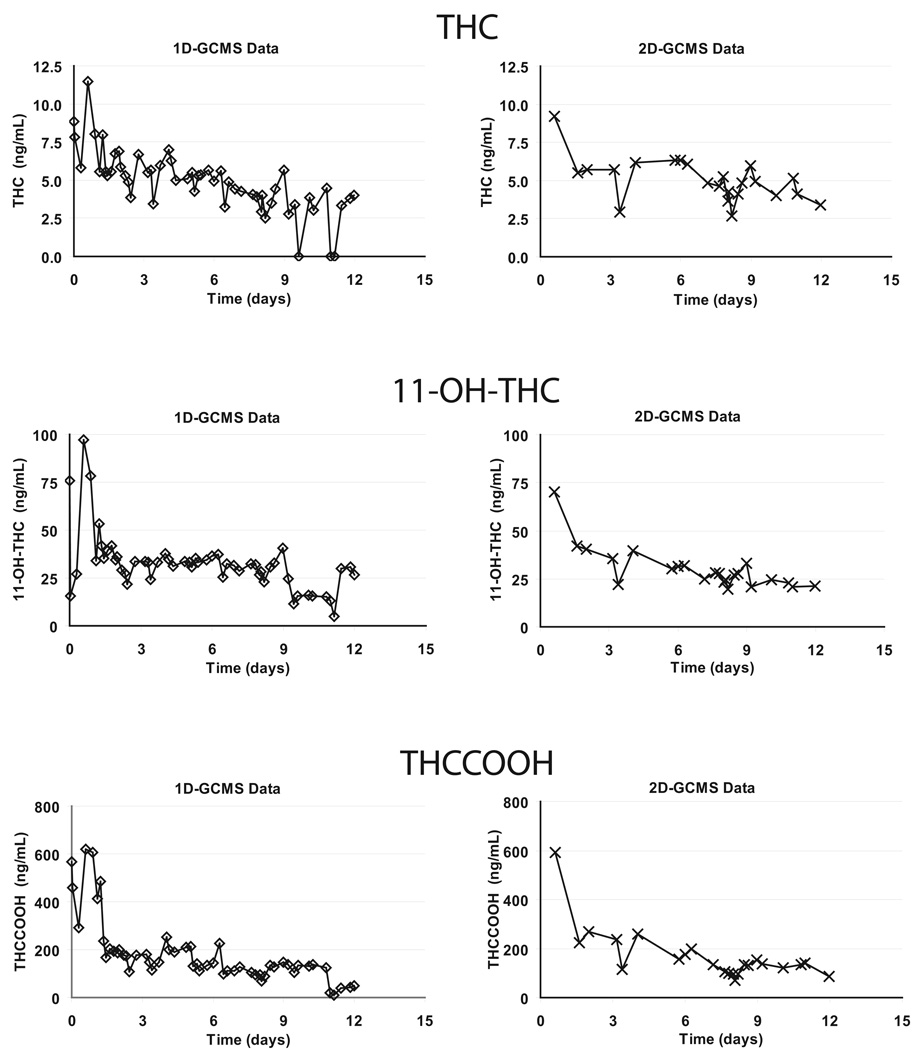
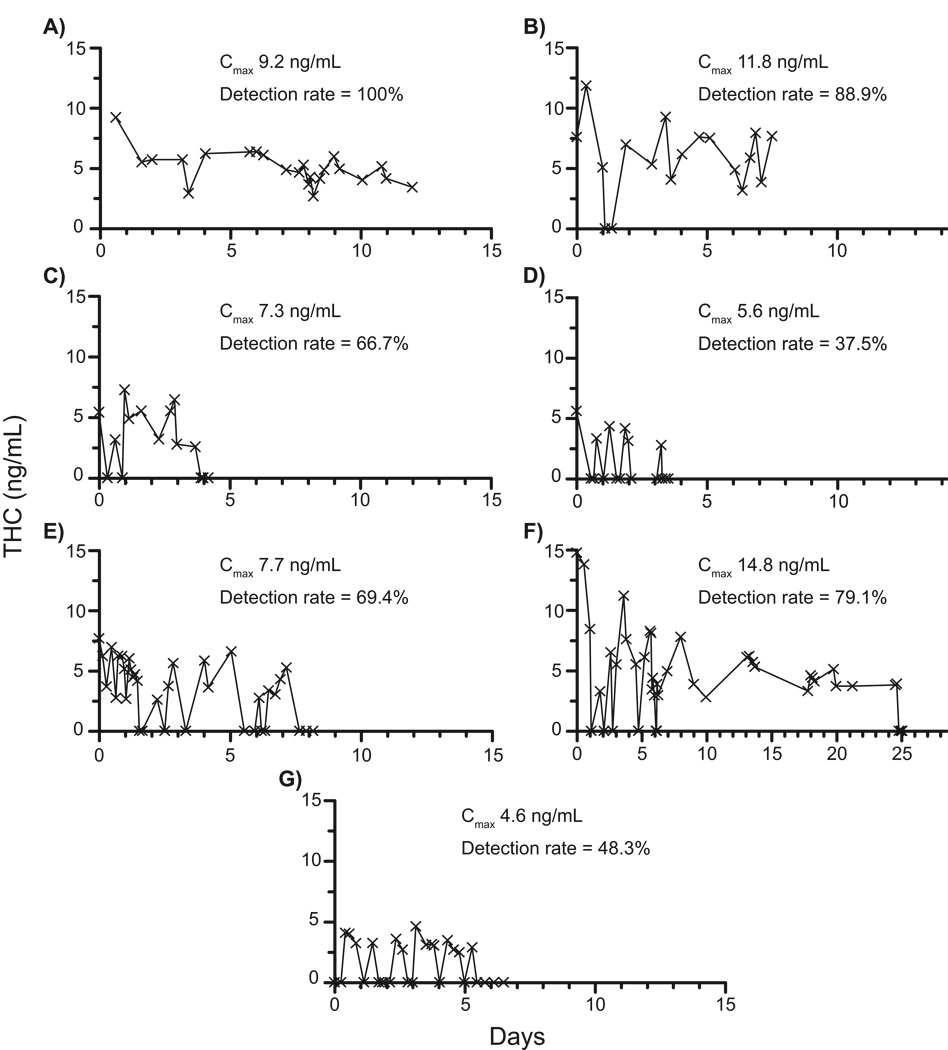
Results: Extended excretion of THC and 11-OH-THC in chronic cannabis users' urine was observed during monitored abstinence; 14 of 33 participants had measurable THC in specimens collected at least 24h after abstinence initiation. Seven subjects had measurable THC in urine for 3, 3, 4, 7, 7, 12, and 24 days after cannabis cessation. 11-OH-THC and THCCOOH were detectable in urine specimens from one heavy, chronic cannabis user for at least 24 days.
Conclusion: For the first time, extended urinary excretion of THC and 11-OH-THC is documented for at least 24 days, negating their effectiveness as biomarkers of recent cannabis exposure, and substantiating long terminal elimination times for urinary cannabinoids following chronic cannabis smoking.
Conflict of interest statement
The authors declare that they have no conflicts of interest. Authors are employed by the Chemistry and Drug Metabolism and Molecular Neuropsychiatry sections of the Intramural Research Program, National Institute on Drug Abuse, National Institutes of Health.
Figures
References
-
- Abraham TT, Lowe RH, Pirnay SO, Darwin WD, Huestis MA. Simultaneous GC-EI-MS determination of Delta9-tetrahydrocannabinol, 11-hydroxy-Delta9-tetrahydrocannabinol, and 11-nor-9-carboxy-Delta9-tetrahydrocannabinol in human urine following tandem enzyme-alkaline hydrolysis. J Anal Toxicol. 2007;31:477–485. - PMC - PubMed
-
- Bolla KI, Brown K, Eldreth D, Tate K, Cadet JL. Dose-related neurocognitive effects of marijuana use. Neurology. 2002;59:1337–1343. - PubMed
-
- Bolla KI, Eldreth D, Matochik JA, Cadet JL. Neural substrates of faulty decision-making in abstinent marijuana users. Neuroimage. 2005;26:480–492. - PubMed
-
- Dackis CA, Pottash AIC, Annitto W, Gold MS. Persistence of urinary marijuana levels after supervised abstinence. Am J Psychiatry. 1982;139:1196–1198. - PubMed
Publication types
MeSH terms
Substances
Grants and funding
LinkOut - more resources
Full Text Sources
Other Literature Sources
Medical
