


Connecting viral with cellular interactomes
- PMID: 19632888
- PMCID: PMC7108267
- DOI: 10.1016/j.mib.2009.06.004
Connecting viral with cellular interactomes
Abstract
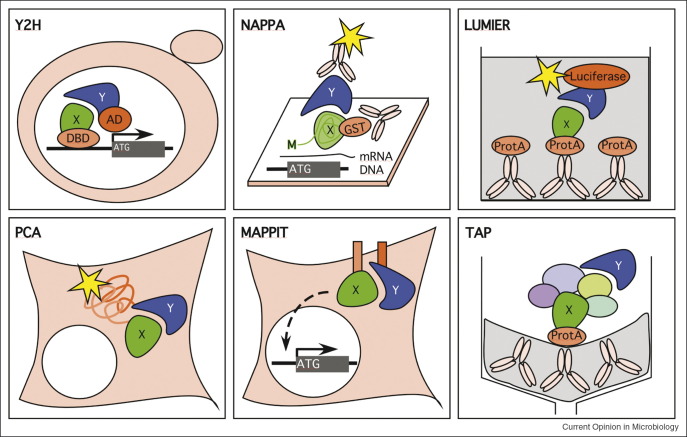
Genome-scale screens for intraviral and virus-host protein interactions and the analysis of literature-curated datasets are able to provide a novel, comprehensive perspective of viruses, and virus-infected cells. Until now, large-scale interaction screens were predominantly performed with the yeast-two-hybrid (Y2H) system; however, alternative high-throughput technologies detecting binary protein interactions or protein complexes have been developed. Although many of the previous studies suffer from a rather poor validation of the results and few biological implications, these technologies potentially lead to a plethora of novel hypotheses. Here, we will give an overview of current approaches and their technical limitations, present recent examples and novel developments.
Figures
References
-
- Fields S., Song O. A novel genetic system to detect protein–protein interactions. Nature. 1989;340:245–246. - PubMed
-
- Fromont-Racine M., Rain J.C., Legrain P. Toward a functional analysis of the yeast genome through exhaustive two-hybrid screens. Nat Genet. 1997;16:277–282. - PubMed
-
- Walhout A.J., Temple G.F., Brasch M.A., Hartley J.L., Lorson M.A., van den H.S., Vidal M. GATEWAY recombinational cloning: application to the cloning of large numbers of open reading frames or ORFeomes. Methods Enzymol. 2000;328:575–592. - PubMed
-
- Rain J.C., Selig L., De R.H., Battaglia V., Reverdy C., Simon S., Lenzen G., Petel F., Wojcik J., Schachter V. The protein–protein interaction map of Helicobacter pylori. Nature. 2001;409:211–215. - PubMed
Publication types
MeSH terms
Grants and funding
LinkOut - more resources
Full Text Sources
Other Literature Sources
