


Effectiveness of a novel integrative online treatment for depression (Deprexis): randomized controlled trial
- PMID: 19632969
- PMCID: PMC2762808
- DOI: 10.2196/jmir.1151
Effectiveness of a novel integrative online treatment for depression (Deprexis): randomized controlled trial
Abstract
Background: Depression is associated with immense suffering and costs, and many patients receive inadequate care, often because of the limited availability of treatment. Web-based treatments may play an increasingly important role in closing this gap between demand and supply. We developed the integrative, Web-based program Deprexis, which covers therapeutic approaches such as behavioral activation, cognitive restructuring, mindfulness/acceptance exercises, and social skills training.
Objective: To evaluate the effectiveness of the Web-based intervention in a randomized controlled trial.
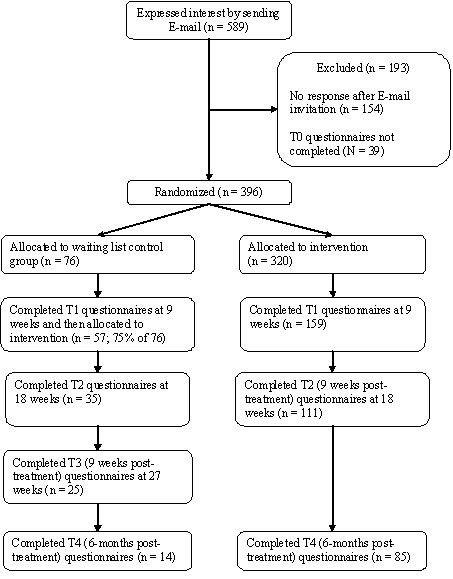
Methods: There were 396 adults recruited via Internet depression forums in Germany, and they were randomly assigned in an 80:20 weighted randomization sequence to either 9 weeks of immediate-program-access as an add-on to treatment-as-usual (N = 320), or to a 9-week delayed-access plus treatment-as-usual condition (N = 76). At pre- and post-treatment and 6-month follow-up, we measured depression (Beck Depression Inventory) as the primary outcome measure and social functioning (Work and Social Adjustment Scale) as the secondary outcome measure. Complete analyses and intention-to-treat analyses were performed.
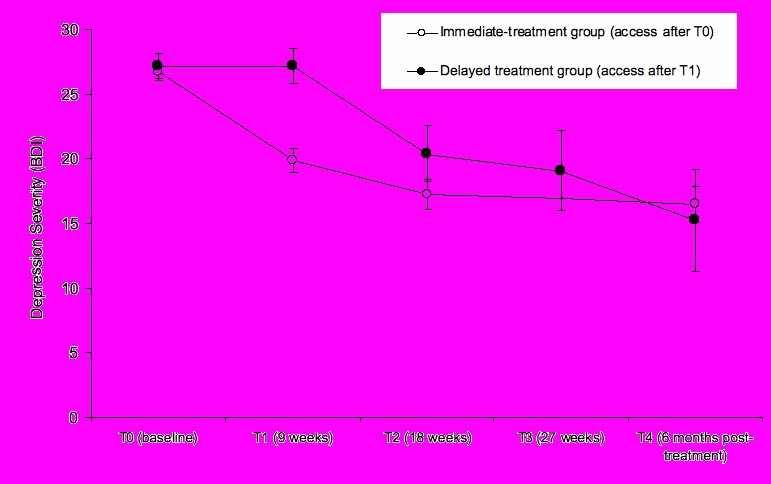
Results: Of 396 participants, 216 (55%) completed the post-measurement 9 weeks later. Available case analyses revealed a significant reduction in depression severity (BDI), Cohen's d = .64 (CI 95% = 0.33 - 0.94), and significant improvement in social functioning (WSA), Cohen's d = .64, 95% (CI 95% = 0.33 - 0.95). These improvements were maintained at 6-month follow-up. Intention-to-treat analyses confirmed significant effects on depression and social functioning improvements (BDI: Cohen's d = .30, CI 95% = 0.05 - 0.55; WSA: Cohen's d = .36, CI 95% = 0.10 - 0.61). Moreover, a much higher percentage of patients in the intervention group experienced a significant reduction of depression symptoms (BDI: odds ratio [OR] = 6.8, CI 95% = 2.90 - 18.19) and recovered more often (OR = 17.3, 95% CI 2.3 - 130). More than 80% of the users felt subjectively that the program had been helpful.
Conclusions: This integrative, Web-based intervention was effective in reducing symptoms of depression and in improving social functioning. Findings suggest that the program could serve as an adjunctive or stand-alone treatment tool for patients suffering from symptoms of depression.
Conflict of interest statement
Dr. Weiss is chief executive officer of the GAIA AG, which is developing products related to the research described in this paper. Björn Meyer was employed by the GAIA AG at the time this research was conducted.
Figures
References
-
- Leslie D L, Rosenheck R. Shifting to outpatient care? Mental health care use and cost under private insurance. Am J Psychiatry. 1999 Aug;156(8):1250–7. http://ajp.psychiatryonline.org/cgi/pmidlookup?view=long&pmid=10450268 - PubMed
-
- Andrews GA, Henderson AS. Unmet Need in Psychiatry: Problems, Resources, Responses. Cambridge, UK: Cambridge University Press; 1999.
Publication types
MeSH terms
LinkOut - more resources
Full Text Sources
Medical
Miscellaneous
