


doi: 10.1128/JB.00845-09.
Epub 2009 Jul 24.
Cyclic di-GMP allosterically inhibits the CRP-like protein (Clp) of Xanthomonas axonopodis pv. citri
Affiliations
- PMID: 19633082
- PMCID: PMC2772467
- DOI: 10.1128/JB.00845-09
Item in Clipboard
Cyclic di-GMP allosterically inhibits the CRP-like protein (Clp) of Xanthomonas axonopodis pv. citri
J Bacteriol.
2009 Nov.
Abstract
The protein Clp from Xanthomonas axonopodis pv. citri regulates pathogenesis and is a member of the CRP (cyclic AMP receptor protein) superfamily. We show that unlike the DNA-binding activity of other members of this family, the DNA-binding activity of Clp is allosterically inhibited by its effector and that cyclic di-GMP serves as that effector at physiological concentrations.
Figures
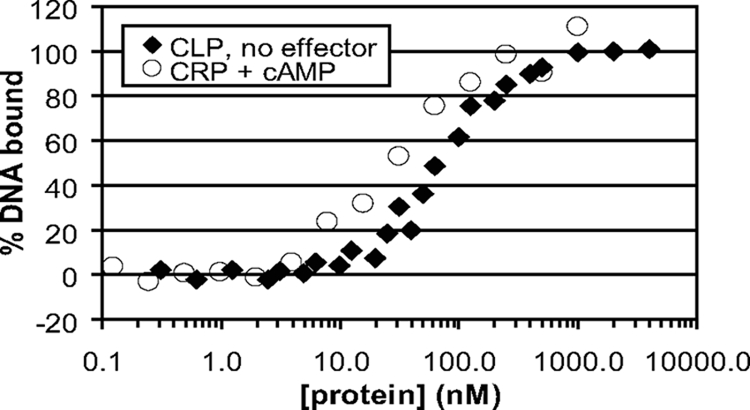
Extent of DNA binding by CRP in the presence of 1 mM cAMP compared to that of C-terminally His-tagged X. axonopodis Clp in the absence of any effector, as determined by fluorescence anisotropy using 10 nM CCpmelR DNA probe. Data points for Clp are compiled from two independent experiments.
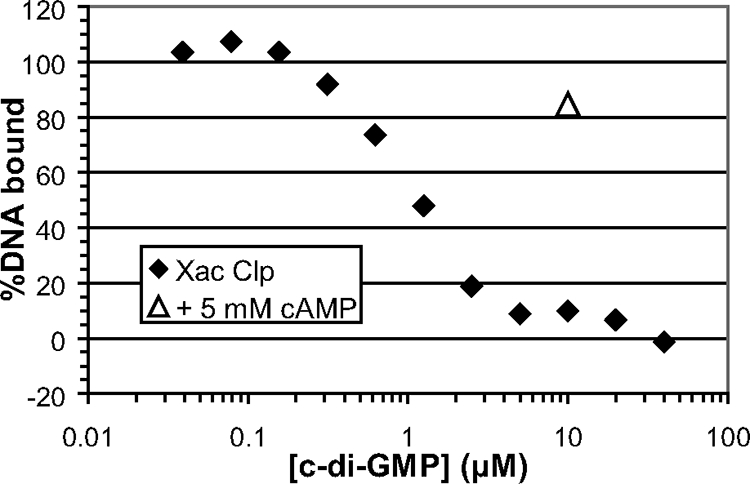
c-di-GMP inhibition of DNA binding by C-terminally His-tagged X. axonopodis Clp as measured by fluorescence anisotropy, using 200 nM protein. A single point shows the restoration of DNA binding upon addition of 5 mM cAMP to the 10 μM c-di-GMP-inhibited Clp sample.
Comment in
-
Cyclic-di-GMP-binding CRP-like protein: a spectacular new role for a veteran signal transduction actor.J Bacteriol. 2009 Nov;191(22):6785-7. doi: 10.1128/JB.01173-09. Epub 2009 Sep 11. J Bacteriol. 2009. PMID: 19749051 Free PMC article. No abstract available.
References
-
- da Silva, A. C., J. A. Ferro, F. C. Reinach, C. S. Farah, L. R. Furlan, R. B. Quaggio, C. B. Monteiro-Vitorello, M. A. Van Sluys, N. F. Almeida, L. M. Alves, A. M. do Amaral, M. C. Bertolini, L. E. Camargo, G. Camarotte, F. Cannavan, J. Cardozo, F. Chambergo, L. P. Ciapina, R. M. Cicarelli, L. L. Coutinho, J. R. Cursino-Santos, H. El-Dorry, J. B. Faria, A. J. Ferreira, R. C. Ferreira, M. I. Ferro, E. F. Formighieri, M. C. Franco, C. C. Greggio, A. Gruber, A. M. Katsuyama, L. T. Kishi, R. P. Leite, E. G. Lemos, M. V. Lemos, E. C. Locali, M. A. Machado, A. M. Madeira, N. M. Martinez-Rossi, E. C. Martins, J. Meidanis, C. F. Menck, C. Y. Miyaki, D. H. Moon, L. M. Moreira, M. T. Novo, V. K. Okura, M. C. Oliveira, V. R. Oliveira, H. A. Pereira, A. Rossi, J. A. Sena, C. Silva, R. F. de Souza, L. A. Spinola, M. A. Takita, R. E. Tamura, E. C. Teixeira, R. I. Tezza, M. Trindade dos Santos, D. Truffi, S. M. Tsai, F. F. White, J. C. Setubal, and J. P. Kitajima. 2002. Comparison of the genomes of two Xanthomonas pathogens with differing host specificities. Nature 417:459-463. - PubMed
-
- He, Y. W., C. Boon, L. Zhou, and L. H. Zhang. 2009. Co-regulation of Xanthomonas campestris virulence by quorum sensing and a novel two-component regulatory system RavS/RavR. Mol. Microbiol. 71:1464-1476. - PubMed
-
- He, Y. W., A. Y. Ng, M. Xu, K. Lin, L. H. Wang, Y. H. Dong, and L. H. Zhang. 2007. Xanthomonas campestris cell-cell communication involves a putative nucleotide receptor protein Clp and a hierarchical signalling network. Mol. Microbiol. 64:281-292. - PubMed
Publication types
MeSH terms
Substances
Grants and funding
LinkOut - more resources
Full Text Sources
Molecular Biology Databases
Research Materials
Miscellaneous
