


Mesophyll distribution of 'antioxidant' flavonoid glycosides in Ligustrum vulgare leaves under contrasting sunlight irradiance
- PMID: 19633310
- PMCID: PMC2749533
- DOI: 10.1093/aob/mcp177
Mesophyll distribution of 'antioxidant' flavonoid glycosides in Ligustrum vulgare leaves under contrasting sunlight irradiance
Abstract
Background and aims: Flavonoids have the potential to serve as antioxidants in addition to their function of UV screening in photoprotective mechanisms. However, flavonoids have long been reported to accumulate mostly in epidermal cells and surface organs in response to high sunlight. Therefore, how leaf flavonoids actually carry out their antioxidant functions is still a matter of debate. Here, the distribution of flavonoids with effective antioxidant properties, i.e. the orthodihydroxy B-ring-substituted quercetin and luteolin glycosides, was investigated in the mesophyll of Ligustrum vulgare leaves acclimated to contrasting sunlight irradiance.
Methods: In the first experiment, plants were grown at 20 % (shade) or 100% (sun) natural sunlight. Plants were exposed to 100 % sunlight irradiance in the presence or absence of UV wavelengths, in a second experiment. Fluorescence microspectroscopy and multispectral fluorescence microimaging were used in both cross sections and intact leaf pieces to visualize orthodihydroxy B-ring-substituted flavonoids at inter- and intracellular levels. Identification and quantification of individual hydroxycinnamates and flavonoid glycosides were performed via HPLC-DAD.
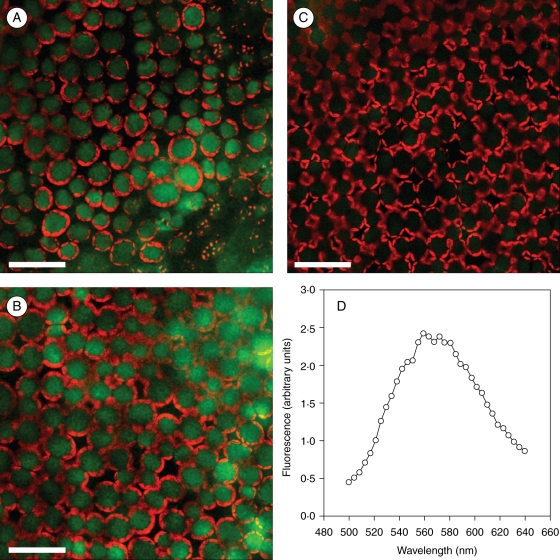
Key results: Quercetin and luteolin derivatives accumulated to a great extent in both the epidermal and mesophyll cells in response to high sunlight. Tissue fluorescence signatures and leaf flavonoid concentrations were strongly related. Monohydroxyflavone glycosides, namely luteolin 4'-O-glucoside and two apigenin 7-O-glycosides were unresponsive to changes in sunlight irradiance. Quercetin and luteolin derivatives accumulated in the vacuoles of mesophyll cells in leaves growing under 100 % natural sunlight in the absence of UV wavelengths.
Conclusions: The above findings lead to the hypothesis that flavonoids play a key role in countering light-induced oxidative stress, and not only in avoiding the penetration of short solar wavelengths in the leaf.
Figures
References
-
- Agati G, Galardi C, Gravano E, Romani A, Tattini M. Flavonoid distribution in tissues of Phillyrea latifolia as estimated by microspectrofluorometry and multispectral fluorescence microimaging. Photochemistry and Photobiology. 2002;76:350–360. - PubMed
-
- Agati G, Matteini P, Goti A, Tattini M. Chloroplast-located flavonoids can scavenge singlet oxygen. New Phytologist. 2007;174:77–89. - PubMed
-
- Babu TS, Akhtar TA, Lampi MA, Tripuranthakam S, Dixon DG, Greenberg BM. Similar stress responses are elicited by copper and ultraviolet radiation in the aquatic plant Lemma gibba: implication of reactive oxygen species as common signals. Plant and Cell Physiology. 2003;44:1320–1329. - PubMed
-
- Bilger W, Rolland M, Nybakken L. UV screening in higher plants induced by low temperature in the absence of UV-B radiation. Photochemical and Photobiological Sciences. 2007;6:190–195. - PubMed
-
- Bondar OP, Pivovarenko VG, Rowe ES. Flavonols – new fluorescent membrane probes for studying the interdigitation of lipid bilayers. Biochimica et Biophysica Acta. 1998;1369:119–130. - PubMed
Publication types
MeSH terms
Substances
LinkOut - more resources
Full Text Sources
Other Literature Sources
