Review
. 2009 Jul 1;4(5):296-301.
doi: 10.4161/epi.4.5.9282. Epub 2009 Jul 17.

Long antisense non-coding RNAs function to direct epigenetic complexes that regulate transcription in human cells

Affiliations
Review

Long antisense non-coding RNAs function to direct epigenetic complexes that regulate transcription in human cells

Kevin V Morris. Epigenetics. .

Abstract

Epigenetic silencing of tumor suppressor gene promoters is one of the most common observations found in cancer. Despite the plethora of observed epigenetically silenced cancer related genes little is known about what is guiding the silencing to these particular loci. Two recent articles suggest that long antisense non-coding RNAs function as epigenetic regulators of transcription in human cells. These reports, along with previous observations that small antisense non-coding RNAs can epigenetically regulate transcription, imply that long antisense non-coding RNAs function as endogenous transcriptional regulatory RNAs in humans. Mechanistically, these long antisense non-coding RNAs may be involved in maintaining balanced transcription at bidirectionally transcribed loci as a method to modulate gene expression according to the selective pressures placed on the cell. The loss of this intricate bidirectional RNA based regulatory network can result in overt epigenetic silencing of gene expression. In the case of tumor suppressor genes this silencing can lead to the loss of cellular regulation and be a contributing factor in cancer. This perspective will highlight the endogenous effector RNAs and mechanism of action whereby long antisense non-coding RNAs transcriptionally regulate gene expression in human cells.


Figures
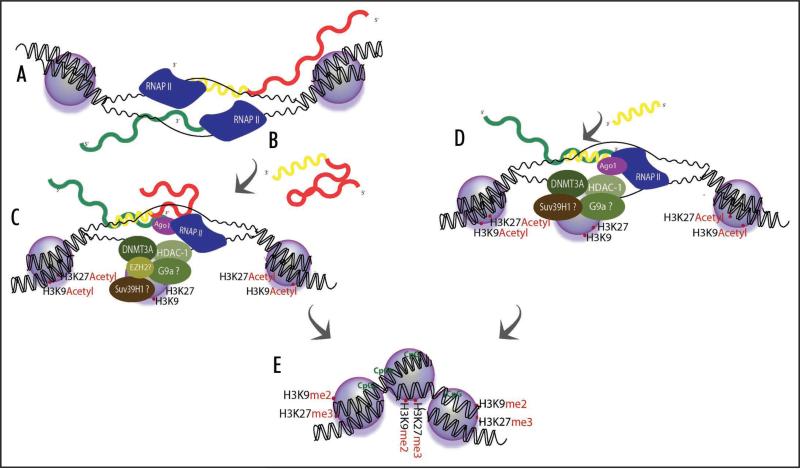
Figure 1
Figure 1
Model for both small and long antisense non-coding RNA directed transcriptional regulation in human cells. (A) Long antisense non-coding RNAs expressed at bidirectionally transcribed genes may fold into (B) secondary structured non-coding RNAs that can (C) interact with particular sites in the promoter of sense strand at the bidirectionally transcribed gene and also influence the recruitment of Ago-1, DNMT3a and HDAC-1 to this target site. (D) Small synthetic antisense non-coding RNAs can be designed to take advantage of the endogenous mechanism and also utilize the same pathway to transcriptionally silence gene expression. (E) The end result of either small or long antisense non-coding RNA transcription silencing is the targeted epigenetic remodeling of the particular RNA targeted loci.
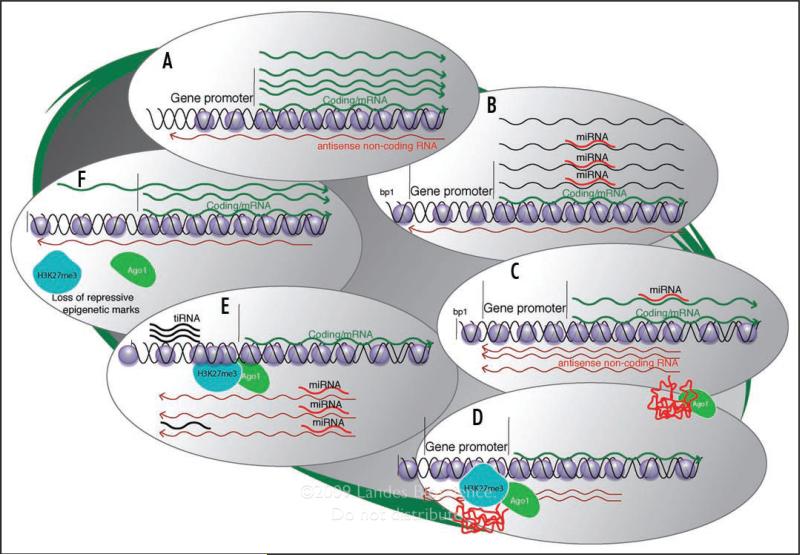
Figure 2
Figure 2
How both tiRNAs and miRNAs might regulate long antisense non-coding RNAs at bidirectionally transcribed loci. (A) The endogenous state of a bidirectional transcribed gene is shown exhibiting low level antisense non-coding RNA expression relative to the highly expressed sense/mRNA. (B) This surplus of sense/mRNA could be targeted by particular sense/mRNA specific miRNAs. (C) The result of miRNA binding to sense/mRNA is a loss of sense/mRNA expression and unimpeded antisense non-coding RNA expression, which can lead to (D) Ago-1, and possibly several other yet-to-be determined proteins, associated interactions with the antisense non-coding RNA that results in the guiding of the epigenetic machinery necessary to transcriptionally silence the long antisense non-coding RNA homology containing region in the sense/mRNA promoter. (E) The result of increased silencing of sense/mRNA expression can be increased unimpeded antisense non-coding RNA expression and possibly a shift in transcription upstream of the long antisense non-coding RNA targeted site. This upstream transcription might then generate tiRNAs that together with the miRNAs would exhibit preferential binding, based on surplus substrate, to the antisense non-coding RNAs. (F) The result of tiRNA and/or miRNA binding the antisense non-coding RNA would be a loss of antisense non-coding RNA directed epigenetic repression leading to an increased potential for RNA polymerase II to intercalate into and transcribe the sense/mRNA gene promoter, ultimately regaining higher levels of sense/mRNA transcription.

References

    1. Mercer TR, Dinger ME, Mattick JS. Long non-coding RNAs: insights into functions. Nature Reviews Genetics. 2009;10:155–9. - PubMed
    1. Mattick JS. The Genetic Signatures of Noncoding RNAs. PLoS Genet. 2009:5. - PMC - PubMed
    1. Ponting CP, Lunter G. Signatures of adaptive evolution within human non-coding sequence. Hum Mol Genet. 2006;15:170–5. - PubMed
    1. Dahary D, Elroy-Stein O, Sorek R. Naturally occurring antisense: Transcriptional leakage or real overlap? Genome Res. 2005;15:364–8. - PMC - PubMed
    1. Taft RJ, Pheasant M, Mattick JS. The relationship between non-protein-coding DNA and eukaryotic complexity. Bioessays. 2007;29:288–99. - PubMed

Publication types

LinkOut - more resources