Tibiofemoral joint osteoarthritis: risk factors for MR-depicted fast cartilage loss over a 30-month period in the multicenter osteoarthritis study
- PMID: 19635831
- PMCID: PMC2734891
- DOI: 10.1148/radiol.2523082197
Tibiofemoral joint osteoarthritis: risk factors for MR-depicted fast cartilage loss over a 30-month period in the multicenter osteoarthritis study
Abstract
Purpose: To assess baseline factors that may predict fast tibiofemoral cartilage loss over a 30-month period.
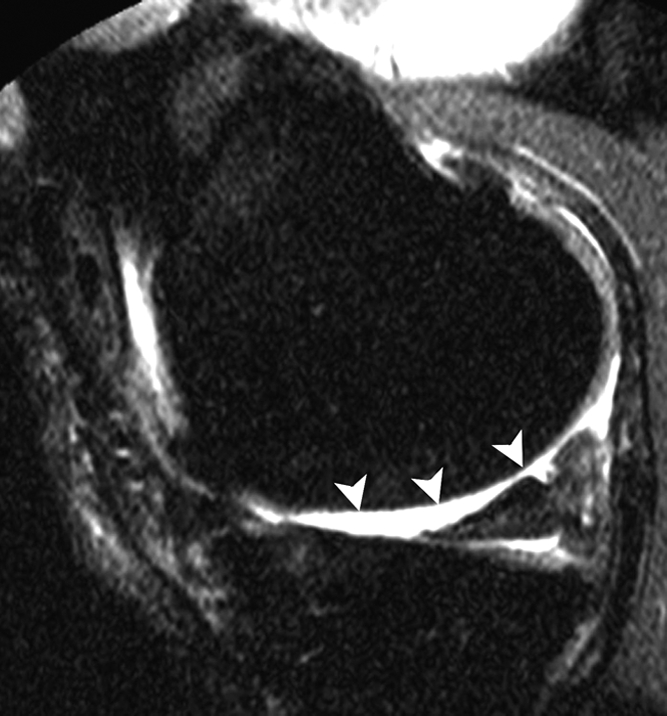
Materials and methods: The Multicenter Osteoarthritis (MOST) study is a longitudinal study of individuals who have or who are at high risk for knee osteoarthritis. The HIPAA-compliant protocol was approved by the institutional review boards of all participating centers, and written informed consent was obtained from all participants. Magnetic resonance (MR) images were read according to the Whole-Organ Magnetic Resonance Imaging Score (WORMS) system. Only knees with minimal baseline cartilage damage (WORMS < or = 2.5) were included. Fast cartilage loss was defined as a WORMS of at least 5 (large full-thickness loss, less than 75% of the subregion) in any subregion at 30-month follow-up. The relationships of age, sex, body mass index (BMI), ethnicity, knee alignment, and several MR features (eg, bone marrow lesions, meniscal damage and extrusion, and synovitis or effusion) to the risk of fast cartilage loss were assessed by using a multivariable logistic regression model.
Results: Of 347 knees, 90 (25.9%) exhibited cartilage loss, and only 20 (5.8%) showed fast cartilage loss. Strong predictors of fast cartilage loss were high BMI (adjusted odds ratio [OR], 1.11; 95% confidence interval [CI]: 1.01, 1.23), the presence of meniscal tears (adjusted OR, 3.19; 95% CI: 1.13, 9.03), meniscal extrusion (adjusted OR, 3.62; 95% CI: 1.34, 9.82), synovitis or effusion (adjusted OR, 3.36; 95% CI: 0.91, 12.4), and any high-grade MR-depicted feature (adjusted OR, 8.99; 95% CI: 3.23, 25.1).
Conclusion: In participants with minimal baseline cartilage damage, the presence of high BMI, meniscal damage, synovitis or effusion, or any severe baseline MR-depicted lesions was strongly associated with an increased risk of fast cartilage loss. Patients with these risk factors may be ideal subjects for preventative or treatment trials.
Figures
References
-
- Amin S, LaValley MP, Guermazi A, et al. The relationship between cartilage loss on magnetic resonance imaging and radiographic progression in men and women with knee osteoarthritis. Arthritis Rheum 2005; 52: 3152– 3159 - PubMed
-
- Bruyere O, Genant H, Kothari M, et al. Longitudinal study of magnetic resonance imaging and standard x-rays to assess disease progression in osteoarthritis. Osteoarthritis Cartilage 2007; 15: 98– 103 - PubMed
-
- Davies-Tuck ML, Wluka AE, Wang Y, et al. The natural history of cartilage defects in people with knee osteoarthritis. Osteoarthritis Cartilage 2008; 16: 337– 342 - PubMed
-
- Ding C, Cicuttini F, Scott F, Cooley H, Boon C, Jones G. Natural history of knee cartilage defects and factors affecting change. Arch Intern Med 2006; 166: 651– 658 - PubMed
Publication types
MeSH terms
Grants and funding
LinkOut - more resources
Full Text Sources
Medical