. 2009 Oct;19(10):1843-8.
doi: 10.1101/gr.095760.109. Epub 2009 Jul 27.

Direct multiplex sequencing (DMPS)--a novel method for targeted high-throughput sequencing of ancient and highly degraded DNA

Affiliations

Direct multiplex sequencing (DMPS)--a novel method for targeted high-throughput sequencing of ancient and highly degraded DNA

Mathias Stiller et al. Genome Res. 2009 Oct.

Abstract

Although the emergence of high-throughput sequencing technologies has enabled whole-genome sequencing from extinct organisms, little progress has been made in accelerating targeted sequencing from highly degraded DNA. Here, we present a novel and highly sensitive method for targeted sequencing of ancient and degraded DNA, which couples multiplex PCR directly with sample barcoding and high-throughput sequencing. Using this approach, we obtained a 96% complete mitochondrial genome data set from 31 cave bear (Ursus spelaeus) samples using only two 454 Life Sciences (Roche) GS FLX runs. In contrast to previous studies relying only on short sequence fragments, the overlapping portion of our data comprises almost 10 kb of replicated mitochondrial genome sequence, allowing for the unambiguous differentiation of three major cave bear clades. Our method opens up the opportunity to simultaneously generate many kilobases of overlapping sequence data from large sets of difficult samples, such as museum specimens, medical collections, or forensic samples. Embedded in our approach, we present a new protocol for the construction of barcoded sequencing libraries, which is compatible with all current high-throughput technologies and can be performed entirely in plate setup.


Figures
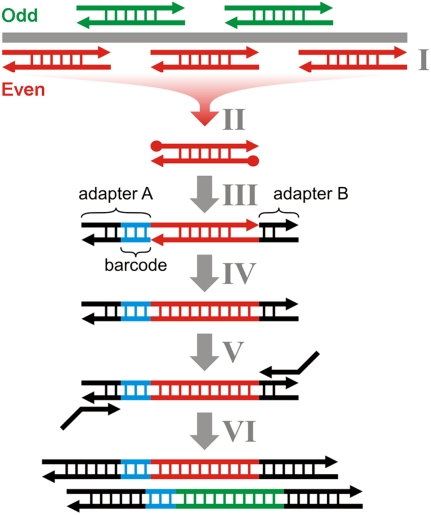
Figure 1.
Figure 1.
Schematic description of DMPS. Multiplex PCRs with nonoverlapping primer sets (“Odd” and “Even”) are performed in plate setup (I). After removing primer dimers and other spurious amplification products by size selective purification with SPRI beads, the double-stranded PCR products are blunt end repaired (II). Two different truncated double-stranded 454-adapters (A and B), one of which is barcoded (blue), are randomly ligated to either end of the double-stranded molecules by single-stranded ligation (III). Nicks are closed using a strand-displacing polymerase (IV), and the adapters are extended to full length in an amplification step with 5′-tailed primers (V). Library molecules carrying the same adapter on both ends are excluded from amplification, because they form hairpin structures that prevent primer annealing. Regardless, such molecules would not interfere with sequencing. Double-stranded barcoded sequencing libraries from multiple PCR products are pooled in equimolar ratios (VI) and sequenced on a high-throughput platform.
Figure 2.
Figure 2.
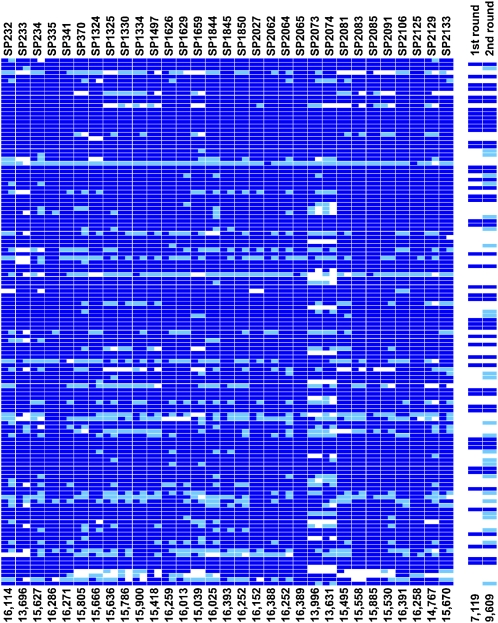
Target coverage in two rounds of cave bear mtDNA sequencing. (Dark blue) Mitochondrial targets covered in the first round of sequencing, (aqua) targets covered after the second round, (white) uncovered targets. There are two columns per sample, one for each replicate. The amount of replicated sequence data obtained from each sample after two rounds of sequencing is shown at the bottom. Approximately 7 kb and 10 kb of the same mitochondrial sequence were covered in all samples after the first and second rounds of sequencing, respectively.
Figure 3.
Figure 3.
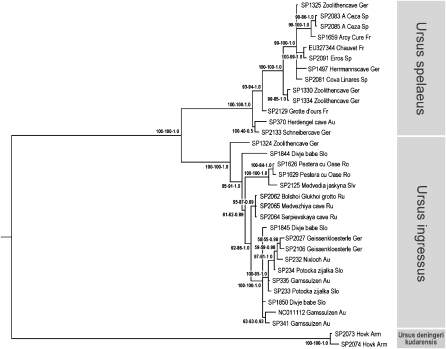
Phylogentic relationships among cave bears. Numbers on branches represent neighbor-joining and maximum-likelihood bootstrap support values and Bayesian posterior probability. The tree is based on 9.6 kb of aligned mtDNA sequence and is rooted with brown bear as the outgroup (branch not shown). Abbreviations behind sample names indicate country of origin (see Supplemental Table S2).
Figure 4.
Figure 4.
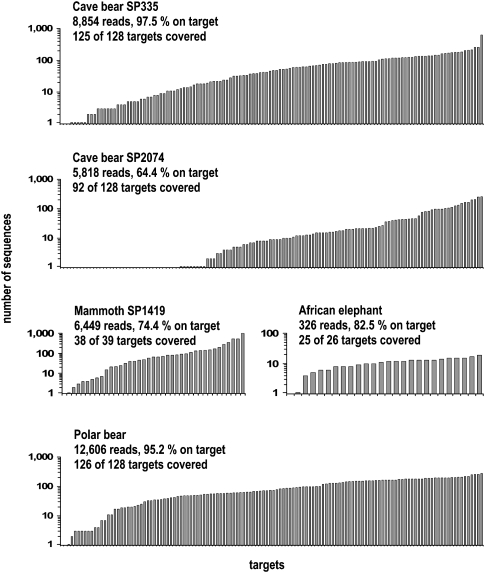
DMPS applied to different samples and targets. Coverage plots resulting from a single round of amplification and sequencing are shown for mitochondrial or nuclear targets of cave bear, mammoth, polar bear, and African elephant. Only two example plots are shown for cave bears (with high and low target coverage), each representing the sequences obtained from two multiplex PCRs (odd and even).

References

    1. Albert TJ, Molla MN, Muzny DM, Nazareth L, Wheeler D, Song X, Richmond TA, Middle CM, Rodesch MJ, Packard CJ, et al. Direct selection of human genomic loci by microarray hybridization. Nat Methods. 2007;4:903–905. - PubMed
    1. Binladen J, Gilbert MT, Bollback JP, Panitz F, Bendixen C, Nielsen R, Willerslev E. The use of coded PCR primers enables high-throughput sequencing of multiple homolog amplification products by 454 parallel sequencing. PLoS One. 2007;2:e197. doi: 10.1371/journal.pone.0000197. - DOI - PMC - PubMed
    1. Briggs AW, Stenzel U, Johnson PL, Green RE, Kelso J, Prüfer K, Meyer M, Krause J, Ronan MT, Lachmann M, et al. Patterns of damage in genomic DNA sequences from a Neandertal. Proc Natl Acad Sci. 2007;104:14616–14621. - PMC - PubMed
    1. Brotherton P, Endicott P, Sanchez JJ, Beaumont M, Barnett R, Austin J, Cooper A. Novel high-resolution characterization of ancient DNA reveals C > U-type base modification events as the sole cause of post mortem miscoding lesions. Nucleic Acids Res. 2007;35:5717–5728. - PMC - PubMed
    1. Craig DW, Pearson JV, Szelinger S, Sekar A, Redman M, Corneveaux JJ, Pawlowski TL, Laub T, Nunn G, Stephan DA, et al. Identification of genetic variants using bar-coded multiplexed sequencing. Nat Methods. 2008;5:887–893. - PMC - PubMed

Publication types

Associated data

LinkOut - more resources