Comparative Study
. 2009 Aug 15;183(4):2642-9.
doi: 10.4049/jimmunol.0900129. Epub 2009 Jul 27.

E-prostanoid 3 receptor deletion improves pulmonary host defense and protects mice from death in severe Streptococcus pneumoniae infection

Affiliations
Comparative Study

E-prostanoid 3 receptor deletion improves pulmonary host defense and protects mice from death in severe Streptococcus pneumoniae infection

David M Aronoff et al. J Immunol. .

Abstract

Prostaglandins (PGs) are potent lipid mediators that are produced during infections and whose synthesis and signaling networks present potential pharmacologic targets for immunomodulation. PGE(2) acts through the ligation of four distinct G protein-coupled receptors, E-prostanoid (EP) 1-4. Previous in vitro and in vivo studies demonstrated that the activation of the G(alphas)-coupled EP2 and EP4 receptors suppresses inflammatory responses to microbial pathogens through cAMP-dependent signaling cascades. Although it is speculated that PGE(2) signaling via the G(alphai)-coupled EP3 receptor might counteract EP2/EP4 immunosuppression in the context of bacterial infection (or severe inflammation), this has not previously been tested in vivo. To address this, we infected wild-type (EP3(+/+)) and EP3(-/-) mice with the important respiratory pathogen Streptococcus pneumoniae or injected mice i.p. with LPS. Unexpectedly, we observed that EP3(-/-) mice were protected from mortality after infection or LPS. The enhanced survival observed in the infected EP3(-/-) mice correlated with enhanced pulmonary clearance of bacteria; reduced accumulation of lung neutrophils; lower numbers of circulating blood leukocytes; and an impaired febrile response to infection. In vitro studies revealed improved alveolar macrophage phagocytic and bactericidal capacities in EP3(-/-) cells that were associated with an increased capacity to generate NO in response to immune stimulation. Our studies underscore the complex nature of PGE(2) immunomodulation in the context of host-microbial interactions in the lung. Pharmacological targeting of the PGE(2)-EP3 axis represents a novel area warranting greater investigative interest in the prevention and/or treatment of infectious diseases.


Figures

Figure 1
Figure 1
EP3−/− mice are protected from death following S. pneumoniae infection. (A) Wild type (WT) or EP3 knockout (KO) mice were infected i.t. with S. pneumoniae as detailed in Materials and Methods. Survival was assessed over time. (B) Bacterial burdens in lung and spleen tissue homogenates were determined by counting colony forming units (CFU) as described in Materials and Methods. *P < 0.05 compared to WT levels at 48 hr after infection.
Figure 2
Figure 2
Reduced neutrophil influx and enhanced macrophage killing of S. pneumoniae in EP3−/− mice. Bronchoalveolar lavage fluid (BALF) was collected from infected wild type (WT) or EP3 knockout (KO) mice 48 hr after inoculation and assessed for leukocyte counts and differential, then expressed as (A) cells per ml or (B) as a percent of the total number of cells. AM, alveolar macrophage, PMN, polymorphonuclear leukocyte (neutrophil). (C) Lung histology scores were determined as described. (D) Myeloperoxidase (MPO) levels were quantitated in lung homogenates 48 hr after infection as noted in Materials and Methods. **P < 0.01 compared to WT levels. The ability of AMs to phagocytose (E) and kill (F) ingested S. pneumoniae was determined in vitro as detailed. *P < 0.05 compared to WT.
Figure 3
Figure 3
Reactive oxygen and nitrogen intermediate production in EP3−/− and EP3+/+ alveolar macrophages. Alveolar macrophages were isolated from uninfected wild type (WT) or EP3 knockout (KO). (A) Cells were cultured with 2′,7′-dichlorodihydrofluorescein diacetate (H2DCF) for 1h then stimulated with heat-killed S. pneumoniae using a multiplicity of infection of 50:1 (dashed lines) or were not stimulated (solid lines). Reactive oxygen intermediates (ROIs) production was assessed fluorometrically and expressed as relative fluorescence units. The data represent the mean of 3 experiments completed in quadruplicate for each time point. (B) WT or KO macrophages were stimulated with recombinant mouse interferon-γ (10 ng/ml) plus lipoteichoic acid (10 μg/ml) for 24 hr and NO2- production was determined as described in Materials and Methods. ***P < 0.001 compared to unstimulated cells; ###P < 0.001 compared to WT levels.
Figure 4
Figure 4
Histopathological and immunological evidence of inflammation in EP3−/− and EP3+/+ mice. Severe suppurative interstitial pneumonia (A) and fibrinonecrotizing pleuritis (B, arrows) in lungs from infected mice. In panel A, most alveolar spaces are obscured by aggregates of necrotic neutrophils (arrows). A is from an EP3+/+ mouse and B is from an EP3−/− mouse. Both lesions were present in both mouse strains though pleuritis was more severe in the EP3−/− animals. Magnification in panels A and B was 400x; bars = 25μm. (C and D) Similar profiles of pulmonary inflammatory mediators in lung homogenates (C) and bronchoalveolar lavage (BAL) fluid (D) from infected wild type (WT) and EP3−/− (KO) mice. Cytokine and chemokine levels were determined by ELISA after infection as described in Materials and Methods. Differences were not statistically significant. MCP-1, monocyte chemotactic protein-1.
Figure 5
Figure 5
White blood cell (WBC) counts are depressed during pneumococcal infection in EP3−/− mice. Cell counts were enumerated in blood samples taken before infection (A) or 24 hr after infection (B) with S. pneumoniae in wild-type (WT) and EP3 knockout (KO) mice. Lymph, lymphocytes; mono, monocytes; PMN, polymorphonuclear leukocyte (neutrophil). **P < 0.01, *P < 0.05 compared to WT counts.
Figure 6
Figure 6
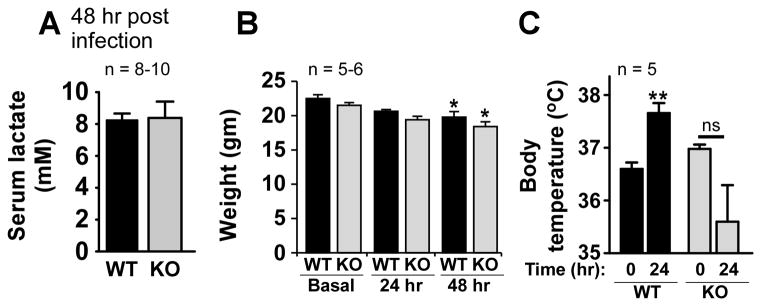
EP3−/− mice exhibit similar degrees of tissue hypoxia and weight loss as wild type mice but have an impaired febrile response to infection. (A) Twenty four hr after infection, serum lactate levels were measured in wild-type (WT) and EP3 knockout (KO) mice. (B) Weights were determined for mice before and 24 and 48 hr after infection. *P < 0.05 compared to basal weight. (C) Core body temperature was measured as detailed in the text for WT and KO mice at time 0 and 24 hr after pneumococcal infection. **P < 0.01 compared to time 0. ns, non-significant.
Figure 7
Figure 7
Deletion of EP3 confers protection against endotoxin-induced death and inflammation. (A) Wild type (WT) or EP3 knockout (KO) mice were injected i.p. with lipopolysaccharide (LPS, 10 mg/kg) as detailed in Materials and Methods. Survival was assessed over time. (B) Evans blue dye extravasation was determined 6 hr after LPS injection in WT and KO mice in the lungs and kidney as outlined in the text. (C and D) Cytokine and chemokine levels were determined in the blood (C) and peritoneal fluid (D) by ELISA 5 hr after i.p. LPS injection in WT and KO mice as described in Materials and Methods. *P < 0.05 compared to WT level.

References

    1. Statistics, N. C. f. H; U. S. D. o. H. a. H. Services, editor. Health, United States, 2007, with chartbook on trends in the health of Americans. U.S. Government Printing Office; Hyattsville, MD: 2007. p. 567.
    1. Mandell LA, Wunderink RG, Anzueto A, Bartlett JG, Campbell GD, Dean NC, Dowell SF, File TM, Jr, Musher DM, Niederman MS, Torres A, Whitney CG. Infectious Diseases Society of America/American Thoracic Society consensus guidelines on the management of community-acquired pneumonia in adults. Clin Infect Dis. 2007;44(Suppl 2):S27–72. - PMC - PubMed
    1. Levine OS, O’Brien KL, Knoll M, Adegbola RA, Black S, Cherian T, Dagan R, Goldblatt D, Grange A, Greenwood B, Hennessy T, Klugman KP, Madhi SA, Mulholland K, Nohynek H, Santosham M, Saha SK, Scott JA, Sow S, Whitney CG, Cutts F. Pneumococcal vaccination in developing countries. Lancet. 2006;367:1880–1882. - PubMed
    1. Kadioglu A, Andrew PW. The innate immune response to pneumococcal lung infection: the untold story. Trends Immunol. 2004;25:143–149. - PubMed
    1. Aronoff DM, Canetti C, Peters-Golden M. Prostaglandin E2 inhibits alveolar macrophage phagocytosis through an E-prostanoid 2 receptor-mediated increase in intracellular cyclic AMP. J Immunol. 2004;173:559–565. - PubMed

Publication types

MeSH terms