


doi: 10.1128/AAC.00585-09.
Epub 2009 Jul 27.
Species identification and antifungal susceptibility patterns of species belonging to Aspergillus section Nigri
Affiliations
- PMID: 19635955
- PMCID: PMC2764190
- DOI: 10.1128/AAC.00585-09
Item in Clipboard
Species identification and antifungal susceptibility patterns of species belonging to Aspergillus section Nigri
Antimicrob Agents Chemother.
2009 Oct.
Abstract
A phylogenetic analysis was performed for 34 Aspergillus strains belonging to section Nigri. Molecular methods allowed for the correct classification into three different clades (A. niger, A. tubingensis, and A. foetidus). Correlation with in vitro itraconazole susceptibility distinguished the following three profiles: susceptible, resistant, and showing a paradoxical effect. A number of different species whose morphological features resemble those of A. niger showed unusual MICs to itraconazole that have never been described for the Aspergillus genus.
Figures
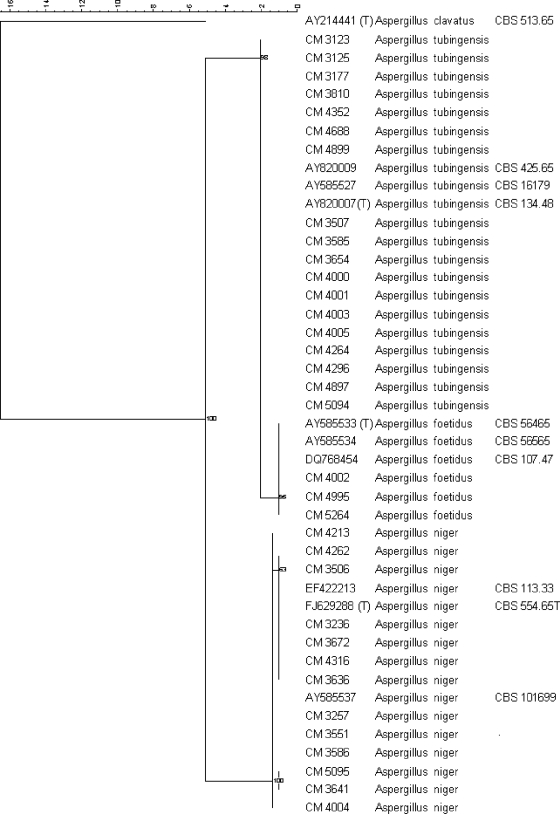
Phylogenetic tree using maximum parsimony phylogenetic analysis and 2,000 bootstrap simulations based on β-tubulin gene sequences from all the Aspergillus section Nigri strains included in the study. Percentages indicate the bootstrap support for each group of sequences. (T), type strain.
References
-
- Abarca, M. L., F. Accensi, J. Cano, and F. J. Cabanes. 2004. Taxonomy and significance of black aspergilli. Antonie van Leeuwenhoek 86:33-49. - PubMed
-
- Balajee, S. A., A. M. Borman, M. E. Brandt, J. Cano, M. Cuenca-Estrella, E. Dannaoui, J. Guarro, G. Haase, C. C. Kibbler, W. Meyer, K. O'Donnell, C. A. Petti, J. L. Rodriguez-Tudela, D. Sutton, A. Velegraki, and B. L. Wickes. 2009. Sequence-based identification of Aspergillus, Fusarium, and Mucorales species in the clinical mycology laboratory: where are we and where should we go from here? J. Clin. Microbiol. 47:877-884. - PMC - PubMed
Publication types
MeSH terms
Substances
Associated data
- Actions
- Actions
- Actions
- Actions
- Actions
- Actions
- Actions
- Actions
- Actions
- Actions
- Actions
- Actions
- Actions
- Actions
- Actions
- Actions
- Actions
- Actions
- Actions
- Actions
- Actions
- Actions
- Actions
- Actions
- Actions
- Actions
- Actions
- Actions
- Actions
- Actions
- Actions
- Actions
- Actions
LinkOut - more resources
Full Text Sources
