


In vitro activity and in vivo efficacy of clavulanic acid against Acinetobacter baumannii
- PMID: 19635957
- PMCID: PMC2764194
- DOI: 10.1128/AAC.00320-09
In vitro activity and in vivo efficacy of clavulanic acid against Acinetobacter baumannii
Abstract
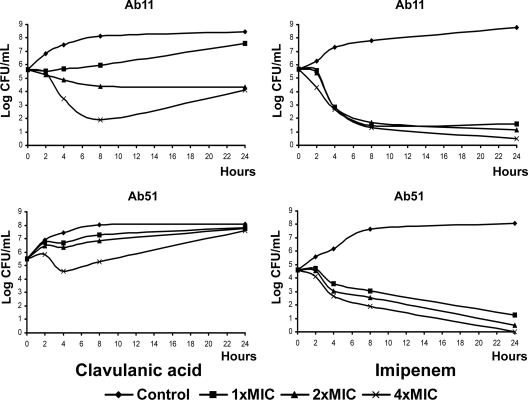
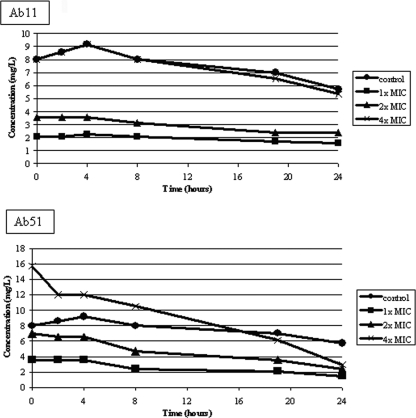
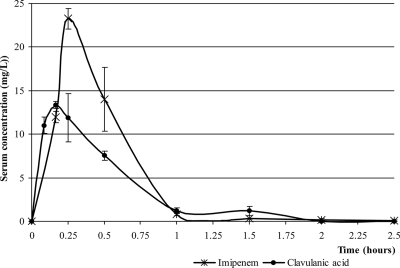
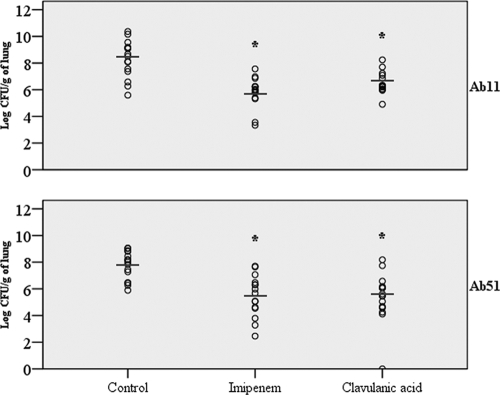
Clavulanic acid (CLA) exhibits low MICs against some Acinetobacter baumannii strains. The present study evaluates the efficacy of CLA in a murine model of A. baumannii pneumonia. For this purpose, two clinical strains, Ab11 and Ab51, were used; CLA MICs for these strains were 2 and 4 mg/liter, respectively, and the imipenem (IPM) MIC was 0.5 mg/liter for both. A pneumonia model in C57BL/6 mice was used. The CLA dosage (13 mg/kg of body weight given intraperitoneally) was chosen to reach a maximum concentration of the drug in serum similar to that in humans and a time during which the serum CLA concentration remained above the MIC equivalent to 40% of the interval between doses. Six groups (n = 15) were inoculated with Ab11 or Ab51 and were allocated to IPM or CLA therapy or to the untreated control group. In time-kill experiments, CLA was bactericidal only against Ab11 whereas IPM was bactericidal against both strains. CLA and IPM both decreased bacterial concentrations in lungs, 1.78 and 2.47 log10 CFU/g (P < or = 0.001), respectively, in the experiments with Ab11 and 2.42 and 2.28 log10 CFU/g (P < or = 0.001), respectively, with Ab51. IPM significantly increased the sterility of blood cultures over that for the controls with both strains (P < or = 0.005); CLA had the same effect with Ab51 (P < 0.005) but not with Ab11 (P = 0.07). For the first time, we suggest that CLA may be used for the treatment of experimental severe A. baumannii infections.
Figures
References
-
- Bamberger, D. M., J. W. Foxworth, D. L. Bridwell, C. S. Shain, and D. N. Gerdin. 2005. Extravascular antimicrobial distribution and the respective blood and urine concentrations in humans, p. 719-814. In V. Lorian (ed.), Antibiotics in laboratory medicine. Lippincott Williams & Wilkins, Philadelphia, PA.
-
- Beale, A. S., E. Faulds, S. E. Hurn, J. Tyler, and B. Slocombe. 1991. Comparative activities of amoxycillin, amoxycillin/clavulanic acid and tetracycline against Chlamydia trachomatis in cell culture and in an experimental mouse pneumonitis. J. Antimicrob. Chemother. 27:627-638. - PubMed
-
- Beceiro, A., F. Fernandez-Cuenca, A. Ribera, L. Martinez-Martinez, A. Pascual, J. Vila, J. Rodriguez-Bano, J. M. Cisneros, J. Pachon, and G. Bou. 2008. False extended-spectrum beta-lactamase detection in Acinetobacter spp. due to intrinsic susceptibility to clavulanic acid. J. Antimicrob. Chemother. 61:301-308. - PubMed
-
- Bou, G., G. Cervero, M. A. Dominguez, C. Quereda, and J. Martinez-Beltran. 2000. PCR-based DNA fingerprinting (REP-PCR, AP-PCR) and pulsed-field gel electrophoresis characterization of a nosocomial outbreak caused by imipenem- and meropenem-resistant Acinetobacter baumannii. Clin. Microbiol. Infect. 6:635-643. - PubMed
Publication types
MeSH terms
Substances
LinkOut - more resources
Full Text Sources
Medical
Molecular Biology Databases
