


Retrospective study of the clinical profile and prognostic indicators in patients of alcoholic liver disease admitted to a tertiary care teaching hospital in Western Nepal
- PMID: 19636178
- PMCID: PMC2841416
- DOI: 10.4103/1319-3767.54746
Retrospective study of the clinical profile and prognostic indicators in patients of alcoholic liver disease admitted to a tertiary care teaching hospital in Western Nepal
Abstract
Background/aim: Alcohol is the most common substance abused in Nepal. Liver disease caused by alcohol abuse, including its end stage, cirrhosis, is a major health care problem, which is difficult to treat.
Objectives: To study the demographic profile, laboratory parameters, complications and their prognostic implications among patients of alcoholic liver disease (ALD).
Materials and methods: Records of all patients of ALD admitted from January1 , 2005 to December 31 , 2006 were studied and followed up to December 31, 2007. A total of 181 patients were analyzed. Their clinical profile and laboratory parameters were noted and analyzed using SPSS-10.0 software.
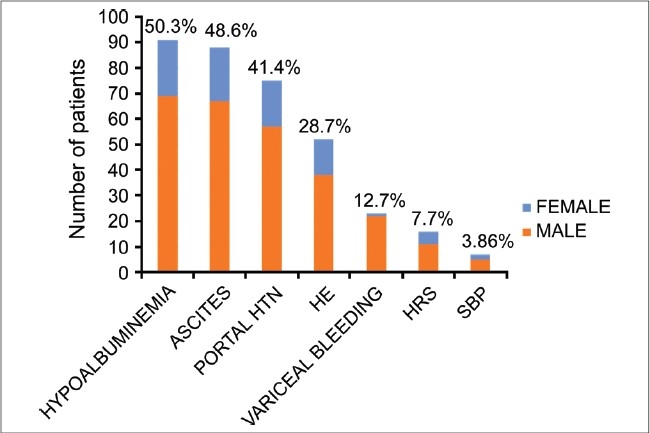
Results: Among the 181 patients, 80.7% were male, 30.9% were army/ex-army and 65.2% were documented smokers. The mean age of presentation was 52.08 years. Jaundice (57.5%) was the most common presentation followed by hepatomegaly (51.4%). Hypoalbuminemia (50.3) followed by ascites (48.1) were common complications. Death occurred in 19.1% of the patients, the most common cause being hepatic encephalopathy (72.2%) followed by variceal bleeding and hepatorenal syndrome. Jaundice, ascites and hepatic encephalopathy at presentation and female sex were significantly associated with increased mortality along with discriminant score > 32, aspartate aminotransferase (AST): Alanine aminotranferase (ALT) > or = 2, ultrasonography (USG)-proven cirrhosis, rise in prothrombin time > or =5 s, total bilirubin > or = 4 mg/dL and ESR > or =34.
Conclusion: ALD was predominantly seen among the productive age group with a high morbidity and mortality. Jaundice, ascites, hepatic encephalopathy at presentation and female sex are poor prognostic indicators along with discriminant score > 32, AST:ALT > or = 2, USG-proven cirrhosis, coagulopathy, hyperbilirubenemia and high ESR.
Conflict of interest statement
Figures
References
-
- Rupa Dhital. Alcohol and young people in Nepal. Available from: http://www.ias.org.uk/resources/publications/theglobe/globe200103-04.
-
- Dennis Kasper L, Eugene Braunwald, Anthony Fauci S, Stephen Hauser L, Dan Longo L, Larry Jameson J. Harrison's Principles Of Internal Medicine. 16th Edition
-
- WHO Sixtieth world health assembly, Provisional agenda item 12.7. April 5 2007. Evidence-based strategies and interventions to reduce alcohol-related harm.
-
- Rehn N, Room R, Edwards G. Alcohol in the European Region – consumption, harm and policies. Copenhagen: World Health Organization Regional Office for Europe; 2001. Available from: mednet3.who.int/prioritymeds/report/FinalRep/Alcohol.
-
- Morgan MY. Alcoholic liver disease Natural history, diagnosis, clinical features, evaluation, management, prognosis and prevention. In: McIntyre N, Benhamou JP, Bircher J, editors. Oxford textbook of clinical Hepatology. Oxford, Eng: Oxford University Press; 1991. pp. 815–55.
Publication types
MeSH terms
LinkOut - more resources
Full Text Sources
Miscellaneous