


Juvenile offenders' alcohol and marijuana trajectories: risk and protective factor effects in the context of time in a supervised facility
- PMID: 19636756
- PMCID: PMC2779036
- DOI: 10.1007/s10964-008-9324-5
Juvenile offenders' alcohol and marijuana trajectories: risk and protective factor effects in the context of time in a supervised facility
Abstract
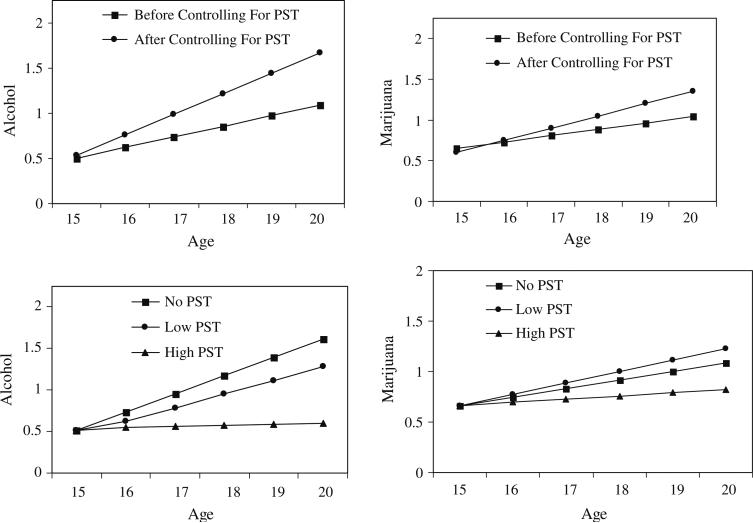
The current study modeled trajectories of substance use from ages 15 to 20 among 1,095 male serious juvenile offenders (M age = 16.54; 42% African-American, 34% Latino, 20% European-American, and 4% other ethnic/racial backgrounds) and prospectively predicted trajectories from risk and protective factors before and after controlling for time spent in a supervised setting. Results indicated that supervised time suppressed age-related growth in substance use. Trajectories of offenders with no supervised time and low levels of supervised time increased in substance use across age, whereas offenders with high levels of supervised time showed no growth. Almost all risk and protective factors had effects on initial substance use but only adolescent history of substance use, impulse control, and psychosocial maturity had an effect on change in substance use over time. Findings highlight the importance of formal sanctions and interventions superimposed on normal developmental processes in understanding trajectories of substance use among serious juvenile offenders.
Figures
References
-
- Aiken L, West S. Multiple regression: testing and interpreting interactions. Sage Publications, Inc; Thousand Oaks, CA, US: 1991.
-
- Abrantes AM, Hoffmann NG, Anton R. Prevalence of co-occurring disorders among juveniles committed to detention centers. International Journal of Offender Therapy and Comparative Criminology. 2005;49(2):179–193. doi:10.1177/0306624X04269673. - PubMed
-
- Adams MS, Robertson CT, Gray-Ray P, Ray MC. Labeling and delinquency. Adolescence. 2003;38:171–186. - PubMed
-
- Bachman G, O'Malley P, Johnston L, Schulenberg J. The decline of substance use young adulthood: Changes in social activities, roles, and beliefs. Erlbaum; NY: 2002.
-
- Bhati SB, Piquero AR. Estimating the impact of incarceration on subsequent offending trajectories: deterrent, criminogenic, or null effect? Journal of Criminal Law and Criminology. 2008;98(1):207–253.
Publication types
MeSH terms
Grants and funding
LinkOut - more resources
Full Text Sources
Medical
