


Second-by-second analysis of alpha 7 nicotine receptor regulation of glutamate release in the prefrontal cortex of awake rats
- PMID: 19637277
- PMCID: PMC2759414
- DOI: 10.1002/syn.20693
Second-by-second analysis of alpha 7 nicotine receptor regulation of glutamate release in the prefrontal cortex of awake rats
Abstract
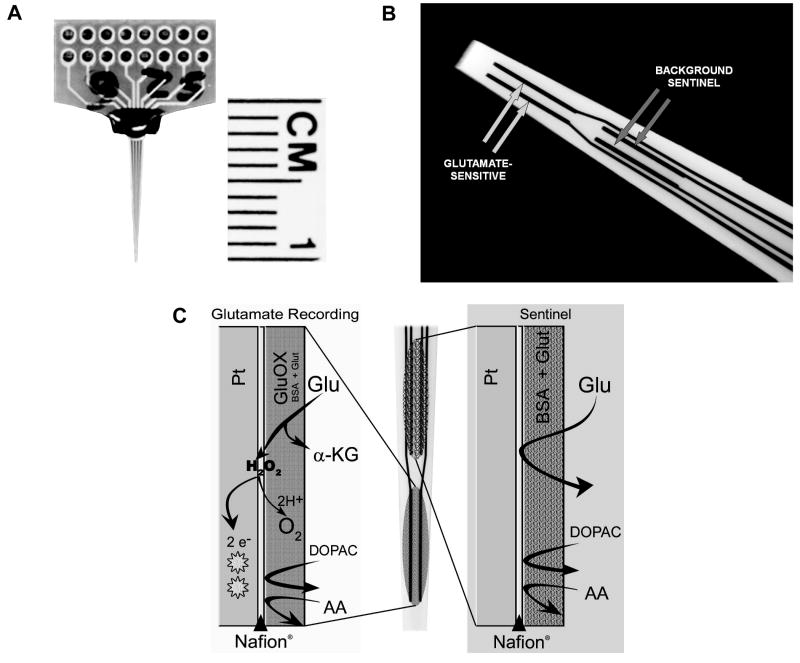
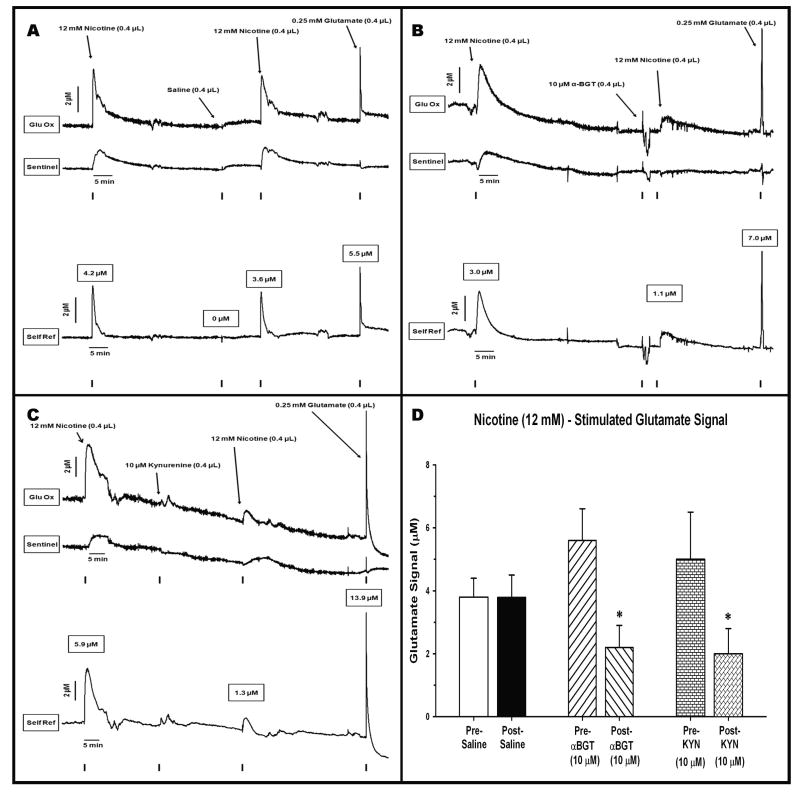
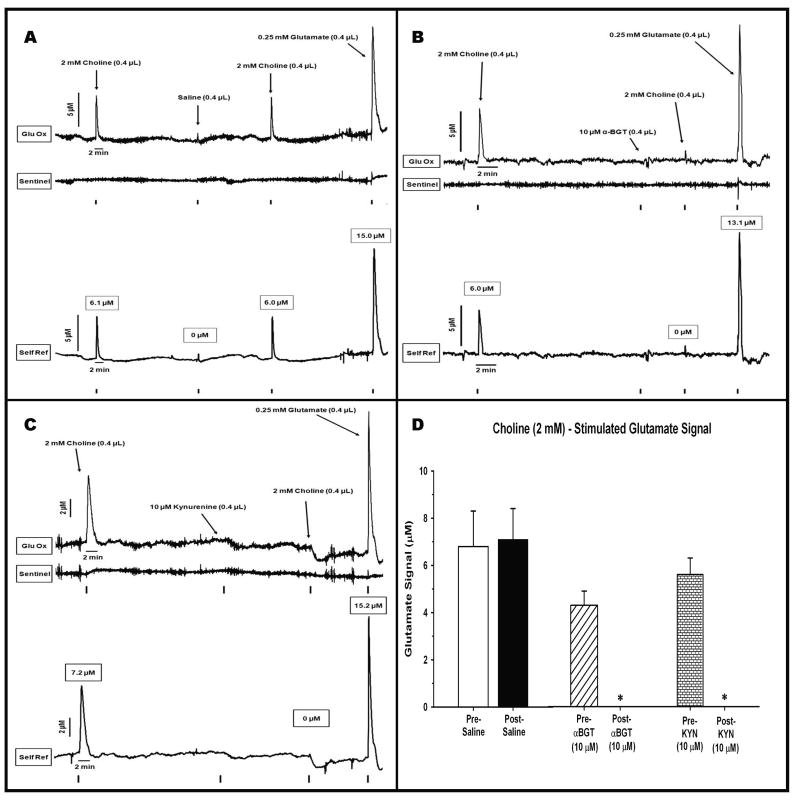
These experiments utilized an enzyme-based microelectrode selective for the second-by-second detection of extracellular glutamate to reveal the alpha 7-based nicotinic modulation of glutamate release in the prefrontal cortex (PFC) of freely moving rats. Rats received intracortical infusions of the nonselective nicotinic agonist nicotine (12.0 mM, 1.0 microg/0.4 microl) or the selective alpha 7 agonist choline (2.0 mM/0.4 microl). The selectivity of drug-induced glutamate release was assessed in subgroups of animals pretreated with the alpha 7 antagonist, alpha-bungarotoxin (alpha-BGT, 10 microM), or kynurenine (10 microM) the precursor of the astrocyte-derived, negative allosteric alpha 7 modulator kynurenic acid. Local administration of nicotine increased glutamate signals (maximum amplitude = 4.3 +/- 0.6 microM) that were cleared to baseline levels in 493 +/- 80 seconds. Pretreatment with alpha-BGT or kynurenine attenuated nicotine-induced glutamate by 61% and 60%, respectively. Local administration of choline also increased glutamate signals (maximum amplitude = 6.3 +/- 0.9 microM). In contrast to nicotine-evoked glutamate release, choline-evoked signals were cleared more quickly (28 +/- 6 seconds) and pretreatment with alpha-BGT or kynurenine completely blocked the stimulated glutamate release. Using a method that reveals the temporal dynamics of in vivo glutamate release and clearance, these data indicate a nicotinic modulation of cortical glutamate release that is both alpha 7- and non-alpha 7-mediated. Furthermore, these data may also provide a mechanism underlying the recent focus on alpha 7 full and partial agonists as therapeutic agents in the treatment of cortically mediated cognitive deficits in schizophrenia.
(c) 2009 Wiley-Liss, Inc.
Figures
References
-
- Alkondon M, Pereira E, Cortes WS, Maelicke A, Albuquergue EX. Choline is a selective agonsit of alpha7 nicotinic acetylcholine receptors in the rat brain neurons. European Journal of Neuroscience. 1997;9(12):2734–2742. - PubMed
-
- Alkondon M, Albuquerque E. Subtype-specific inhibition of nicotinic acetylcholine receptors by choline: a regulatory pathway. Journal of Pharmacology and Experimental Therapeutics. 2006;318(1):268–275. - PubMed
-
- Bitner RS, Bunnelle WH, Anderson DJ, Briggs CA, Buccafusco J, Curzon P, Decker MW, Frost JM, Gronlien J, Gubbins E, Li J, Malysz J, Markosyan S, Marsch K, Meyer MD, Nikkel AL, Radek RJ, Robb HM, Timmerman D, Sullivan JP, Gopalakrishnan M. Broad-spectrum efficacy across cognitive domains by α7 nicotinic acetylcholine receptor agonism correlates with activation of ERK1/2 and CREB phosphorylation pathways. Journal of Neuroscience. 2007;27(39):10578–10587. - PMC - PubMed
-
- Bruno JP, Gash C, Martin B, Zmarowski A, Pomerleau F, Burmeister J, Huettl P, Gerhardt GA. Second-by-second measurement of acetylcholine release in prefrontal cortex. European Journal of Neuroscience. 2006;24(10):2749–2757. - PubMed
-
- Buchanan RW, Conley RR, Dickinson D, Ball MP, Feldman S, Gold JM, McMahon RP. Galantamine for the treatment of cognitive impairments in people with schizophrenia. American Journal of Psychiatry. 2008;165:82–89. - PubMed
Publication types
MeSH terms
Substances
Grants and funding
LinkOut - more resources
Full Text Sources
Miscellaneous