Short term persistence of human papillomavirus and risk of cervical precancer and cancer: population based cohort study
- PMID: 19638649
- PMCID: PMC2718087
- DOI: 10.1136/bmj.b2569
Short term persistence of human papillomavirus and risk of cervical precancer and cancer: population based cohort study
Abstract
Objective: To evaluate the cumulative incidence of cervical intraepithelial neoplasia II or worse (grade II+) or cervical intraepithelial neoplasia grade III+ after short term persistence of prevalently detected carcinogenic human papillomavirus (HPV).
Design: Population based cohort study.
Setting: Guanacaste, Costa Rica.
Participants: 2282 sexually active women actively followed after enrolment.
Main outcome measures: Primary end points: three year and five year cumulative incidence of histologically confirmed cervical intraepithelial neoplasia grade II+ (n=70). Cervical specimens collected at each visit tested for more than 40 HPV genotypes. HPV 16, 18, 26, 31, 33, 35, 39, 45, 51, 52, 56, 58, 59, 66, 68, 73, and 82 were considered the primary carcinogenic genotypes.
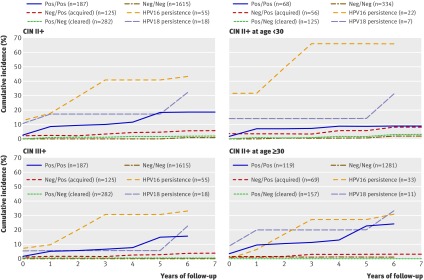
Results: Women who tested positive for a carcinogenic HPV at enrolment and after about one year (9-21 months) (positive/positive) had a three year cumulative incidence of cervical intraepithelial neoplasia grade II+ of 17.0% (95% confidence interval 12.1% to 22.0%). Those who tested negative/positive (3.4%, 0.1% to 6.8%), positive/negative (1.2%, -0.2% to 2.5%), and negative/negative (0.5%, 0.1% to 0.9%) were at a significantly lower risk. There was little difference in the cumulative incidence of cervical intraepithelial neoplasia grade II+ between testing positive twice for any carcinogenic HPV genotype (same genotype or different genotypes) v testing positive twice for the same carcinogenic genotype (17.0% v 21.3%, respectively). Short term persistence of HPV 16 strongly predicted cervical intraepithelial neoplasia grade II+, with a three year cumulative incidence of 40.8% (26.4% to 55.1%). Similar patterns were observed for the five year cumulative incidence of grade II+ and for three year and five year cumulative incidence of grade III+.
Conclusions: Short term persistence of a prevalently detected carcinogenic HPV infection, especially HPV 16, strongly predicts a subsequent diagnosis of cervical intraepithelial neoplasia II+ over the next few years.
Conflict of interest statement
Competing interests: None declared.
Figures


Comment in
-
Cervical screening according to age and HPV status.BMJ. 2009 Jul 28;339:b3005. doi: 10.1136/bmj.b3005. BMJ. 2009. PMID: 19638652 No abstract available.
References
-
- Castle PE, Wheeler CM, Solomon D, Schiffman M, Peyton CL. Interlaboratory reliability of hybrid capture 2. Am J Clin Pathol 2004;122:238-45. - PubMed
-
- Carozzi FM, Del Mistro A, Confortini M, Sani C, Puliti D, Trevisan R, et al. Reproducibility of HPV DNA testing by hybrid capture 2 in a screening setting. Am J Clin Pathol 2005;124:716-21. - PubMed
-
- Arbyn M, Sasieni P, Meijer CJ, Clavel C, Koliopoulos G, Dillner J. Chapter 9: Clinical applications of HPV testing: a summary of meta-analyses. Vaccine 2006;24(suppl 3):S78-89. - PubMed
-
- Mayrand MH, Duarte-Franco E, Rodrigues I, Walter SD, Hanley J, Ferenczy A, et al. Human papillomavirus DNA versus Papanicolaou screening tests for cervical cancer. N Engl J Med 2007;357:1579-88. - PubMed
-
- Naucler P, Ryd W, Tornberg S, Strand A, Wadell G, Elfgren K, et al. Human papillomavirus and Papanicolaou tests to screen for cervical cancer. N Engl J Med 2007;357:1589-97. - PubMed