Performance evaluation of a new rapid urine test for chlamydia in men: prospective cohort study
- PMID: 19638650
- PMCID: PMC2718085
- DOI: 10.1136/bmj.b2655
Performance evaluation of a new rapid urine test for chlamydia in men: prospective cohort study
Abstract
Objective: To evaluate the performance of a rapid test for chlamydia with first void male urine samples as a potential tool for diagnosis and screening of chlamydial infection in men.
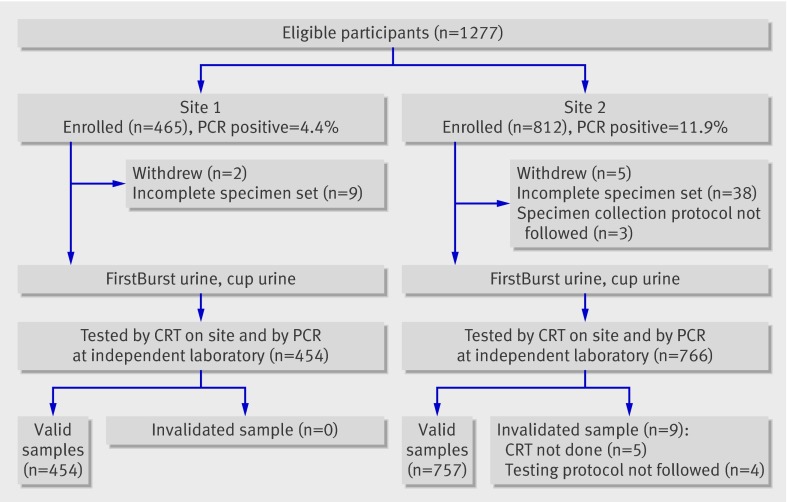
Design: Evaluation of test performance in prospective cohort study. Settings A young people's sexual health centre (site 1) and a genitourinary medicine clinic (site 2) in the United Kingdom.
Participants: 1211 men aged 16-73 attending either of the two sites.
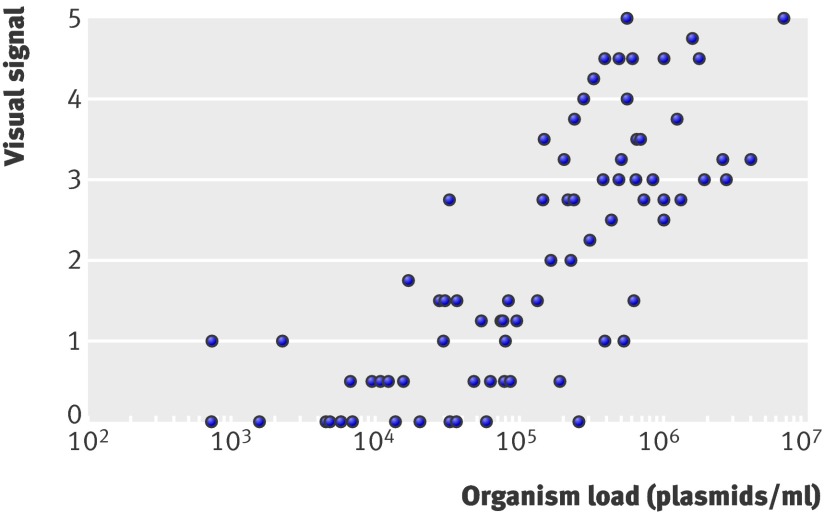
Main outcome measures: Sensitivity, specificity, positive predictive value, and negative predictive value of the Chlamydia Rapid Test versus polymerase chain reaction assay. Relation between the visual signal of the Chlamydia Rapid Test and organism load.
Results: Detection rates for Chlamydia trachomatis infection with polymerase chain reaction were 4.4% (20/454) at site 1 and 11.9% (90/757) at site 2. Compared with polymerase chain reaction assay, the resolved sensitivity, specificity, positive predictive value, and negative predictive value of the Chlamydia Rapid Test was 82.6% (90/109), 98.5% (1085/1102), 84.1% (90/107), and 98.3% (1085/1104), respectively. The organism load in first void urine samples that were positive for chlamydia ranged from 7.28x10(2) to 6.93x10(6) plasmids/ml and correlated significantly with the visual signal of the Chlamydia Rapid Test (r=0.7897, P<0.001).
Conclusions: The performance of the new Chlamydia Rapid Test with first void male urine samples indicates that it would be an effective diagnostic tool for chlamydial infection in men. The availability of test results within an hour allows for immediate treatment and contact tracing, potentially reducing the risks of persistent infection and onward transmission. The test could also provide a simple and reliable alternative to nucleic acid amplification assays for testing of male urine in chlamydial screening programmes in high prevalence settings.
Conflict of interest statement
Competing interests: J-PM, C-EM, and HHL are equity holders in Diagnostics for the Real World, which markets the rapid test technologies developed at the University of Cambridge. Both the University of Cambridge and the Wellcome Trust are also equity holders of the company.
Figures
References
-
- Centers for Disease Control and Prevention. Sexually transmitted disease surveillance, 2006. Atlanta, GA: US Department of Health and Human Services, November 2007.
-
- Health Protection Agency. Chlamydia statistics. www.hpa.org.uk/infections/topics_az/hiv_and_sti/Stats/STIs/chlamydia/sta....
-
- Idahl A, Boman J, Kumlin U, Olofsson JI. Demonstration of Chlamydia trachomatis IgG antibodies in the male partner of the infertile couple is correlated with a reduced likelihood of achieving pregnancy. Hum Reprod 2004;19:1121-6. - PubMed
Publication types
MeSH terms
Substances
Grants and funding
LinkOut - more resources
Full Text Sources
Medical