Editorial
doi: 10.1038/msb.2009.51.
Epub 2009 Jul 28.
Systems biology and the virtual physiological human
- PMID: 19638973
- PMCID: PMC2724980
- DOI: 10.1038/msb.2009.51
Item in Clipboard
Editorial
Systems biology and the virtual physiological human
Mol Syst Biol.
2009.
No abstract available
Conflict of interest statement
The authors declare that they have no conflict of interest.
Figures
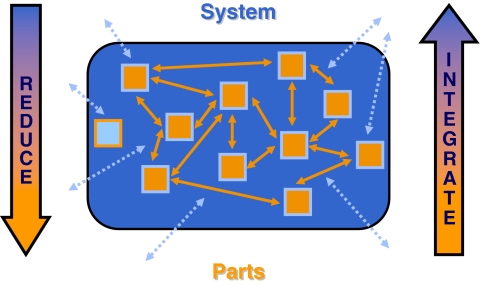
A system as an ‘entity that maintains its existence through the mutual interaction of its parts' (von Bertalanffy, 1968). Systems research must combine the (i) identification and (ii) detailed characterisation of parts (orange boxes, as opposed to ‘look-alikes', pale blue box, which need to be identified and excluded), with the exploration of their interactions (iii) with each other (orange arrows), and (iv) with the environment (pale blue dashed arrows affecting parts either directly, or indirectly through modulation of internal interactions), to develop a (v) systemic understanding (an important, but often overlooked, aspect is that the system itself not only enables, but also restricts, the type and extent of functions and interactions that may occur; dark-blue box). Systems research therefore requires a combination of reductionist and integrative tools and techniques.

Our understanding of ‘real world systems' (top left) usually forms a simplified representation (top right) of that reality, and therefore represents a model in its own right. The progressive development of this understanding is based on the application and analysis of experimental and theoretical models. For biological systems research, these models allow the exploration of partial systems behaviour at all relevant structural levels between body and molecule. ‘Wet' experimental models are developed through a broad range of research directions and provide increasingly detailed data on structure–function relations and their change over time. This can be re-integrated using ‘dry' conceptual (thought) and formal (computation) models. Many of these developments occur in parallel. Systems biology provides the framework for the targeted interrelation of these different facets of model application to bio-medical research and development. Note that, for simplicity, this diagram depicts models by horizontal arrows, although models can involve multiple scales.
References
-
- Allessie M, Ausma J US (2002) Electrical, contractile and structural remodeling during atrial fibrillation. Cardiovasc Res 54: 230–246 - PubMed
-
- Auffray C, Nottale L (2008) Scale relativity theory and integrative systems biology 1. Founding principles and scale laws. Progress Biophys Mol Biol 97: 79–114 - PubMed
-
- Bernabeu MO, Bordas R, Pathmanathan P, Pitt-Francis J, Cooper J, Garny A, Gavaghan DJ, Rodriguez B, Southern JA, Whiteley JP (2009) Chaste: incorporating a novel multiscale spatial and temporal algorithm into a large scale open source library. Philos Trans R Soc A 367: 1907–1930 - PubMed
-
- Bordas R, Carpentieri B, Fotia G, Maggio F, Nobes R, Pitt-Francis J, Southern JA (2009) Simulation of cardiac electrophysiology on next-generation high-performance computers. Philos Trans R Soc A 367: 1951–1970 - PubMed
Publication types
MeSH terms
Grants and funding
LinkOut - more resources
Full Text Sources