


Newborn adiposity measured by plethysmography is not predicted by late gestation two-dimensional ultrasound measures of fetal growth
- PMID: 19640967
- PMCID: PMC3151022
- DOI: 10.3945/jn.109.109058
Newborn adiposity measured by plethysmography is not predicted by late gestation two-dimensional ultrasound measures of fetal growth
Abstract
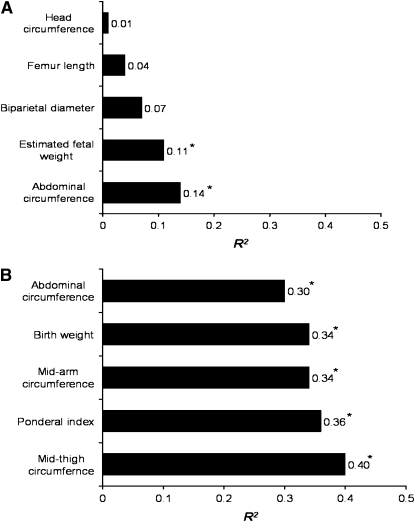
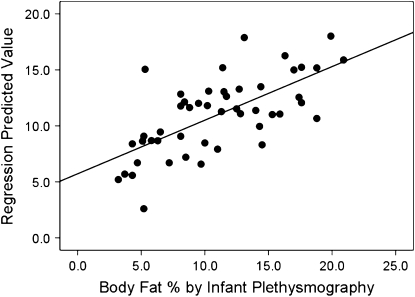
Noninvasive measures of fetal and neonatal body composition may provide early identification of children at risk for obesity. Air displacement plethysmography provides a safe, precise measure of adiposity and has recently been validated in infants. Therefore, we explored relationships between term newborn percent body fat (%BF) measured by air displacement plethysmography to 2-dimensional ultrasound (2-D US) biometric measures of fetal growth and maternal and umbilical cord endocrine activity. A total of 47 mother/infant pairs were studied. Fetal biometrics by 2-D US and maternal blood samples were collected during late gestation (35 wk postmenstrual age); infants were measured within 72 h of birth. Fetal biometrics included biparietal diameter, femur length, head circumference, abdominal circumference (AC), and estimated fetal weight (EFW). Serum insulin, insulin-like growth factor (IGF) 1, IGF binding protein-3, and leptin concentrations were measured in umbilical cord and maternal serum. The mean %BF determined by plethysmography was 10.9 +/- 4.8%. EFW and fetal AC had the largest correlations with newborn %BF (R(2) = 0.14 and 0.10, respectively; P < 0.05); however, stepwise linear regression modeling did not identify any fetal biometric parameters as a significant predictor of newborn %BF. Newborn mid-thigh circumference (MTC; cm) and ponderal index (PI; weight, kg/length, cm(3)) explained 21.8 and 14.4% of the variability in %BF, respectively, and gave the best stepwise linear regression model (%BF = 0.446 MTC + 0.347 PI -29.692; P < 0.001). We conclude that fetal growth biometrics determined by 2-D US do not provide a reliable assessment of %BF in term infants.
Figures
References
-
- Ong KK. Size at birth, postnatal growth and risk of obesity. Horm Res. 2006;65 Suppl 3:65–9. - PubMed
-
- Gluckman PD, Pinal E. Regulation of fetal growth by the somatoprophic axis. J Nutr. 2003;133:S1741–6. - PubMed
-
- Gluckman PD. The role of pituitary hormones, growth factors and insulin in the regulation of fetal growth. In: Clarke JR, editor. Oxford reviews for reproductive biology. Oxford: Carendon Press; 1986. p. 1–60. - PubMed
-
- Larciprete G, Valensise H, Di Pierro G, Vasapollo B, Casolino B, Archeini D, Jarvis S, Cirese E. Intrauterine growth restriction and fetal body composition. Ultrasound Obstet Gynecol. 2005;26:258–62. - PubMed
-
- Barker DJP. Mothers, babies and health in later life. 2nd ed. Edinburgh: Churchill Livingstone; 1998. p.1–6.
Publication types
MeSH terms
Grants and funding
LinkOut - more resources
Full Text Sources
Medical
Research Materials
Miscellaneous
