. 2009 Nov 30;41(11):782-92.
doi: 10.3858/emm.2009.41.11.084.

Effect of nicotinamide on early graft failure following intraportal islet transplantation

Affiliations

Effect of nicotinamide on early graft failure following intraportal islet transplantation

Da-Yeon Jung et al. Exp Mol Med. .

Abstract

Intraportal islet transplantation (IPIT) may potentially cure Type 1 diabetes mellitus; however, graft failure in the early post-transplantation period presents a major obstacle. In this study, we tested the ability of nicotinamide to prevent early islet destruction in a syngeneic mouse model. Mice (C57BL/6) with chemically-induced diabetes received intraportal transplants of syngeneic islet tissue in various doses. Islets were cultured for 24 h in medium with or without 10 mM nicotinamide supplementation. Following IPIT, islet function was confirmed by an intraperitoneal glucose tolerance test (IPGTT) and hepatectomy. The effects of nicotinamide were evaluated by blood glucose concentration, serum monocyte chemoattractant protein-1 (MCP-1) concentration, and immunohistology at 3 h and 24 h after IPIT. Among the various islet doses, an infusion of 300 syngeneic islets treated with nicotinamide exhibited the greatest differences in glucose tolerance between recipients of treated and untreated (i.e., control) islets. One day after 300 islet equivalent (IEQ) transplantation, islets treated with nicotinamide were better granulated than the untreated islets (P=0.01), and the recipients displayed a slight decrease in serum MCP-1 concentration, as compared to controls. After 15 days, recipients of nicotinamide-pretreated islets showed higher levels of graft function (as measured by IPGTT) than controls. The pretreatment also prolonged graft survival (>100 days) and function; these were confirmed by partial hepatectomy, which led to the recurrence of diabetes. Pretreatment of islet grafts with nicotinamide may prevent their deterioration on the early period following IPIT in a syngeneic mouse model.


Figures
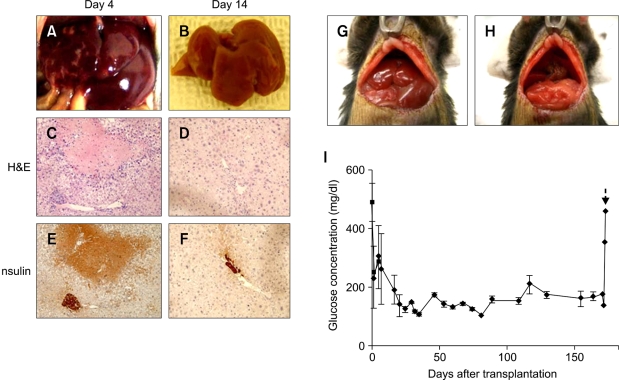
Figure 1
Figure 1
Evaluation of islet grafts early (days 4 and 12) and late (day 178) after intraportal islet transplantation. Four days (A, C, E) and 14 days (B, D, F) after islet transplantation, 70% of the liver was removed. Histological examination revealed multiple foci of necrosis on the liver surface (A, B). Hematoxylin/eosin staining (H&E) (C, D), and immunoperoxidase staining with antibody against insulin (magnification ×200) (E, F) of liver sections, are shown. Histological sections for each marker are representative of three animals from each treatment group. In recipients of 350 islets with long-term graft survival, 70% of the liver was also removed (G, H). Blood glucose levels of recipients were monitored, and normoglycemic mice underwent partial hepatectomy at the time points indicated by arrows in (I) to confirm long-term graft function and acceptance.
Figure 2
Figure 2
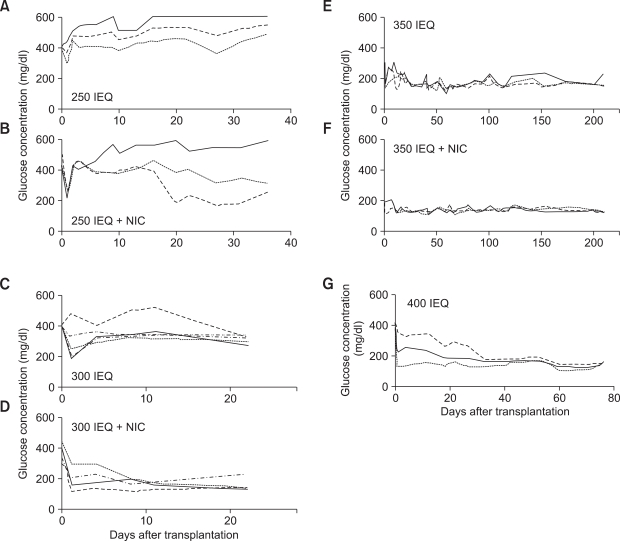
Beneficial effect of nicotinamide on the hyperglycemia in diabetic mice. Recipients received 250 (A, B), 300 (C, D), 350 (E, F), or 400 (G) syngeneic islets that were pretreated without (A, C, E, G) or with (B, D, F) nicotinamide. Individual lines represent the non-fasting plasma glucose levels of each animal. NIC, nicotinamide.
Figure 3
Figure 3
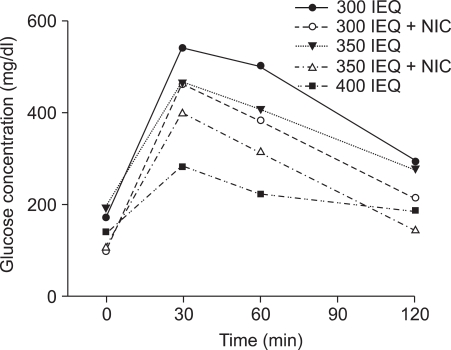
IPGTT in mice receiving islets with or without nicotinamide pretreatment. The IPGTT was performed in diabetic mice at 15 days post-transplantation. Experimental groups included diabetic mice that received 300, 350, or 400 syngeneic, nicotinamide-pretreated or untreated islets. The results for all five groups are expressed as mean plasma glucose concentrations (n = 3). NIC, nicotinamide.
Figure 4
Figure 4
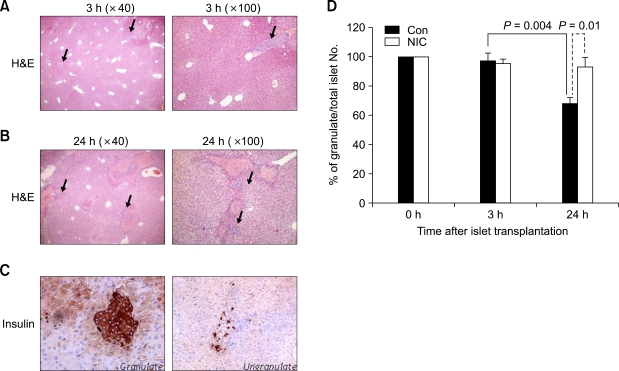
Morphological changes in the engrafted liver. Liver tissues were collected 3 h (A) and 24 h post-transplantation (B, C), and stained with H&E (A, B) and monoclonal antibody to insulin (C). Insulin-positive cells were morphologically granulated or de-granulated (C, left or right, respectively). The percentage of granulation was based on the number of granulated islets out of the total number of insulin staining cells at 0, 3, and 24 h post-transplantation. The percentage of granulation at 0 h was calculated with islets before transplantation, and no de-granulated islets were observed.
Figure 5
Figure 5
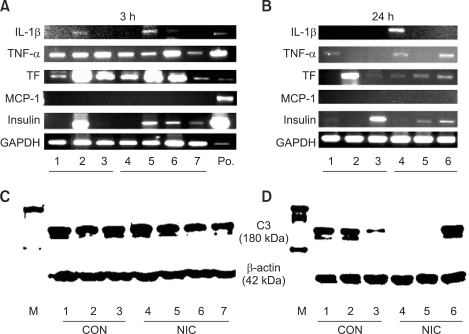
Expression of inflammatory mediators in the liver after IPTX. Islet cells pretreated without (control; lanes 1-3) or with nicotinamide (nicotinamide; lanes 4-6 and/or 7) were intraportally transplanted in the diabetic mouse. After 3 h or 24 h of transplantation, liver of recipient was sacrificed. RNA expressions for IL-1β, TNF-α, TF, MCP-1, insulin, and GAPDH were detected by RT-PCR analysis in the liver 3 h (A) or 24 h (B) after IPTX. C3 and β-actin were detected by Western blot analysis in the liver sample at both times (C, D). Cell line RAW 264.7 activated by LPS was used as a positive control (Po.) of IL-1β, TNF-α, TF, MCP-1, and GAPDH. Cell line MIN 6 was used as a positive control of insulin. NIC, nicotinamide.
Figure 6
Figure 6
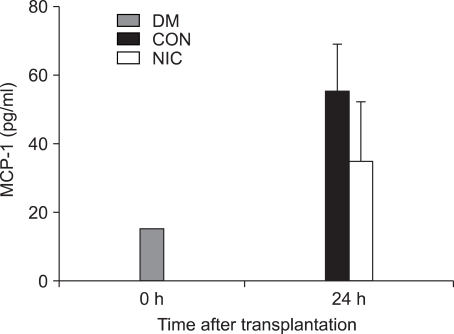
MCP-1 concentrations after intraportal transplantation of nicotinamide-pretreated and untreated islets. Diabetic mice receiving 300 IEQ with or without nicotinamide pretreatment were divided with two groups (CON, control; NIC, nicotinamide. pretreatment). At 24 h post-transplantation, MCP-1 concentrations were analyzed in recipient sera. Serum of diabetic mice (DM) was harvested before islet transplantation for the 0 h measurement.
Figure 7
Figure 7
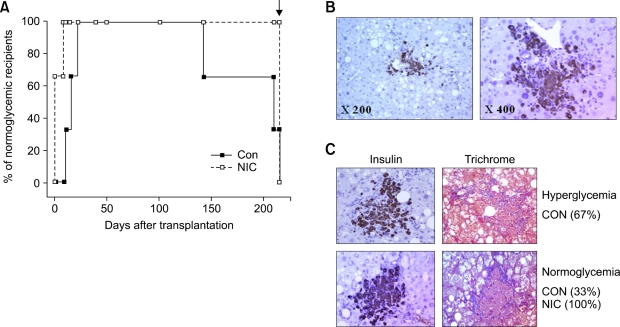
Diabetes cure rate and histology in long-term grafts. Diabetic mice that received 350 IEQ were divided into control (CON) (-■-) and NIC pretreatment (-□-) groups. Long-term graft survival between groups was described as the percentage of recipients cured of diabetes (A). In order to confirm long-term graft function and acceptance, normoglycemic mice underwent partial hepatectomy of the graft-bearing liver at the time points indicated (arrows). Insulin positive-staining cells were observed near the blood vessels of long-term grafts (B). Islet cells were present in hyperglycemic (recurrent diabetes) and normoglycemic recipients (C: top and bottom panels, respectively). Beta cells were stained with anti-insulin antibody (dark brown color, left panel), and fibrotic lesions were detected by Masson's trichrome staining (blue color, right panel).

References

    1. Andersen HU, Jorgensen KH, Egeberg J, Mandrup-Poulsen T, Nerup J. Nicotinamide prevents interleukin-1 effects on accumulated insulin release and nitric oxide production in rat islets of Langerhans. Diabetes. 1994;43:770–777. - PubMed
    1. Andrades P, Asiedu C, Rodriguez C, Goodwin J, Deckard LA, Jargal U, Balgansuren G, Thomas JM. Insulin secretion from pancreatic islets in fibrin glue clots at different fibrinogen and thrombin concentrations. Transplant Proc. 2007;39:1607–1608. - PubMed
    1. Beattie GM, Montgomery AM, Lopez AD, Hao E, Perez B, Just ML, Lakey JR, Hart ME, Hayek A. A novel approach to increase human islet cell mass while preserving β-cell function. Diabetes. 2002;51:3435–3439. - PubMed
    1. Berman DM, Cabrera O, Kenyon NM, Miller J, Tam SH, Khandekar VS, Picha KM, Soderman AR, Jordan RE, Bugelski PJ, Horninger D, Lark M, Davis JE, Alejandro R, Berggren PO, Zimmerman M, O'Neil JJ, Ricordi C, Kenyon NS. Interference with tissue factor prolongs intrahepatic islet allograft survival in a nonhuman primate marginal mass model. Transplantation. 2007;84:308–315. - PubMed
    1. Buscema M, Vinci C, Gatta C, Rabuazzo MA, Vignen R, Purrello F. Nicotinamide partially reverses the interleukin-1 beta inhibition of glucose-induced insulin release in pancreatic islets. Metabolism. 1992;41:296–300. - PubMed

Publication types

MeSH terms