. 2009 Jul 31:5:27.
doi: 10.1186/1746-6148-5-27.

Disruption of chromosome 11 in canine fibrosarcomas highlights an unusual variability of CDKN2B in dogs

Affiliations

Disruption of chromosome 11 in canine fibrosarcomas highlights an unusual variability of CDKN2B in dogs

Jesús Aguirre-Hernández et al. BMC Vet Res. .

Abstract

Background: In dogs in the western world neoplasia constitutes the most frequently diagnosed cause of death. Although there appear to be similarities between canine and human cancers, rather little is known about the cytogenetic and molecular alterations in canine tumours. Different dog breeds are susceptible to different types of cancer, but the genetic basis of the great majority of these predispositions has yet to be discovered. In some retriever breeds there is a high incidence of soft tissue sarcomas and we have previously reported alterations of chromosomes 11 and 30 in two poorly differentiated fibrosarcomas. Here we extend our observations and present a case report on detail rearrangements on chromosome 11 as well as genetic variations in a tumour suppressor gene in normal dogs.

Results: BAC hybridisations on metaphases of two fibrosarcomas showed complex rearrangements on chromosome 11, and loss of parts of this chromosome. Microsatellite markers on a paired tumour and blood DNA pointed to loss of heterozygosity on chromosome 11 in the CDKN2B-CDKN2A tumour suppressor gene cluster region. PCR and sequencing revealed the homozygous loss of coding sequences for these genes, except for exon 1beta of CDKN2A, which codes for the N-terminus of p14ARF. For CDKN2B exon 1, two alleles were observed in DNA from blood; one of them identical to the sequence in the dog reference genome and containing 4 copies of a 12 bp repeat found only in the canine gene amongst all species so far sequenced; the other allele was shorter due to a missing copy of the repeat. Sequencing of this exon in 141 dogs from 18 different breeds revealed a polymorphic region involving a GGC triplet repeat and a GGGGACGGCGGC repeat. Seven alleles were recorded and sixteen of the eighteen breeds showed heterozygosity.

Conclusion: Complex chromosome rearrangements were observed on chromosome 11 in two Labrador retriever fibrosarcomas. The chromosome alterations were reflected in the loss of sequences corresponding to two tumour suppressor genes involved in cell-cycle progression. Sequencing of CDKN2B across many different breeds revealed a widespread polymorphism within the first exon of the gene, immediately before the ankyrin coding sequences.


Figures
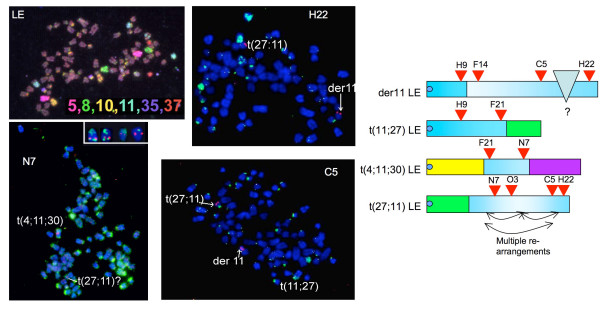
Figure 1
Figure 1
Chromosome painting of metaphases spreads from canine fibrosarcoma LE. Chromosome painting of tumour LE (6 colour paints, colours as shown) shows 4 derivative chromosomes containing CFA11 DNA. To look at the distribution of CFA11 BACs, metaphases were hybridised with a mixed paint of CFA 4, 27 and 30 (green) and a single BAC paint as indicated in examples shown, (red). For N7, where the t(27;11) is difficult to identify because of a high green background, additional hybridising chromosomes from other metaphases are shown; inset at twice the scale. Diagrams summarise hybridisation of all BACs with each derivative containing chromosome 11. The red arrowheads denote BACs consistently binding to the chromosomes shown. Chromosomes in the diagram are CFA11 in blue (mid blue -centromeric; light blue -telomeric); CFA27 green; CFA4 yellow; CFA30 purple.
Figure 2
Figure 2
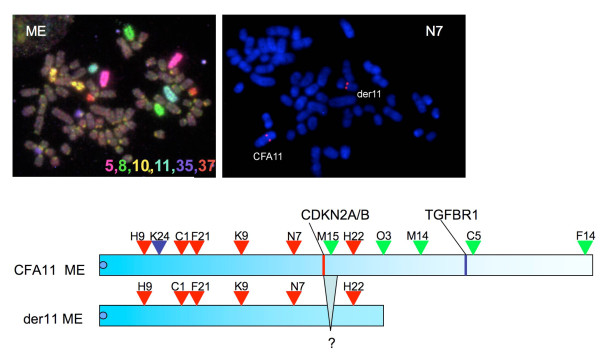
Chromosome painting of metaphases spreads derived from fibrosarcoma ME. Chromosome painting of tumour ME (6 colour paints, colours as shown) shows a der11 with ± 40% of the genomic material of the normal chromosome. An example BAC hybridisation is shown, using RP81_381-N7 (red). Diagrams of the normal and derivative chromosome show hybridisation positions of BACs: red arrowheads – BACs consistently binding to both chromosomes; green arrowheads -those not hybridising to the derivative; blue arrowhead -consistent hybridisation to the normal but inconsistent to the der 11 chromosome.
Figure 3
Figure 3
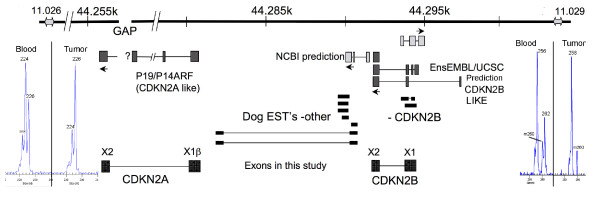
Map of the canine region containing the CDKN2B-CDKN2A locus. Top, position of CAMC11.026, CAMC11.029, and of the gap in the genomic sequence assembly. Middle, microsatellites presenting loss of heterozygosity; also, position of predicted CDKN2 related exons (darker grey), other unrelated exons (light grey), and canine ESTs in the database (black). Bottom, exon designations used here.
Figure 4
Figure 4
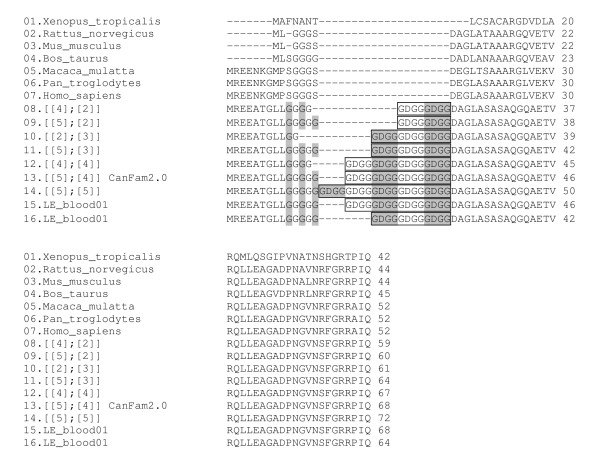
Predicted canine CDKN2B exon 1 amino acid sequences. Alternate Gly residues in the polymorphic region have a grey background, while the GlyAspGlyGly repeats are enclosed in a frame and alternate repeats also have a grey background. In LE's tumour DNA the exon was missing, but not in peripheral blood where it was heterozygous. Alleles are identified in a simplified way (e.g., [2][3]] corresponds to p. [Gly10[2];Gly15_Gly18[3]]).
Figure 5
Figure 5
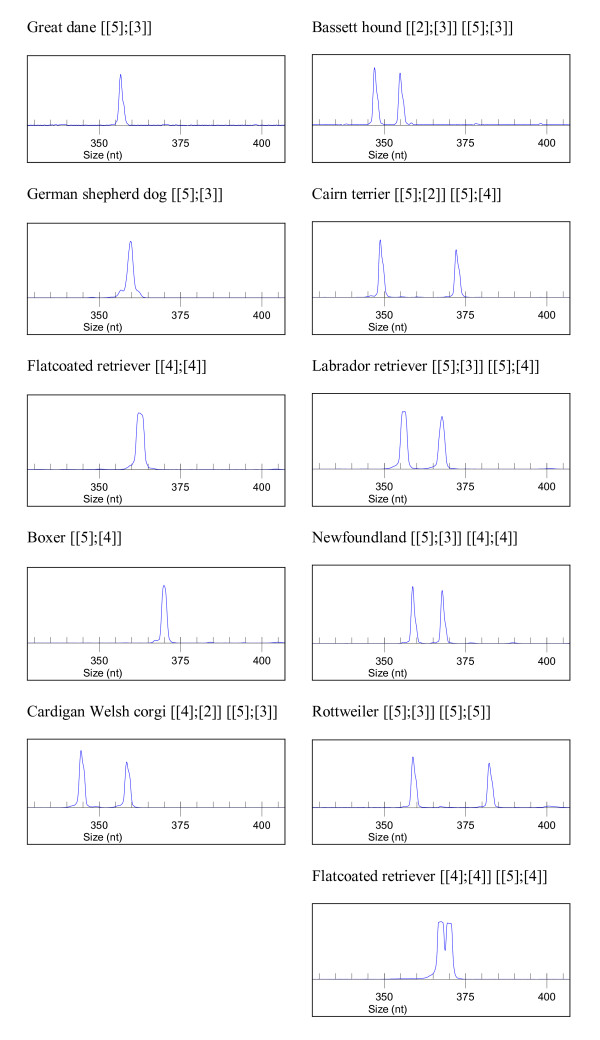
CDKN2B exon 1 genotype determination in dogs of different breeds. Dye-labelled PCR products were separated by capillary electrophoresis. Fragments representing all different sizes were sequenced to confirm the identity of the alleles.
Figure 6
Figure 6
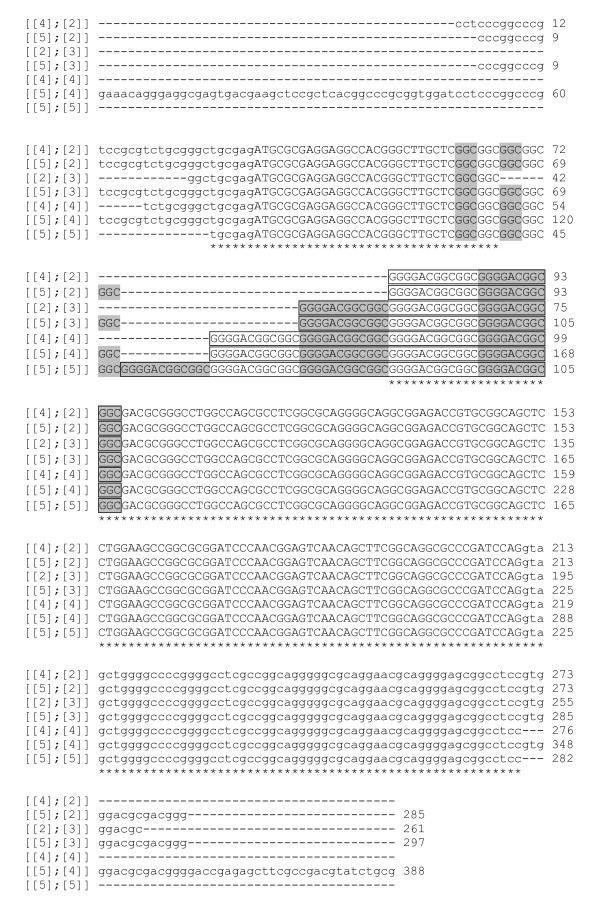
CDKN2B exon 1 alleles observed in canine blood and tumour samples. Alternate GGC triplets coding for Gly have a grey background. The dodecameric nucleotide sequence (GGGGACGGCGGC) coding for the GlyAspGlyGly repeats are within a box, with alternate repeats having a grey background. Intronic sequences are in lowercase. Alleles are identified with a short version of their description; e.g., [4][2]] stands for g. [109GGC[4];124GGGGACGGCGGC[2]]. The [5][4]] allele corresponds to the reference genome (CanFam2.0).
Figure 7
Figure 7
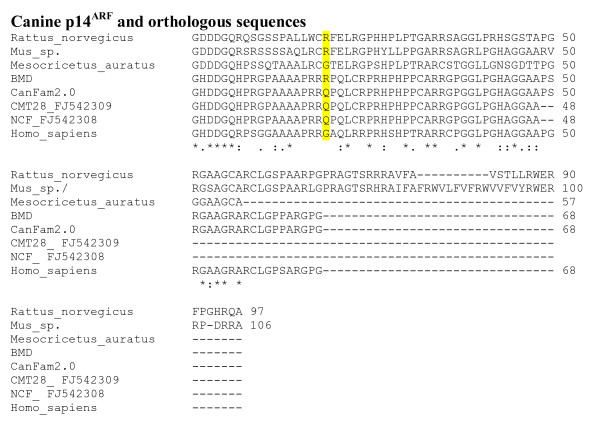
Polymorphism in exon 2 of canine CDKN2A in the p14ARF reading frame and alignment to orthologous sequences. The dog polymorphic residue is highlighted in yellow.
Figure 8
Figure 8
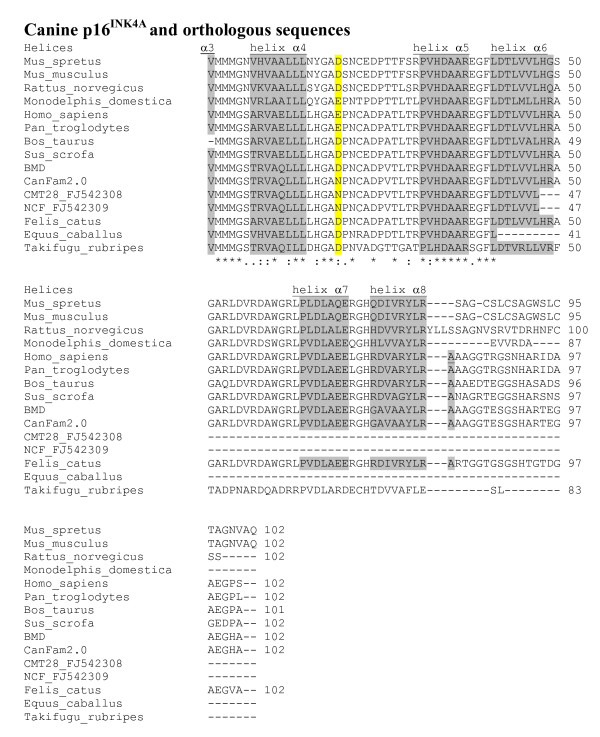
Polymorphism in exon 2 of canine CDKN2A in the p16INK4A reading frame and alignment to orthologous sequences. The canine polymorphic position is highlighted in yellow in the loop joining the second and third ankyrin repeats. The α helix residues of the ankyrin repeats have a grey background. CanFam2.0 -dog reference genome; BMD -Bernese Mountain dog with the alternative Asp residue; CMT28_FJ542308 -canine mammary tumour cell line; NCF_FJ542309 -cultured canine fibroblasts.

References

    1. Withrow SJ, Powers BE, Straw RC, Wilkins RM. Comparative aspects of osteosarcoma. Dog versus man. Clin Orthop Relat Res. 1991;270:159–168. - PubMed
    1. Vail DM, MacEwen EG. Spontaneously occurring tumors of companion animals as models for human cancer. Cancer Invest. 2000;18:781–792. doi: 10.3109/07357900009012210. - DOI - PubMed
    1. Hendrick MJ, Mahaffey EA, Moore FM, Vos JH, Walder EJ. Histological classification of mesenchymal tumors of skin and soft tissues of domestic animals. Washington, D.C: American Registry of Pathology; 1998.
    1. Sargan DR, Milne BS, Aguirre Hernandez J, O'Brien PC, Ferguson-Smith MA, Hoather T, Dobson JM. Chromosome rearrangements in canine fibrosarcomas. J Hered. 2005;96:766–773. doi: 10.1093/jhered/esi122. - DOI - PubMed
    1. Guyon R, Lorentzen TD, Hitte C, Kim L, Cadieu E, Parker HG, Quignon P, Lowe JK, Renier C, Gelfenbeyn B, Vignaux F, DeFrance HB, Gloux S, Mahairas GG, Andre C, Galibert F, Ostrander EA. A 1-Mb resolution radiation hybrid map of the canine genome. Proc Natl Acad Sci USA. 2003;100:5296–5301. doi: 10.1073/pnas.0831002100. - DOI - PMC - PubMed

Publication types

Substances

LinkOut - more resources