


Environmental contributors to the achievement gap
- PMID: 19643133
- PMCID: PMC2789840
- DOI: 10.1016/j.neuro.2009.07.012
Environmental contributors to the achievement gap
Abstract
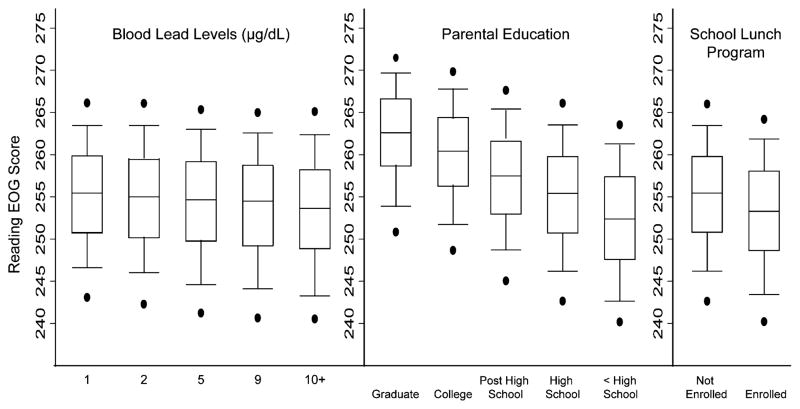
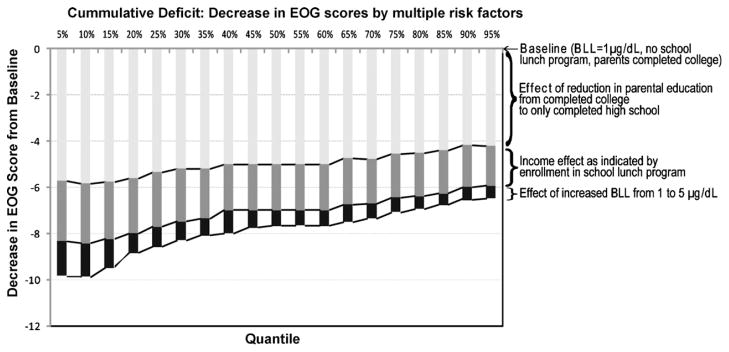
Extensive research shows that blacks, those of low socioeconomic status, and other disadvantaged groups continue to exhibit poorer school performance compared with middle and upper-class whites in the United States' educational system. Environmental exposures may contribute to the observed achievement gap. In particular, childhood lead exposure has been linked to a number of adverse cognitive outcomes. In previous work, we demonstrated a relationship between early childhood lead exposure and end-of-grade (EOG) test scores on a limited dataset. In this analysis, data from the North Carolina Childhood Lead Poisoning Prevention Program surveillance registry were linked to educational outcomes available through the North Carolina Education Research Data Center for all 100 counties in NC. Our objectives were to confirm the earlier study results in a larger population-level database, determine whether there are differences in the impact of lead across the EOG distribution, and elucidate the impact of cumulative childhood social and environmental stress on educational outcomes. Multivariate and quantile regression techniques were employed. We find that early childhood lead exposure is associated with lower performance on reading EOG test scores in a clear dose-response pattern, with the effects increasingly more pronounced in moving from the high end to the low end of the test score distribution. Parental educational attainment and family poverty status also affect EOG test scores, in a similar dose-response fashion, with the effects again most pronounced at the low end of the EOG test score distribution. The effects of environmental and social stressors (especially as they stretch out the lower tail of the EOG distribution) demonstrate the particular vulnerabilities of socioeconomically and environmentally disadvantaged children. Given the higher average lead exposure experienced by African American children in the United States, lead does in fact explain part of the achievement gap.
Conflict of interest statement
None to report
Figures
References
-
- Aaronson D. A note on the benefits of homeownership. Journal of Urban Economics. 2000;47(3):356–69.
-
- Alexander KL, Entwisle DR, Horsey CS. From first grade forward: early foundations of high school dropout. Sociology of Education. 1997;70:87–107.
-
- Baker TL, Velez W. Access to and opportunity in postsecondary education in the United States: a review. Sociology of Education. 1996;69:82–101.
-
- Bellinger D, Rappaport L. Developmental assessment and interventions. In: Harvey B, editor. Managing elevated blood lead levels among young children: recommendations from the advisory committee on childhood lead poisoning prevention. Atlanta: CDC; 2002. pp. 77–95.
-
- Bellinger DC, Stiles KM, Needleman HL. Low-level lead exposure, intelligence and academic achievement: a long-term follow-up study. Pediatrics. 1992;90(6):855–61. - PubMed
Publication types
MeSH terms
Substances
Grants and funding
LinkOut - more resources
Full Text Sources
Medical
Miscellaneous
