


Review
doi: 10.1189/jlb.0509368.
Epub 2009 Jul 30.
Innate immune control and regulation of influenza virus infections
Affiliations
- PMID: 19643736
- PMCID: PMC2752015
- DOI: 10.1189/jlb.0509368
Item in Clipboard
Review
Innate immune control and regulation of influenza virus infections
J Leukoc Biol.
2009 Oct.
Abstract
Adaptive immune responses are critical for the control and clearance of influenza A virus (IAV) infection. However, in recent years, it has become increasingly apparent that innate immune cells, including natural killer cells, alveolar macrophages (aMphi), and dendritic cells (DC) are essential following IAV infection in the direct control of viral replication or in the induction and regulation of virus-specific adaptive immune responses. This review will discuss the role of these innate immune cells following IAV infection, with a particular focus on DC and their ability to induce and regulate the adaptive IAV-specific immune response.
Figures
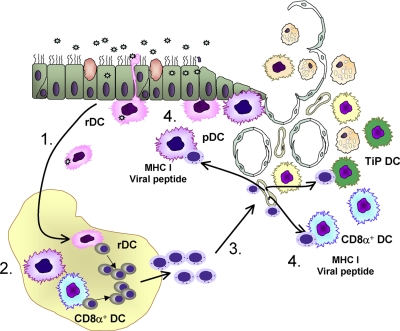
The role of DC in the initiation and regulation of adaptive CD8 T-cell responses following IAV infection. 1. rDC lining the airways and alveolar spaces of the lungs acquire influenza antigen through direct infection or uptake of apoptotic bodies from infected epithelial cells. This causes rDC to mature and migrate to the lung draining LN. 2. Once in the LN, rDC pass on antigen to LN-resident CD8a+ DC. LN-resident CD8a+ DC and rDC interact with naïve antigen-specific CD8 T cells in the LN and initiate a program of activation, proliferation, and differentiation into cytotoxic effector cells. 3. Activated effector CD8 T cells migrate from the LN to the lungs. 4. CD8 T cells undergo a second direct interaction with MHC I expressing, viral antigen-presenting pulmonary pDC, CD8a+ DC or TiP DC in order to accumulate to sufficient numbers to mediate viral clearance and protection.
References
-
- Barker W H, Mullooly J P. Impact of epidemic type A influenza in a defined adult population. Am J Epidemiol. 1980;112:798–811. - PubMed
-
- Barker W H, Mullooly J P. Pneumonia and influenza deaths during epidemics: implications for prevention. Arch Intern Med. 1982;142:85–89. - PubMed
-
- Thompson W W, Comanor L, Shay D K. Epidemiology of seasonal influenza: use of surveillance data and statistical models to estimate the burden of disease. J Infect Dis. 2006;194:S82–S91. - PubMed
Publication types
MeSH terms
Grants and funding
LinkOut - more resources
Full Text Sources
Other Literature Sources
Medical
