Editorial
doi: 10.3324/haematol.2009.008912.
Current treatment of AL amyloidosis
- PMID: 19644136
- PMCID: PMC2719026
- DOI: 10.3324/haematol.2009.008912
Item in Clipboard
Editorial
Current treatment of AL amyloidosis
Haematologica.
2009 Aug.
Abstract
Several effective chemotherapy regimens have been developed during the last decade significantly improving the outlook of patients with AL amyloidosis. Drs. Palladini and Merlini describe our current knowledge in the field and examine future perspectives. See related article on page 1094.
Figures
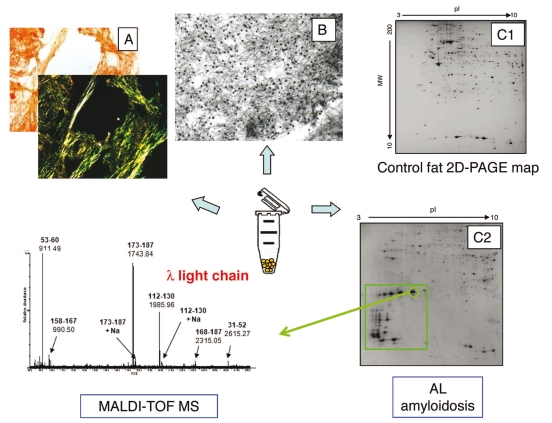
Typing amyloid deposits in subcutaneous adipose tissue. The 10–30 mg fine needle fat aspirate can be used for: (A) Congo red staining and analysis under polarized light showing the diagnostic green birefringence (upper left panel, Nikon Eclipse E600, magnification x 200); (B) for typing the amyloid deposits using electron-microscopy immunohistochemistry, in this case the amyloid fibrils are decorated by a gold- labeled antibody recognizing an anti-κ antibody (central upper panel, TEM Philips CM12, magnification x 22000, gold particles are 15 nm in diameter); and for proteomic analysis by bidimensional- PAGE and mass spectrometry. Comparison with control adipose tissue (C1) allowed location of prominent novel spots (squared in green) in patient (C2). Spots corresponding to fragments or post-translational modifications of the amyloidogenic protein were also observed. Identification of the novel spots, and thus amyloid typing, was obtained by MALDI-TOF mass spectrometry and peptide mass fingerprinting.
Comment on
-
Histological regression of amyloid in AL amyloidosis is exclusively seen after normalization of serum free light chain.Haematologica. 2009 Aug;94(8):1094-100. doi: 10.3324/haematol.2008.004119. Haematologica. 2009. PMID: 19644141 Free PMC article.
References
-
- Merlini G, Bellotti V. Molecular mechanisms of amyloidosis. N Engl J Med. 2003;349:583–96. - PubMed
-
- Anesi E, Palladini G, Perfetti V, Arbustini E, Obici L, Merlini G. Therapeutic advances demand accurate typing of amyloid deposits. Am J Med. 2001;111:243–4. - PubMed
-
- Bellotti V, Chiti F. Amyloidogenesis in its biological environment: challenging a fundamental issue in protein mis-folding diseases. Curr Opin Struct Biol. 2008;18:771–9. - PubMed
-
- Merlini G, Stone MJ. Dangerous small B-cell clones. Blood. 2006;108:2520–30. - PubMed
Publication types
MeSH terms
Substances
LinkOut - more resources
Full Text Sources
Medical