


Signal processing and distribution in cortical-brainstem pathways for smooth pursuit eye movements
- PMID: 19645893
- PMCID: PMC3057571
- DOI: 10.1111/j.1749-6632.2009.03859.x
Signal processing and distribution in cortical-brainstem pathways for smooth pursuit eye movements
Abstract
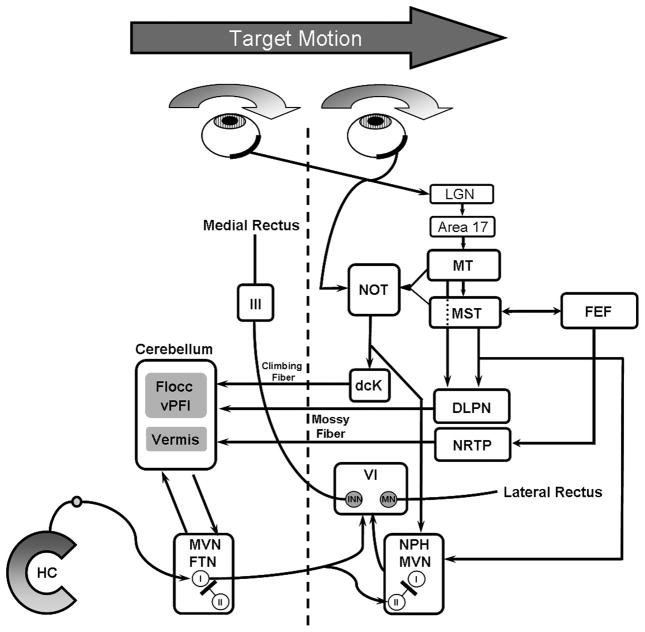
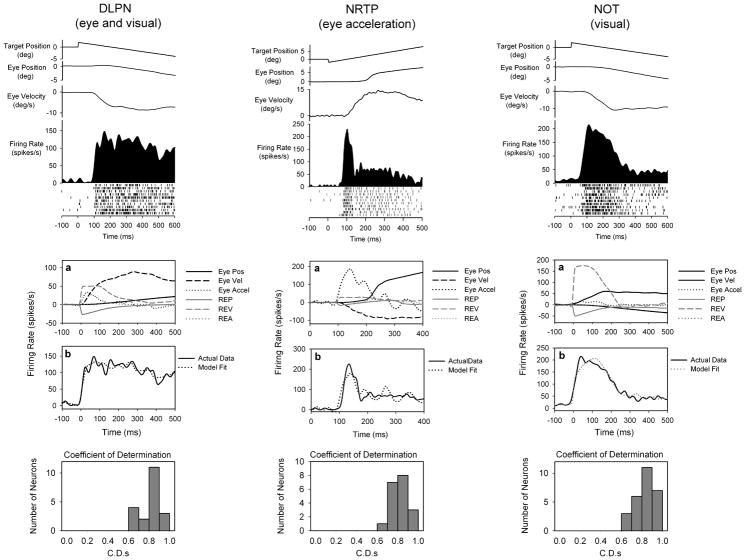
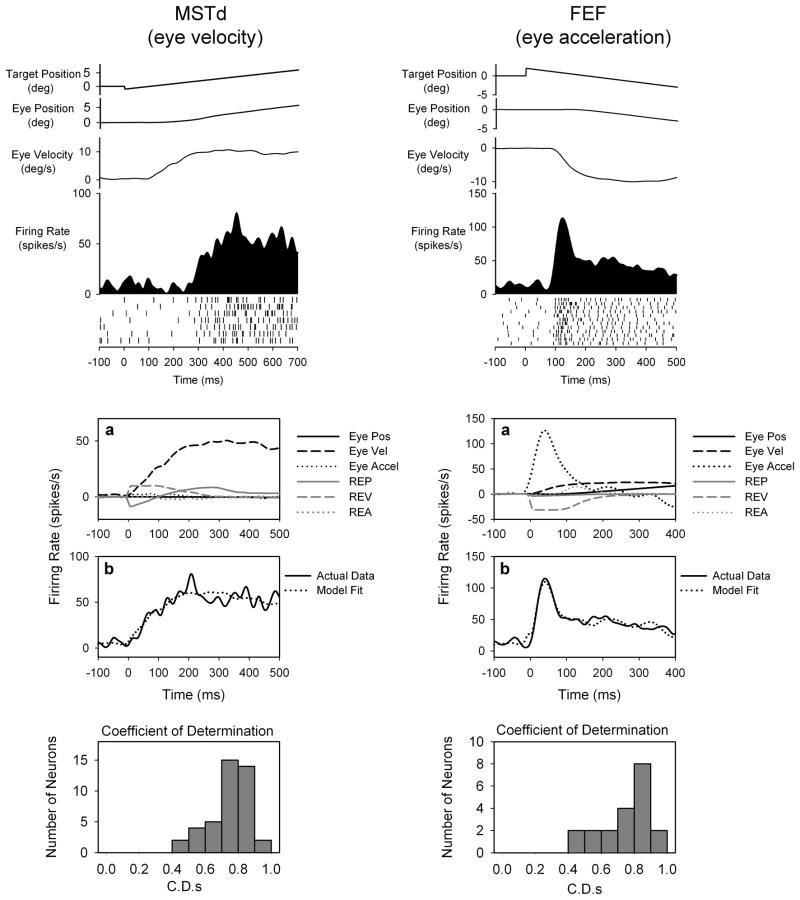
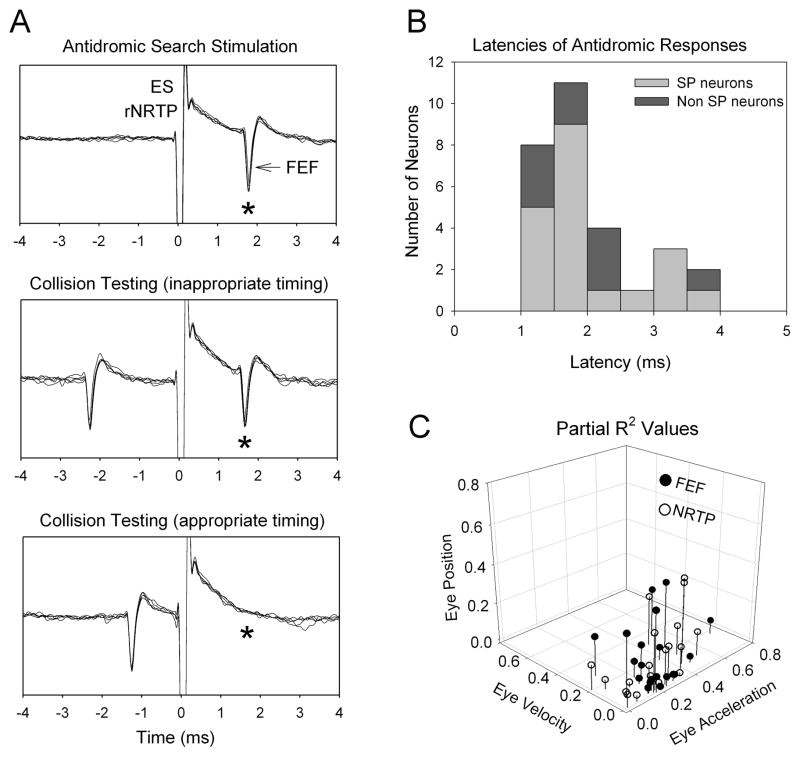
Smooth pursuit (SP) eye movements are used to maintain the image of a moving object relatively stable on the fovea. Even when tracking a single target over a dark background, multiple areas including frontal eye fields (FEF) and middle temporal (MT) and medial superior temporal (MST) cortex contribute to converting visual signals into initial commands for SP. Signals in the cortical pursuit system reach the oculomotor cerebellum through brainstem centers including the dorsolateral pontine nucleus (DLPN), nucleus reticularis tegmenti pontis (NRTP), and pretectal nucleus of the optic tract (NOT). The relative information carried in these parallel pathways remains to be fully defined. We used multiple linear-regression modeling to estimate the relative sensitivities of cortical (MST, FEF), pontine (NRTP, DLPN), and NOT neurons to eye- and retinal-error parameters (position, velocity, and acceleration) during step-ramp SP of macaques (Macaca mulatta). We found that a large proportion of pursuit-related MST and DLPN neurons were most sensitive to eye-velocity or retinal error velocity. In contrast, a large proportion of FEF and rostral NRTP neurons were most sensitive to eye acceleration. Visual neurons in MST, DLPN, and NOT were most sensitive to retinal image velocity.
Figures
References
-
- Leigh RJ, Zee DS. The neurology of eye movements. 4. New York: Oxford Univ. Press; 2006.
-
- Krauzlis RJ. Recasting the smooth pursuit eye movement system. J Neurophysiol. 2004;91:591–603. - PubMed
-
- Voogd J, Barmack NH. Oculomotor Cerebellum. Prog Brain Res. 2006;151:231–268. - PubMed
-
- Dursteler MR, Wurtz RH, Newsome WT. Directional pursuit deficits following lesions of the foveal representation within the superior temporal sulcus of the macaque monkey. J Neurophysiol. 1987;57:1262–1287. - PubMed
Publication types
MeSH terms
Grants and funding
LinkOut - more resources
Full Text Sources
