. 2009 Nov;168(2):313-22.
doi: 10.1016/j.jsb.2009.07.022. Epub 2009 Jul 29.

The dimer formed by the periplasmic domain of EpsL from the Type 2 Secretion System of Vibrio parahaemolyticus

Affiliations

The dimer formed by the periplasmic domain of EpsL from the Type 2 Secretion System of Vibrio parahaemolyticus

Jan Abendroth et al. J Struct Biol. 2009 Nov.

Abstract

The Type 2 Secretion System (T2SS), occurring in many Gram-negative bacteria, is responsible for the transport of a diversity of proteins from the periplasm across the outer membrane into the extracellular space. In Vibrio cholerae, the T2SS secretes several unrelated proteins including the major virulence factor cholera toxin. The T2SS consists of three sub-assemblies, one of which is the Inner Membrane Complex which contains multiple copies of five proteins, including the bitopic membrane protein EpsL. Here, we report the 2.3A resolution crystal structure of the periplasmic domain of EpsL (peri-EpsL) from Vibrio parahaemolyticus, which is 56% identical in sequence to its homolog in V. cholerae. The domain adopts a circular permutation of the "common" ferredoxin fold with two contiguous sub-domains. Remarkably, this infrequently occurring permutation was for the first time observed in the periplasmic domain of EpsM (peri-EpsM), another T2SS protein which interacts with EpsL. These two domains are 18% identical in sequence which may indicate a common evolutionary origin. Both peri-EpsL and peri-EpsM form dimers, but the organization of the subunits in these dimers appears to be entirely different. We have previously shown that the cytoplasmic domain of EpsL is also dimeric and forms a heterotetramer with the first domain of the "secretion ATPase" EpsE. The latter enzyme is most likely hexameric. The possible consequences of the combination of the different symmetries of EpsE and EpsL for the architecture of the T2SS are discussed.


Figures
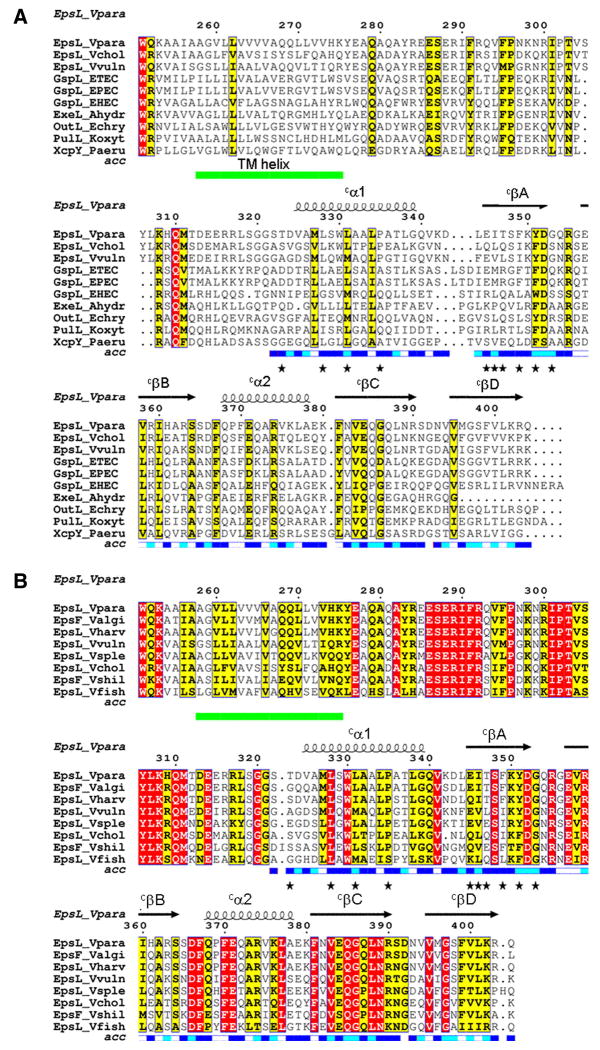
Figure 1
Figure 1. Family Sequence alignments of peri-GspL domains
A. Representative examples from a broad family of GspL sequences, starting from about ten residues prior to the predicted TM helix (green bar). Shown are the Vibrio parahaemolyticus, Vibrio cholerae, Vibrio vulnificus, ETEC, EPEC, EHEC, Aeromonas hydrophila, Klebsiella oxytoca, Erwinia chrysanthemi and Pseudomonas aeruginosa GspL homologs. Note that the nomenclature for P. aeruginosa GspL homolog is XcpY (Filloux, 2004; Johnson et al., 2006). Horizontal arrows indicate β-strands and spirals α-helices in the peri-EpsL domain running from residue 319 to 403 in V. parahaemolyticus EpsL. The bar underneath the alignment indicates the degree by which residues are buried in the monomer. White is not solvent accessible; light blue intermediately accessible; dark-blue accessible. Black asterisks underneath the alignment indicate key residues in the peri-EpsL dimer interface. Residues in white on red background are identical in all sequences shown; residues in back on a yellow background are homologous throughout the family of sequences depicted. B. Representative examples of peri-EpsL sequences from a diversity of Vibrio species. The secondary structure elements, interface residues and conservation of amino acids are indicated in a similar manner as in Figure 1A.
Figure 2
Figure 2. Structure of V. parahaemolyticus peri-EpsL
A. Domain diagram of C and Vibrio cholerae EpsL. Crystal structures of the cytoplasmic domain have been determined previously for V. cholerae EpsL (Abendroth et al., 2004a; Abendroth et al., 2004b) with PDB codes 1w97 and 2bh1. The construct 319-404 of V. parahaemolyticus used in the current study which revealed the conformation of residues 322-404 of peri-EpsL are also indicated. In green the predicted transmembrane helix. B. Size exclusion chromatography of Vp peri-EpsL. Size exclusion chromatogram, using Superdex 75 HR10/30 of a solution of 3.8 mg/ml V. parahaemolyticus peri-EpsL in 20 mM Tris-HCl buffer, pH 8.0, 150 mM NaCl. The peak eluted at 12.74 mL (blue line). In black letter horizontally the elution volume in mL; in red lines and letters fraction numbers. Vertically the absorption at 280 nm in milli absorption units (mAU). Using a calibration curve based on five standard proteins, the estimated molecular weight of Vp peri-EpsL is 17.1 kDa. C. Dynamic light scattering by Vp peri-EpsL. Dynamic light scattering profile of a solution of 3.8 mg/ml V. parahaemolyticus EpsL in 20 mM Tris-HCl buffer, pH 8.0, 150 mM NaCl, 150 mM imidazole, using a DynaPro instrument from Protein Solutions. Vertically the scattering intensity; horizontally the dynamic radius Rh in nm. The polydispersity of the solution is 12.5 %. The estimated molecular weight of Vp peri-EpsL is 18.9 kDa based on the dynamic radius, and 21.4 kDa by the volume shape hydration method, using software provided by the instrument manufacturer. D. The Vp peri-EpsL dimer in the crystal. The direction of view is approximately parallel to the crystallographic twofold (indicated by a yellow elongated ellipse) generating the dimer (see also text) with the α-helices in front and the β-sheet in the back. The subunits A′ and A are positioned left and right, respectively. β-strands are shown in red, α-helices in blue. The order of secondary structure elements in each subunit is αββ–αββ. The electron density for the loop between helix Cα2 and strand CβD was too weak and hence was not built. The anti-parallel four-stranded β-sheet per subunit is extended to form an eight-stranded anti-parallel β-sheet in the dimer. E. Surface features of the dimer. Right, same direction of view as in C above along the (yellow) twofold axis, revealing a hydrophobic patch near the twofold axis at the dimer interface formed by residues from helices Cα1 and Cα1′. Left, view rotated 180 degrees compared to right, with a positively charged region close to the twofold axis near the dimer interface.
Figure 2
Figure 2. Structure of V. parahaemolyticus peri-EpsL
A. Domain diagram of C and Vibrio cholerae EpsL. Crystal structures of the cytoplasmic domain have been determined previously for V. cholerae EpsL (Abendroth et al., 2004a; Abendroth et al., 2004b) with PDB codes 1w97 and 2bh1. The construct 319-404 of V. parahaemolyticus used in the current study which revealed the conformation of residues 322-404 of peri-EpsL are also indicated. In green the predicted transmembrane helix. B. Size exclusion chromatography of Vp peri-EpsL. Size exclusion chromatogram, using Superdex 75 HR10/30 of a solution of 3.8 mg/ml V. parahaemolyticus peri-EpsL in 20 mM Tris-HCl buffer, pH 8.0, 150 mM NaCl. The peak eluted at 12.74 mL (blue line). In black letter horizontally the elution volume in mL; in red lines and letters fraction numbers. Vertically the absorption at 280 nm in milli absorption units (mAU). Using a calibration curve based on five standard proteins, the estimated molecular weight of Vp peri-EpsL is 17.1 kDa. C. Dynamic light scattering by Vp peri-EpsL. Dynamic light scattering profile of a solution of 3.8 mg/ml V. parahaemolyticus EpsL in 20 mM Tris-HCl buffer, pH 8.0, 150 mM NaCl, 150 mM imidazole, using a DynaPro instrument from Protein Solutions. Vertically the scattering intensity; horizontally the dynamic radius Rh in nm. The polydispersity of the solution is 12.5 %. The estimated molecular weight of Vp peri-EpsL is 18.9 kDa based on the dynamic radius, and 21.4 kDa by the volume shape hydration method, using software provided by the instrument manufacturer. D. The Vp peri-EpsL dimer in the crystal. The direction of view is approximately parallel to the crystallographic twofold (indicated by a yellow elongated ellipse) generating the dimer (see also text) with the α-helices in front and the β-sheet in the back. The subunits A′ and A are positioned left and right, respectively. β-strands are shown in red, α-helices in blue. The order of secondary structure elements in each subunit is αββ–αββ. The electron density for the loop between helix Cα2 and strand CβD was too weak and hence was not built. The anti-parallel four-stranded β-sheet per subunit is extended to form an eight-stranded anti-parallel β-sheet in the dimer. E. Surface features of the dimer. Right, same direction of view as in C above along the (yellow) twofold axis, revealing a hydrophobic patch near the twofold axis at the dimer interface formed by residues from helices Cα1 and Cα1′. Left, view rotated 180 degrees compared to right, with a positively charged region close to the twofold axis near the dimer interface.
Figure 3
Figure 3. Comparison of EpsL and EpsM dimers
The V. parahaemolyticus EpsL and V. cholerae EpsM (Abendroth et al., 2004b) dimers side by side. Subunits A in the two molecules are aligned such that similarity in topology is evident and at the same time the differences between the dimers are clear. The EpsL dimers interact via helices Cα1 and Cα1′, and via the anti-parallel strands Cβ1 and Cβ1′. EpsM dimers, in contrast, interact via contacts between helices α2 and α2′.
Figure 4
Figure 4. Schematic drawing of possible architectures of the GspE:GspL subcomplex in the Inner Membrane Platform of the T2SS
The view is from the cytoplasm outwards. The hexamer of GspE (purple) and the three dimers of cyto-GspL (shades of green per dimer) shown in the center are in the cytoplasm. Predicted TM-helices of GspL are shown as hatched rods, located in the inner membrane. On the outside are depicted three peri-GspL dimers in the periplasm (in darker shades of green), which, in three dimensions, could be much closer together than this schematic suggests. A tentative position of the peri-GspM dimer, with its twofold axis aligned with that of the peri-EpsL dimer, is depicted in light and darker yellow. N1 = the N1 domain of GspE; N2-C1-C2 = the N2-C1-C2 domains of GspE; c-L = N-terminal cytoplasmic domain of GspL; p-L = C-terminal periplasmic domain of GspL; p-M = periplasmic domain of GspM. In the left lower part of the drawing, the buried solvent accessible surfaces in the N1-GspE:c-GspL, c-GspL:c-GspL, p-GspL:p-GspL and p-GspM:p-GspM interfaces are indicated. In the left upper part of the figure the approximate number of residues in different linkers is indicated. Comma's are added to the central ring of GspE N2-C1-C2 domains, and to the left upper N1-domains of GspE and both domains of the GspL and GspM dimers, to show the different symmetry relationships: approximate cyclic C6 symmetry for the GspE hexamer, dimeric symmetry for the cytoplasmic domains of GspL and the associated N1-GspE domains as well as for the periplasmic domains of GspL and GspM. This implies that the linkers between N1 and N2 domains of GspE have to adopt two quite different conformations in order to connect two adjacent N2-C1-C2 domains in the hexamer with the N1-domains in the N1-GspE:c-GspL heterotetramer. These linkers are shown in slightly different shades of color (Of course, in actual fact, the six N1-N2 linkers might have all six quite different conformations). The schematics are based, amongst others, on the crystal structure of the dimer of V. parahemolyticus peri-EpsL (Figures 2D) and on several previous crystal structures (Abendroth et al., 2004a; Abendroth et al., 2004b; Abendroth et al., 2005; Robien et al., 2003). See also Section 4.3 in the main text.

References

    1. Abendroth J, Bagdasarian M, Sandkvist M, Hol WGJ. The structure of the cytoplasmic domain of EpsL, an inner membrane component of the type II secretion system of Vibrio cholerae: An unusual member of the actin-like ATPase superfamily. Journal of Molecular Biology. 2004a;344:619–633. - PubMed
    1. Abendroth J, Rice AE, McLuskey K, Bagdasarian M, Hol WGJ. The crystal structure of the periplasmic domain of the type II secretion system protein EpsM from Vibrio cholerae: The simplest version of the ferredoxin fold. Journal of Molecular Biology. 2004b;338:585–596. - PubMed
    1. Abendroth J, Murphy P, Sandkvist M, Bagdasarian M, Hol WGJ. The X-ray structure of the type II secretion system complex formed by the N-terminal domain of EpsE and the cytoplasmic domain of EpsL of Vibrio cholerae. Journal of Molecular Biology. 2005;348:845–855. - PubMed
    1. Abendroth J, Mitchell DD, Korotkov KV, Johnson TL, Kreger A, Sandkvist M, Hol WG. The three-dimensional structure of the cytoplasmic domains of EpsF from the type 2 secretion system of Vibrio cholerae. J Struct Biol. 2009;166:303–315. - PMC - PubMed
    1. Abrahams JP, Buchanan SK, Van Raaij MJ, Fearnley IM, Leslie AG, Walker JE. The structure of bovine F1-ATPase complexed with the peptide antibiotic efrapeptin. Proceedings of the National Academy of Sciences of the United States of America. 1996;93:9420–9424. - PMC - PubMed

Publication types

MeSH terms

LinkOut - more resources
