


Innate-like recognition of microbes by invariant natural killer T cells
- PMID: 19646850
- PMCID: PMC2766928
- DOI: 10.1016/j.coi.2009.07.002
Innate-like recognition of microbes by invariant natural killer T cells
Abstract
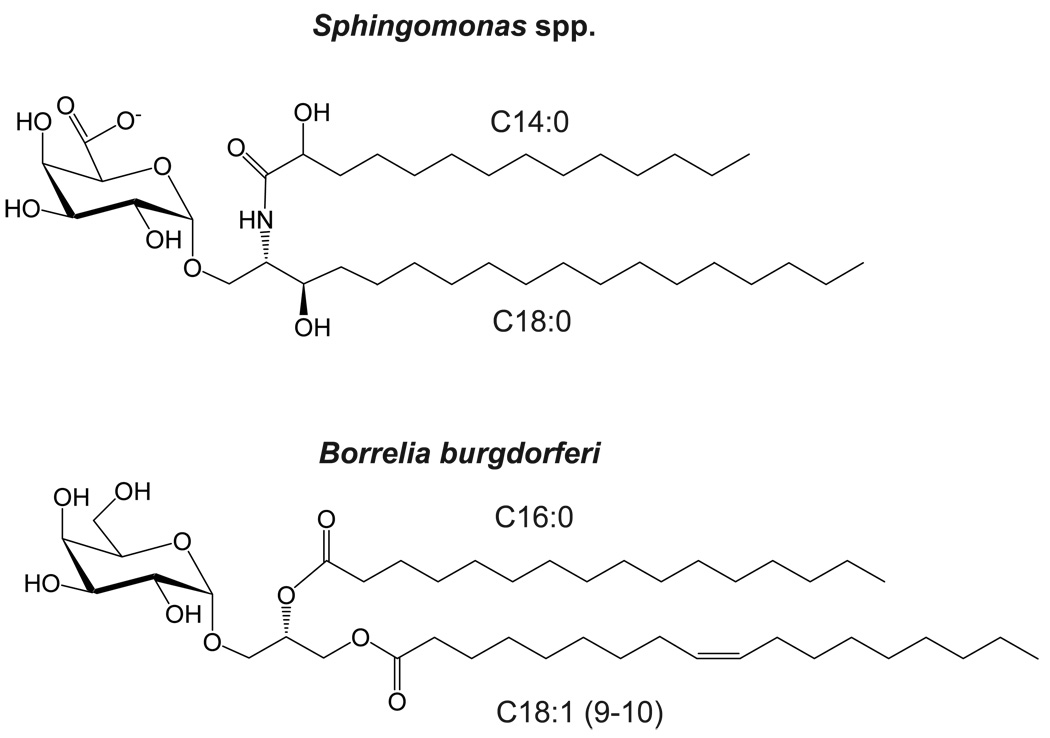
Invariant natural killer T cells (iNKT cells) express a restricted T cell antigen receptor (TCR) repertoire and they respond rapidly to glycolipid antigens presented by CD1d. These glycolipid antigens have hexose sugars in alpha-linkage to two types of lipids that can bind to CD1d. Recent work has shown that the responses of iNKT cells to antigen-bearing microbes can have a profound impact on the development of inflammatory diseases. iNKT cells overcome the limitation of their limited TCR diversity by also responding in a foreign antigen-independent fashion to some infectious agents, similar to NK cells. Recent results demonstrate several mechanisms for the indirect activation of iNKT cells by viruses or TLR ligands, dependent on self-antigen recognition and/or different cytokines produced by antigen presenting cells. The means by which iNKT cells influence other cell types and overall host defense are likewise diverse, illustrating the flexibility and functional diversity of this T lymphocyte sublineage.
References
-
- Brigl M, Brenner MB. CD1: Antigen Presentation and T Cell Function. Annu Rev Immunol. 2004;22:817–890. - PubMed
-
- Kronenberg M. Toward an understanding of NKT cell biology: progress and paradoxes. Annu Rev Immunol. 2005;23:877–900. - PubMed
-
- Bendelac A, Savage PB, Teyton L. The biology of NKT cells. Annu Rev Immunol. 2007;25:297–336. - PubMed
-
- Morita M, Motoki K, Akimoto K, Natori T, Sakai T, Sawa E, Yamaji K, Koezuka Y, Kobayashi E, Fukushima H. Structure-activity relationship of alpha-galactosylceramides against B16-bearing mice. J Med Chem. 1995;38:2176–2187. - PubMed
-
- Kawano T, Cui J, Koezuka Y, Toura I, Kaneko Y, Motoki K, Ueno H, Nakagawa R, Sato H, Kondo E, et al. CD1d-restricted and TCR-mediated activation of valpha14 NKT cells by glycosylceramides. Science. 1997;278:1626–1629. - PubMed
Publication types
MeSH terms
Substances
Grants and funding
LinkOut - more resources
Full Text Sources
