. 2009 Aug 25;19(16):1341-50.
doi: 10.1016/j.cub.2009.07.016. Epub 2009 Jul 30.

Short- and long-term memory in Drosophila require cAMP signaling in distinct neuron types

Affiliations

Short- and long-term memory in Drosophila require cAMP signaling in distinct neuron types

Allison L Blum et al. Curr Biol. .

Abstract

Background: A common feature of memory and its underlying synaptic plasticity is that each can be dissected into short-lived forms involving modification or trafficking of existing proteins and long-term forms that require new gene expression. An underlying assumption of this cellular view of memory consolidation is that these different mechanisms occur within a single neuron. At the neuroanatomical level, however, different temporal stages of memory can engage distinct neural circuits, a notion that has not been conceptually integrated with the cellular view.

Results: Here, we investigated this issue in the context of aversive Pavlovian olfactory memory in Drosophila. Previous studies have demonstrated a central role for cAMP signaling in the mushroom body (MB). The Ca(2+)-responsive adenylyl cyclase RUTABAGA is believed to be a coincidence detector in gamma neurons, one of the three principle classes of MB Kenyon cells. We were able to separately restore short-term or long-term memory to a rutabaga mutant with expression of rutabaga in different subsets of MB neurons.

Conclusions: Our findings suggest a model in which the learning experience initiates two parallel associations: a short-lived trace in MB gamma neurons, and a long-lived trace in alpha/beta neurons.


Figures
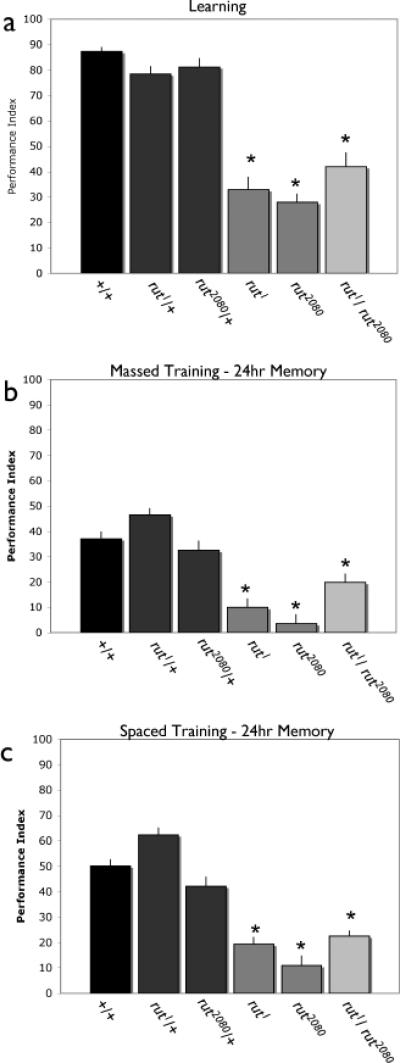
Figure 1
Figure 1. The rutabaga gene is required to support all memory phases
Female flies that were wild type (W1118 isoCJ1), heterozygous for rut1 or rut2080, homozygous rut1 or rut2080, or trans-heterozygous for both alleles were tested for immediate memory after a single training session a), or 24 hour memory after massed b) or spaced c) training. Both homozygous rut1 and rut2080 as well as the transheterozygous animals exhibited significantly lower performance indices from wild type controls. P<0.05, a)N=6 for all groups, b) N=12 for all groups, c) N=13 for all groups.
Figure 2
Figure 2
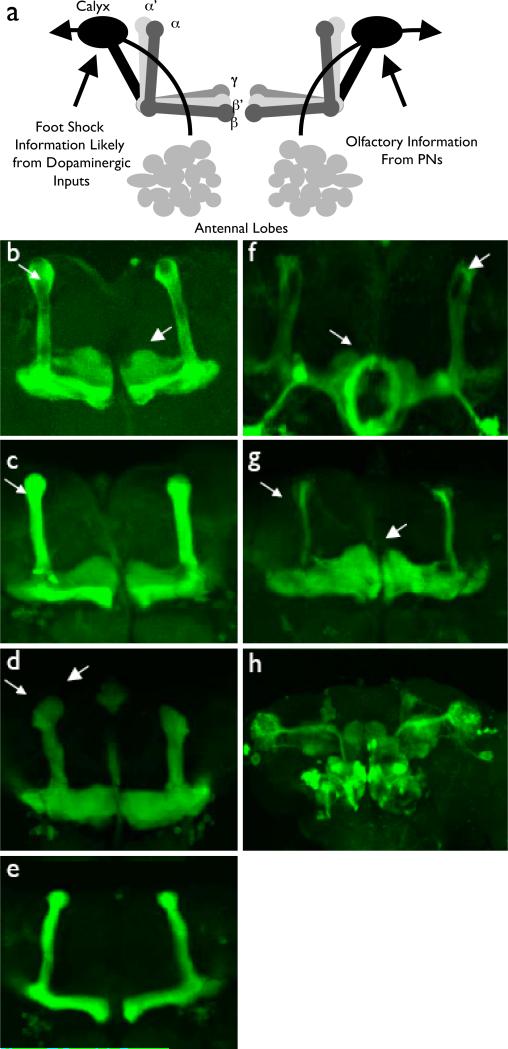
Gal4 Driven MB Driver GFP Expression. For each Gal4 Driver, unless otherwise noted, a projection of the MB lobe region of male flies heterozygous for Gal4 and UAS-mcd8:GFP is shown. a) Schematic of olfactory system in Drosophila. Olfactory information from Antennal Lobes is conveyed to the MB calyx via projection neurons (PNs). Foot-shock (Unconditioned Stimulus, US) is thought to be conveyed by dopaminergic inputs to MBs (not shown). MB Kenyon cells are made up of three principle neuron types: α’/β’ and α/β neurons have both a vertical and horizontal branch whereas γ lobes neurons consist of a single, horizontal projection. b) 247 driven GFP expression. Expression is restricted to alpha/beta (small arrowhead) and gamma neurons (large arrowhead). c) C309 driven GFP expression. Again, expression is restricted to alpha/beta (small arrowhead) and gamma neurons (large arrowhead). d) OK107 driven GFP expression. OK107 expression pattern labels alpha’/beta’ (small arrowhead), alpha/beta (large arrowhead), and gamma neurons. e) C739 driven GFP expression. Expression is restricted to alpha/beta type neurons in the MB. f) C305a driven GFP expression. The C305a expression pattern labels approximately half of alpha’/beta’ (large arrowhead) MB neurons, ellipsoid body neurons (small arrowhead), as well as antennal lobes. g) 201Y driven GFP expression. The 201Y expression pattern labels gamma (large arrowhead) and a small number of core alpha/beta neurons (small arrowhead). h) GH146 driven GFP expression. A whole brain projection of male flies heterozygous for GH146 Gal4 and UAS-mcd8:GFP is shown. GH146 labels olfactory projection neurons (PNs).
Figure 3
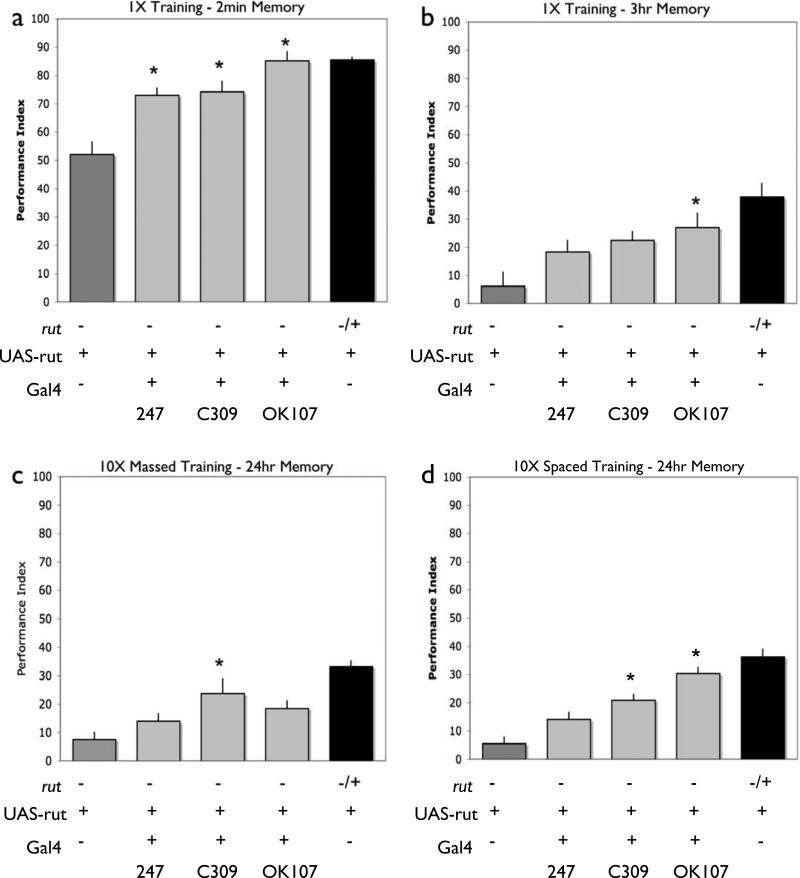
Figure 3. Broad MB expression of rutabaga can support all memory phases
Memory retention was tested 2 minutes (a) and 3 hours (b) after a single training session as well as 24 hours after either massed (c) or spaced (d) training. In each case, performance was compared among the following groups: rut2080 mutant males with a UAS-rut+ transgene but no Gal4 driver (rut2080/Y; UAS-rut), rut2080 heterozygous females with a UAS-rut+ transgene but no Gal4 driver (rut2080/+; UAS-rut), rut2080 mutant males with a UAS-rut+ transgene and one of three MB Gal4 lines (247, C309, or OK107) or, rut2080 heterozygous females with a UAS-rut+ transgene and one of the three Gal4 lines (Because rut is X linked, we used hemizygous males for these experiments. In this and all figures that follow, the males are shown in white bars and the heterozygous female siblings that do not contain a Gal4 are shown black, and the heterozygous females containing Gal4 lines are shown in an associated supplemental figure. The control females for this figure are shown in Fig. S1). In contrast with the rut2080/Y; UAS-rut mutant males, rut2080mutant males with both a UAS-rut+ transgene and each of the MB Gal4 drivers (247, C309, or OK107), exhibit significantly improved levels of performance measured 2-min after training [P<0.05, N=6 for all groups] (a), improved performance either three hours a single training session, with OK107 showing significant improvement [P<0.05, N=7 for all groups] (b) or 24 hours after either massed, with C309 showing significant improvement [P<0.05, N=15 for all groups] (c) or spaced training with both C309 and OK107 showing significant improvement [P<0.05, N=23 for all groups] (d). In all cases, no significant improvements were observed in control females that were rut2080/+; UAS-rut and contained a Gal4 line (Figure S1).
Figure 4
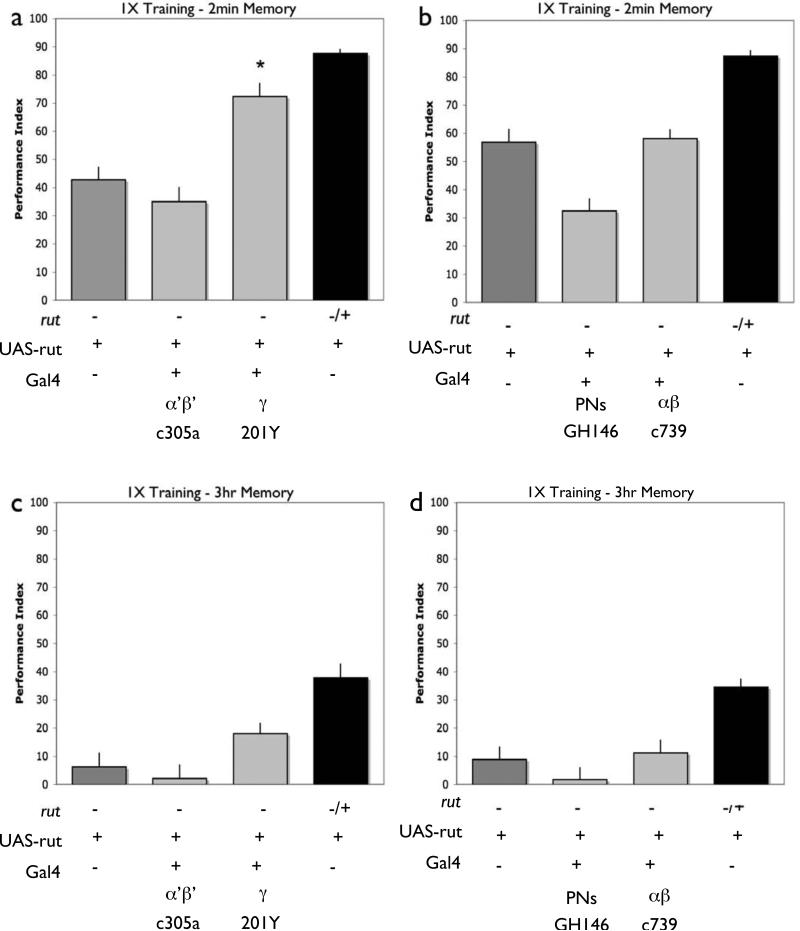
Figure 4. MB γ Lobe expression of rut supports early memory
Memory retention was tested 2 minutes (a,b) and 3 hours (c,d) after a single training session rut2080males with a UAS-rut+ transgene but no Gal4 driver (rut2080/Y; UAS-rut) exhibit reduced performance relative to heterozygous sisters (rut2080/+; UAS-rut). In contrast, rut2080mutant males with both a UAS-rut+ transgene and the 201Y gamma lobe Gal4 driver exhibit significantly improved levels of performance and significantly improved performance relative to mutant levels (a). However, rut2080mutant males with both a UAS-rut+ transgene and an alpha’/beta’ Gal4 driver (C305a) (a), alpha/beta Gal4 driver (C739) (b) or PN driver (GH146) (b), were not significantly improved from mutant controls. P<0.05, (a)N=8 for all groups, (b)N=12 for all groups. Flies of the same genotypes were also tested for three hour memory after a single training session. In this case, expression with the lobe specific Gal4 drivers 201Y, C305a, (c), C739 and GH146 (d) was not sufficient to significantly improve performance above mutant levels. P<0.05, (c)N=7 for all groups, (d)N=8 for all groups. In all cases, no significant improvements were observed in control females that were rut2080/+; UAS-rut and contained a Gal4 line (Figure S2).
Figure 5
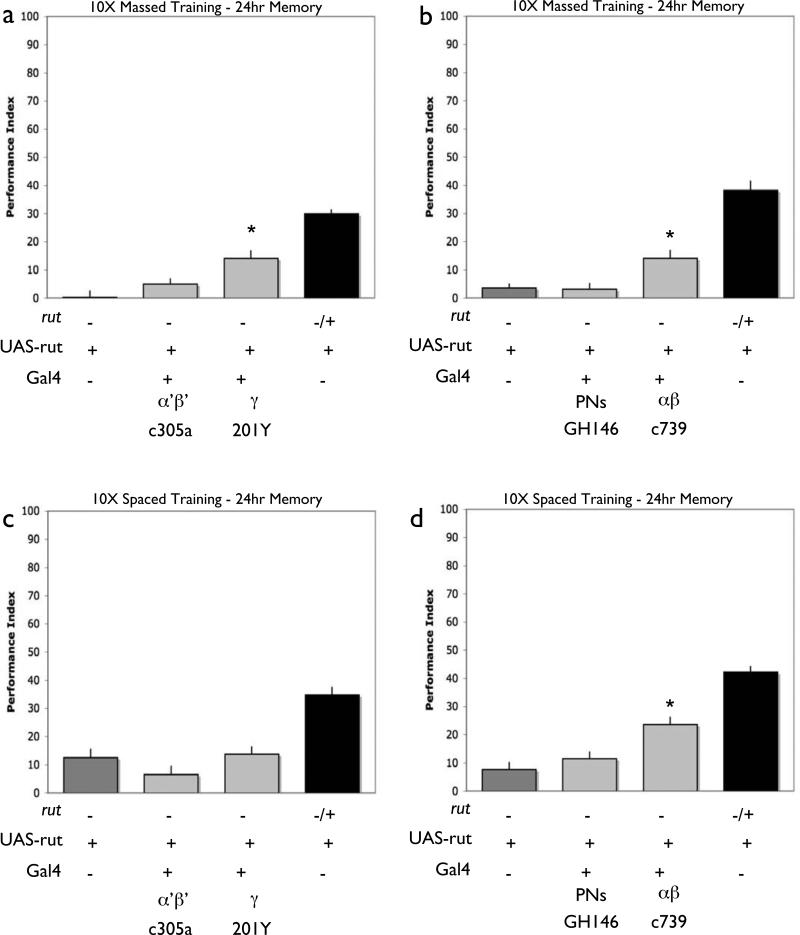
Figure 5. rutabaga expression in both γ and α/β neurons supports 24 hour memory
Memory retention was 24 hours after either massed (a,c) or spaced (b,d) training. rut2080males with a UAS-rut+ transgene but no Gal4 driver (rut2080/Y; UAS-rut) exhibit reduced performance relative to heterozygous sisters (rut2080/+; UAS-rut) 24 hours after massed training. rut2080mutant males heterozygous for both a UAS-rut+ transgene and the 201Y gamma lobe Gal4 driver (a) or the C739 alpha/beta driver (b) exhibit significantly improved levels of performance compared to mutant controls. Performance levels were not significantly improved with flies carrying the C305a (a), or GH146 (b) Gal4 drivers. P<0.05, a)N=16 for all groups, b) N=18 for all groups. Flies of the same genotypes were also tested 24 hours after spaced training. In this case, only flies with carrying the C739 alpha/beta driver showed performance significantly above mutant levels (d). Flies carrying the 201Y, C305a, or GH146 drivers were not improved compared to mutant levels (c, d). P<0.05, c)N=16 for all groups, d) N=18 for all groups. In all cases, no significant improvements were observed in control females that were rut2080/+; UAS-rut and contained a Gal4 line (Figure S3).
Figure 6
Figure 6. rutabaga expression in both γ and α/β lobes combined supports all memory phases
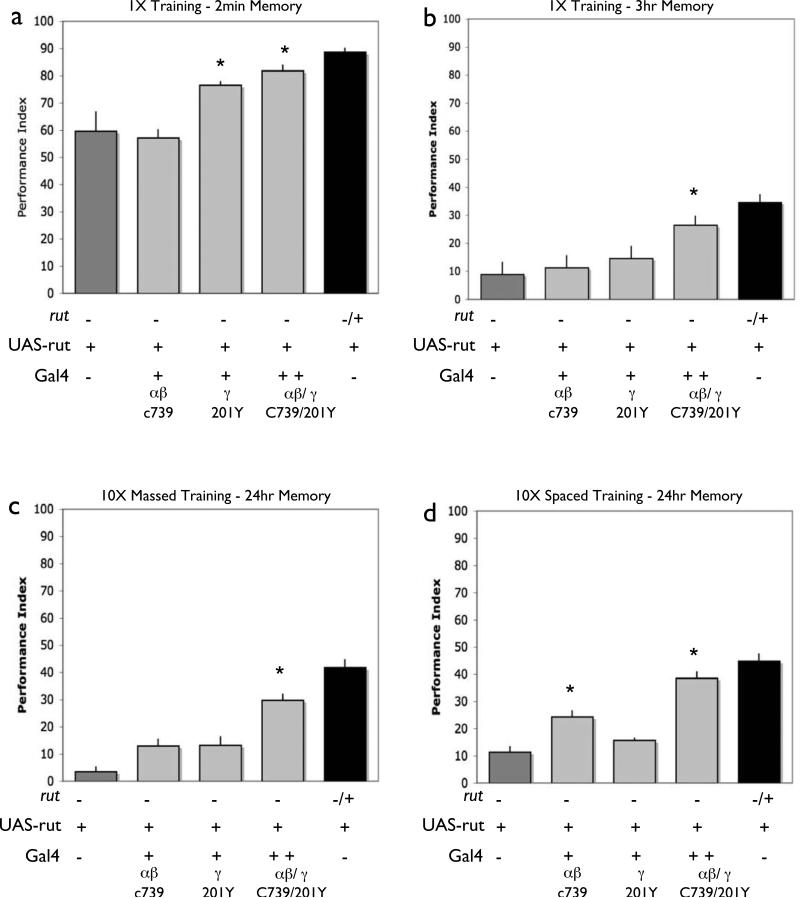
Memory retention was tested 2 minutes (a) and 3 hours (b) after a single training session as well as 24 hours after either massed (c) or spaced (d) training. In each case, performance was compared among the following groups: rut2080 mutant males with a UAS-rut+ transgene but no Gal4 driver (rut2080/Y; UAS-rut), rut2080 heterozygous females with a UAS-rut+ transgene but no Gal4 driver (rut2080/+; UAS-rut), rut2080 mutant males with a UAS-rut+ transgene and either the 201Y or C739 drivers alone, or the 201Y and C739 Gal4 drivers combined, and rut2080 heterozygous females with a UAS-rut+ transgene and these Gal4 lines (these control females are shown in Fig. S4). In contrast with the rut2080/Y; UAS-rut mutant males, rut2080mutant males with both a UAS-rut+ transgene and either the 201Y, or 201Y combined with C739 Gal4 drivers exhibit nearly normal levels of performance measured 2-min after training, while C739 expression caused no improvement [P<0.05, N=6 for all groups] (a), and only expression combined with both the 201Y and C739 drivers significantly improved performance three hours after a single training session [P<0.05, N=8 for all groups] (b) Only expression combined with both the 201Y and C739 drivers significantly improved performance 24 hours after massed training [P<0.05, N=18 for all groups] (c). For 24 hours after spaced training, expression with the C739 driver alone resulted in significant improvement of performance, however, this effect was augmented by combining both C739 and 201Y expression. [P<0.05, N=23 for all groups]. In all cases, no significant improvements were observed in control females that were rut2080/+; UAS-rut and contained a Gal4 line with the exception of flies carrying both the 201Y and C739 drivers combined after spaced training (Figure S4).
Figure 7
Figure 7. Gal4 expression pattern of double Gal4 lines
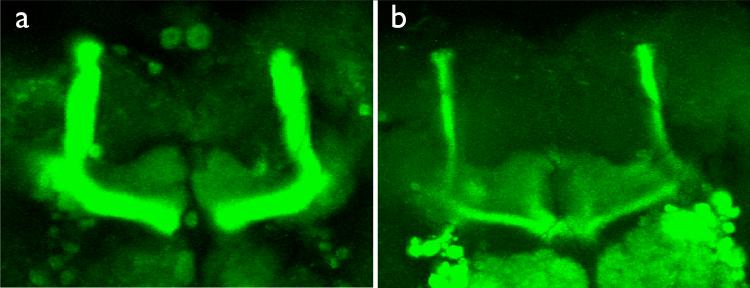
A projection of the MB lobe region of male flies heterozygous for each of two Gal4 drivers, and UAS-mcd8:GFP is shown. (a) combined 201Y and C739 driven GFP expression. 201Y expression in γ lobes, and C739 expression in α/β lobes are each visible. (b) combined 201Y and C305a driven GFP expression. 201Y expression in γ lobes, and C305a expression in α’/β’, as well in ellipsoid body and antennal lobe are visible.
Figure 8
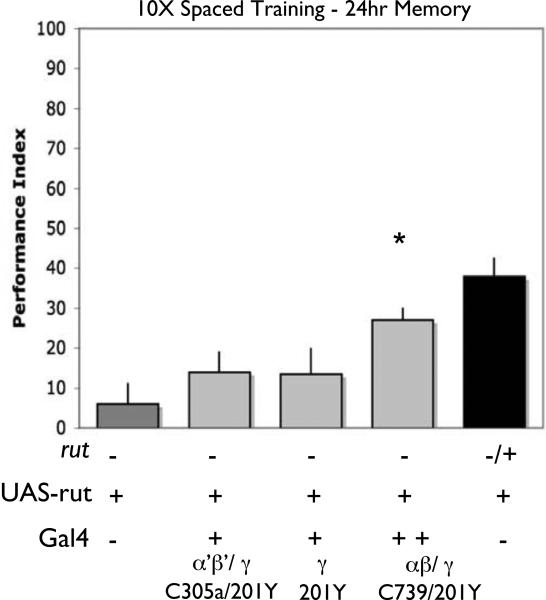
Figure 8. rutabaga expression in both γ and α’/β’ lobes combined does not restore memory 24 hours after spaced training
Memory retention was tested 24 hours after spaced training. In each case, performance was compared among the following groups: rut2080 mutant males with a UAS-rut+ transgene but no Gal4 driver (rut2080/Y; UAS-rut), rut2080 heterozygous females with a UAS-rut+ transgene but no Gal4 driver (rut2080/+; UAS-rut), rut2080 mutant males with a UAS-rut+ transgene and the 201Y driver alone, or the 201Y and c305a, or 201y and C739 Gal4 drivers combined. For 24 hours after spaced training, expression with the either the 201Y driver alone, or with both the c305a and 201y drivers combined did not significantly improve performance compared to rut2080 mutant males with a UAS-rut+ transgene but no Gal4 line. As first observed in Fig. 6, we see significant improvement when we combine C739 and 201Y. [P<0.05, N=8 for all groups]. In all cases, no significant differences were observed among control females that were rut2080/+; UAS-rut and contained a Gal4 line (Fig. S6).

Comment in

References

    1. Dubnau J, Tully T. Gene discovery in Drosophila: new insights for learning and memory. Annu Rev Neurosci. 1998. pp. 407–444. http://www.ncbi.nlm.nih.gov/entrez/query.fcgi?cmd=Retrieve&db=PubMed&dop.... - PubMed
    1. Hawkins RD, Kandel ER, Bailey CH. Molecular mechanisms of memory storage in Aplysia. Biol Bull. 2006. pp. 174–191. http://www.ncbi.nlm.nih.gov/entrez/query.fcgi?cmd=Retrieve&db=PubMed&dop.... - PubMed
    1. Stough S, Shobe JL, Carew TJ. Intermediate-term processes in memory formation. Curr Opin Neurobiol. 2006. pp. 672–678. http://www.ncbi.nlm.nih.gov/entrez/query.fcgi?cmd=Retrieve&db=PubMed&dop.... - PubMed
    1. Martin KC, Casadio A, Zhu H, Yaping E, Rose JC, Chen M, Bailey CH, Kandel ER. Synapse-specific, long-term facilitation of aplysia sensory to motor synapses: a function for local protein synthesis in memory storage. Cell. 1997. pp. 927–938. http://www.ncbi.nlm.nih.gov/entrez/query.fcgi?cmd=Retrieve&db=PubMed&dop.... - PubMed
    1. Lonze BE, Ginty DD. Function and regulation of CREB family transcription factors in the nervous system. Neuron. 2002. pp. 605–623. http://www.ncbi.nlm.nih.gov/entrez/query.fcgi?cmd=Retrieve&db=PubMed&dop.... - PubMed

Publication types

MeSH terms

LinkOut - more resources