


RNA-MATE: a recursive mapping strategy for high-throughput RNA-sequencing data
- PMID: 19648138
- PMCID: PMC2752615
- DOI: 10.1093/bioinformatics/btp459
RNA-MATE: a recursive mapping strategy for high-throughput RNA-sequencing data
Abstract
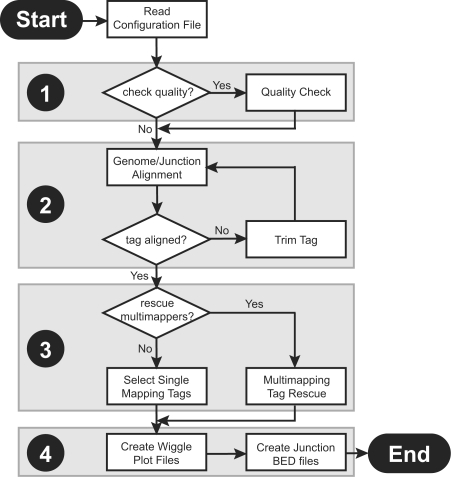
Mapping of next-generation sequencing data derived from RNA samples (RNAseq) presents different genome mapping challenges than data derived from DNA. For example, tags that cross exon-junction boundaries will often not map to a reference genome, and the strand specificity of the data needs to be retained. Here we present RNA-MATE, a computational pipeline based on a recursive mapping strategy for placing strand specific RNAseq data onto a reference genome. Maximizing the mappable tags can provide significant savings in the cost of sequencing experiments. This pipeline provides an automatic and integrated way to align color-space sequencing data, collate this information and generate files for examining gene-expression data in a genomic context.
Availability: Executables, source code, and exon-junction libraries are available from http://grimmond.imb.uq.edu.au/RNA-MATE/
Figures
References
-
- Carninci P, et al. Genome-wide analysis of mammalian promoter architecture and evolution. Nat. Genet. 2006;38:626–635. - PubMed
-
- Cloonan N, et al. Stem cell transcriptome profiling via massive-scale mRNA sequencing. Nat. Meth. 2008;5:613–619. - PubMed
-
- Faulkner GJ, et al. A rescue strategy for multimapping short sequence tags refines surveys of transcriptional activity by CAGE. Genomics. 2008;91:281–288. - PubMed
Publication types
MeSH terms
LinkOut - more resources
Full Text Sources
Other Literature Sources
