. 2009 Jul;21(7):1992-2007.
doi: 10.1105/tpc.109.065821. Epub 2009 Jul 31.

The Arabidopsis PLEIOTROPIC DRUG RESISTANCE8/ABCG36 ATP binding cassette transporter modulates sensitivity to the auxin precursor indole-3-butyric acid

Affiliations

The Arabidopsis PLEIOTROPIC DRUG RESISTANCE8/ABCG36 ATP binding cassette transporter modulates sensitivity to the auxin precursor indole-3-butyric acid

Lucia C Strader et al. Plant Cell. 2009 Jul.

Abstract

Plants have developed numerous mechanisms to store hormones in inactive but readily available states, enabling rapid responses to environmental changes. The phytohormone auxin has a number of storage precursors, including indole-3-butyric acid (IBA), which is apparently shortened to active indole-3-acetic acid (IAA) in peroxisomes by a process similar to fatty acid beta-oxidation. Whereas metabolism of auxin precursors is beginning to be understood, the biological significance of the various precursors is virtually unknown. We identified an Arabidopsis thaliana mutant that specifically restores IBA, but not IAA, responsiveness to auxin signaling mutants. This mutant is defective in PLEIOTROPIC DRUG RESISTANCE8 (PDR8)/PENETRATION3/ABCG36, a plasma membrane-localized ATP binding cassette transporter that has established roles in pathogen responses and cadmium transport. We found that pdr8 mutants display defects in efflux of the auxin precursor IBA and developmental defects in root hair and cotyledon expansion that reveal previously unknown roles for IBA-derived IAA in plant growth and development. Our results are consistent with the possibility that limiting accumulation of the IAA precursor IBA via PDR8-promoted efflux contributes to auxin homeostasis.


Figures
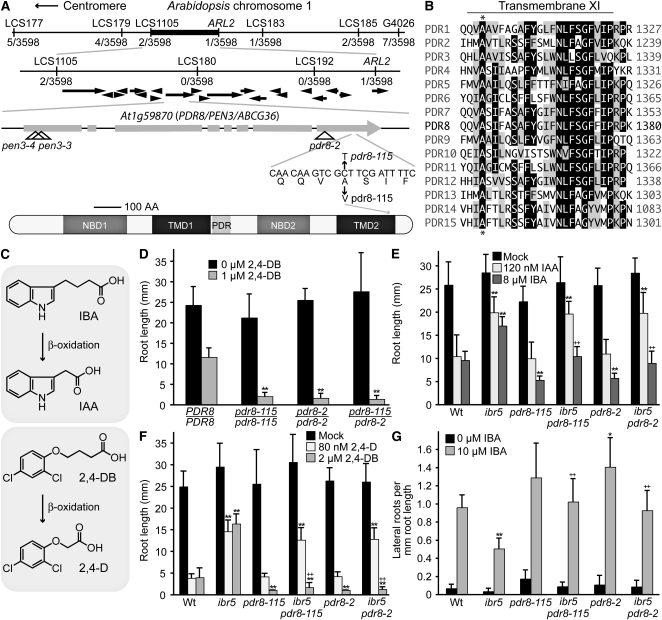
Figure 1.
Figure 1.
pdr8 Alleles Suppress a Subset of ibr5 Phenotypes. (A) Recombination mapping with the indicated PCR-based markers (see Supplemental Table 1 online) localized MS115 to a 72-kb region containing 21 predicted genes (black arrows) between LCS1105 and ARL2 with 2/3598 north and 1/3598 south recombinants. Examination of the PDR8 (At1g59870) gene in this region revealed a C-to-T mutation at position 4844 in MS115 DNA and results in an Ala-1357 to Val substitution. pdr8-2 (SALK_142256) carries a T-DNA insert in the eighth exon of PDR8 (Kobae et al., 2006); pen3-3 (SALK_110926) and pen3-4 (SALK_000578) carry T-DNA inserts in the first exon of PDR8 (Stein et al., 2006). The cartoon shows a PDR8 schematic based on output from the domain-predicting program SMART (Schultz et al., 1998). PDR8 contains two nucleotide binding domains (NBD), two transmembrane domains (TMD) containing six predicted transmembrane spans each, and a PDR signature motif. A thirteenth predicted transmembrane span after TMD2 is not shown. (B) The pdr8-115 mutation disrupts a conserved Ala in TMD2. The alignment shows the eleventh predicted transmembrane-spanning region of the 15 Arabidopsis PDR/ABCG family members (accession numbers listed in Supplemental Table 4 online). Sequences were aligned using the MegAlign program (DNAStar). Amino acid residues identical in at least eight sequences are boxed in black; chemically similar residues in at least eight sequences are shaded in gray. The position of the pdr8-115 mutation is indicated with an asterisk. (C) IBA is a naturally occurring IAA precursor; 2,4-DB is a precursor of the synthetic auxin 2,4-D. Both IBA and 2,4-DB are converted to the active auxins IAA and 2,4-D in a process similar to fatty acid β-oxidation. (D) pdr8-115 is allelic to pdr8-2. Complementation test showing primary root lengths of 8-d-old Col-0 wild-type (PRD8/PDR8), pdr8-115/pdr8-115, pdr8-2/pdr8-2, and pdr8-115/pdr8-2 seedlings grown under yellow-filtered light at 22°C on medium supplemented with ethanol (mock) or 1 μM 2,4-DB (n ≥ 10). (E) Primary root lengths of 8-d-old Col-0 (Wt), ibr5-1, pdr8-115, ibr5-1 pdr8-115 (MS115), pdr8-2, and ibr5-1 pdr8-2 seedlings grown under yellow-filtered light at 22°C on medium supplemented with 120 nM IAA or 8 μM IBA (n ≥ 12). (F) Primary root lengths of 8-day-old Col-0 (Wt), ibr5-1, pdr8-115, ibr5-1 pdr8-115 (MS115), pdr8-2, and ibr5 pdr8-2 seedlings grown under yellow-filtered light at 22°C on medium supplemented with 80 nM 2,4-D or 2 μM 2,4-DB (n ≥ 15). (G) Lateral roots were counted 4 d after transfer of 4-d-old seedlings to medium supplemented with either 0 (ethanol control) or 10 μM IBA (n = 12). Error bars represent sd of the means. Statistically significant differences from the wild type in two-tailed t tests assuming unequal variance are indicated by single (P ≤ 0.001) and double (P ≤ 0.0001) asterisks. Statistically significant differences from ibr5-1 in two-tailed t tests assuming unequal variance are indicated by single (P ≤ 0.001) and double (P ≤ 0.0001) plus symbols.
Figure 2.
Figure 2.
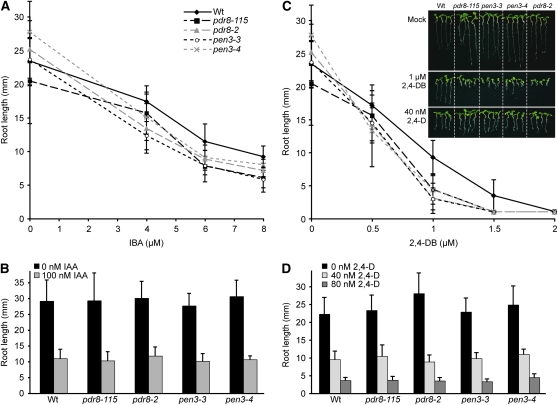
pdr8 Alleles Display Hypersensitivity to IBA and 2,4-DB. (A) Primary root lengths of 8-d-old Col-0 (Wt), pdr8-115, pdr8-2, and pen3-4 seedlings grown under yellow-filtered light at 22°C on medium supplemented with ethanol (0 μM IBA) or various concentrations of IBA (n ≥ 15). (B) Primary root lengths of 8-d-old Col-0 (Wt), pdr8-115, pdr8-2, and pen3-4 seedlings grown under yellow-filtered light at 22°C on medium supplemented with ethanol (0 nM IAA) or various concentrations of IAA (n ≥ 12). (C) Primary root lengths of 8-d-old Col-0 (Wt), pdr8-115, pdr8-2, and pen3-4 seedlings grown under yellow-filtered light at 22°C on medium supplemented with ethanol (0 μM 2,4-DB) or various concentrations of 2,4-DB (n ≥ 15). Inset: Photograph of 8-d-old Col-0 (Wt), pdr8-115, pdr8-2, and pen3-4 seedlings grown under yellow light at 22°C on medium supplemented with ethanol (mock), 1 μM 2,4-DB, or 40 nM 2,4-D. (D) Primary root lengths of 8-d-old Col-0 (Wt), pdr8-115, pdr8-2, and pen3-4 seedlings grown under yellow-filtered light at 22°C on medium supplemented with ethanol (0 μM 2,4-D) or various concentrations of 2,4-D (n ≥ 15). Error bars represent sd of the means. pdr8-2 and pen3-3 roots were significantly shorter than wild-type roots on 4 μM IBA (P ≤ 0.001), and pdr8-115, pdr8-2, pen3-3, and pen3-4 roots were significantly shorter than wild-type roots on 6 and 8 μM IBA (P ≤ 0.001) in two-tailed t tests assuming unequal variance. pdr8-115, pdr8-2, pen3-3, and pen3-4 roots were significantly shorter than wild-type roots on 1 and 1.5 μM 2,4-DB (P ≤ 0.001) in two-tailed t tests assuming unequal variance. [See online article for color version of this figure.]
Figure 3.
Figure 3.
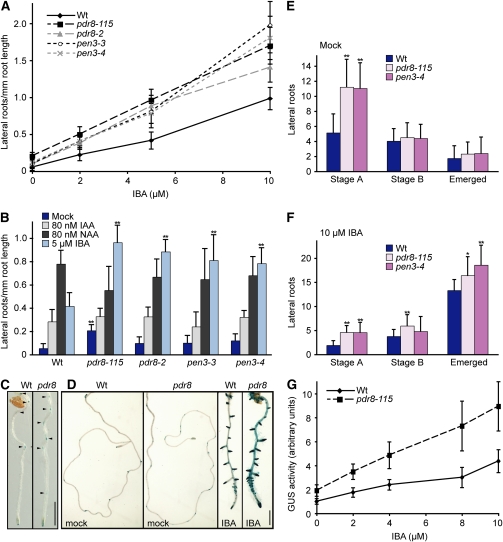
pdr8 Mutants Exhibit Increased Lateral Root Production. (A) Lateral roots of Col-0 (Wt), pdr8-115, pdr8-2, and pen3-4 were counted 4 d after transfer of 4-d-old seedlings to medium supplemented with either 0 μM (ethanol control) or various concentrations of IBA (n = 12). (B) Lateral roots of Col-0 (Wt), pdr8-115, pdr8-2, and pen3-4 were counted 4 d after transfer of 4-d-old seedlings to medium supplemented with either ethanol (Mock) or the indicated concentrations of IBA, IAA, or NAA (n = 12). (C) Four-day-old Col-0 (Wt) and pdr8-115 seedlings carrying the DR5-GUS construct (Ulmasov et al., 1997) were stained for GUS activity. Arrowheads indicate lateral root primordia. (D) Four-day-old Col-0 (Wt) and pdr8-115 seedlings carrying the DR5-GUS construct were transferred to medium supplemented with either 0 (ethanol control) or 10 μM IBA, grown under yellow light at 22°C for an additional 4 d, and then stained for GUS activity. Bar = 1 mm. (E) and (F) Four-day-old Col-0 (Wt) and pdr8-115 seedlings were transferred to medium supplemented with either 0 (Mock) (E) or 10 μM IBA (F), grown under yellow light at 22°C for an additional 4 d, and then cleared and the number and stage of lateral root primordia recorded (n ≥ 30). Stage A spans the first anticlinal division of a pericycle cell to a lateral root primordium with three cell layers. Stage B consists of preemergent lateral roots with more than three cell layers. (G) Four-day-old Col-0 (Wt) and pdr8-115 seedlings carrying the DR5-GUS construct were transferred to medium supplemented with either 0 (ethanol control) or various concentrations of IBA, grown under yellow light at 22°C for an additional 4 d, and then fluorometrically assayed GUS activity. GUS activity is presented as normalized fluorescence. Data are from 16 replicates of three seedlings each. Error bars represent sd of the means. Statistically significant differences from the wild type in two-tailed t tests assuming unequal variance are indicated by single (P ≤ 0.001) and double (P ≤ 0.0001) asterisks in (B), (E), and (F). In (A), pdr8-115 exhibited significantly more lateral roots per root length than the wild type in the absence of IBA treatment (P ≤ 0.0001); pdr8-115, pdr8-2, pen3-3, and pen3-4 exhibited significantly more lateral roots per root length than the wild type at all IBA concentrations (P ≤ 0.0001). In (G), GUS activity in pdr8-115 carrying the DR5-GUS construct was significantly higher than in the wild type carrying the DR5-GUS construct in the absence of IBA and at all tested IBA concentrations (P ≤ 0.0001).
Figure 4.
Figure 4.
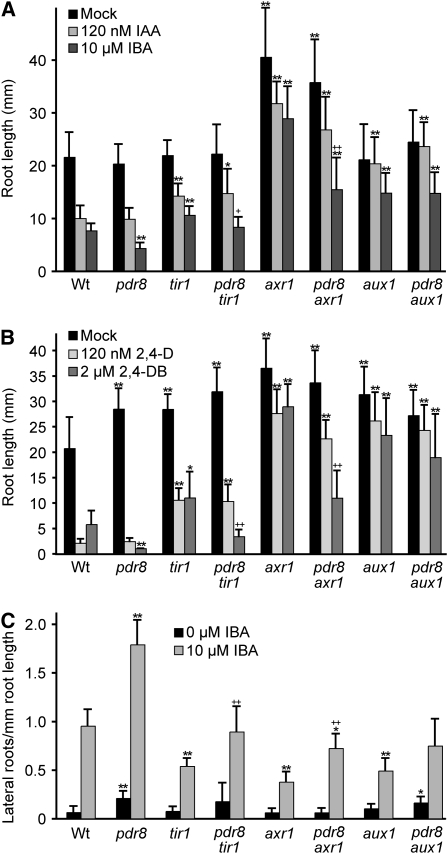
pdr8 Suppresses a Subset of Auxin Response Mutant Defects. (A) Normalized root lengths of 8-d-old Col-0 (Wt), pdr8-115, tir1-1, pdr8-115 tir1-1, axr1-3, pdr8-115 axr1-3, aux1-7, and pdr8-115 aux1-7 seedlings grown under yellow-filtered light at 22°C on medium supplemented with 120 nM IAA or 10 μM IBA (n ≥ 15). (B) Normalized root lengths of 8-d-old Col-0 (Wt), pdr8-115, tir1-1, pdr8-115 tir1-1, axr1-3, pdr8-115 axr1-3, aux1-7, and pdr8-115 aux1-7 seedlings grown under yellow-filtered light at 22°C on medium supplemented with 120 nM 2,4-D or 2 μM 2,4-DB (n ≥ 13). (C) Lateral roots were counted 4 d after transfer of 4-d-old seedlings to medium supplemented with either 0 (ethanol control) or 10 μM IBA (n = 15). Error bars represent sd of the means. Statistically significant differences from the wild type in two-tailed t tests assuming unequal variance are indicated by single (P ≤ 0.001) and double (P ≤ 0.0001) asterisks. Statistically significant differences between the auxin-resistant parent and its corresponding pdr8 double mutant in two-tailed t tests assuming unequal variance are indicated by single (P ≤ 0.001) and double (P ≤ 0.0001) plus symbols.
Figure 5.
Figure 5.
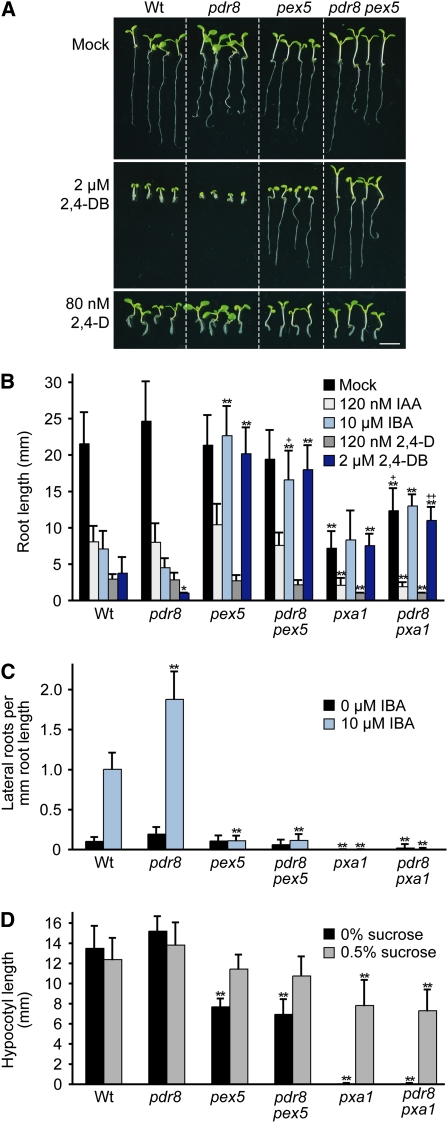
The Heightened Responses of pdr8 to IBA and 2,4-DB Are Suppressed by Peroxisome Biogenesis and Transport Mutants. (A) Photograph of 8-d-old Col-0 (Wt), pdr8-115, pex5-1, and pdr8-115 pex5-1 seedlings grown under yellow light at 22°C on medium supplemented with ethanol (mock), 2 μM 2,4-DB, or 80 nM 2,4-D. Bar = 1 cm. (B) Primary root lengths of 8-d-old Col-0 (Wt), pdr8-115, pex5-1, pdr8-115 pex5-1, pxa1-1, and pdr8-115 pxa1-1 seedlings grown under yellow-filtered light at 22°C on medium supplemented with 120 nM IAA, 10 μM IBA, 120 nM 2,4-D, or 2 μM 2,4-DB (n ≥ 11). (C) Lateral roots were counted 4 d after transfer of 4-d-old seedlings to medium supplemented with either 0 (ethanol control) or 10 μM IBA (n = 12). (D) Sucrose dependence of Col-0 (Wt), pdr8-115, pex5-1, pdr8-115 pex5-1, pxa1-1, and pdr8-115 pxa1-1. Hypocotyl lengths were measured 4 d after transfer of 1-d-old seedlings to the dark (n ≥ 16). Error bars represent sd of the means. Statistically significant differences from the wild type in two-tailed t tests assuming unequal variance are indicated by single (P ≤ 0.001) and double (P ≤ 0.0001) asterisks. Statistically significant differences between the resistant parent and its corresponding pdr8 double mutant in two-tailed t tests assuming unequal variance are indicated by single (P ≤ 0.001) and double (P ≤ 0.0001) plus symbols. pdr8 pex5 had significantly fewer lateral roots than pdr8 in both mock- (P ≤ 0.001) and IBA-treated (P ≤ 0.0001) conditions. pdr8 pxa1 had significantly fewer lateral roots than pdr8 in both mock and IBA-treated conditions (P ≤ 0.0001).
Figure 6.
Figure 6.
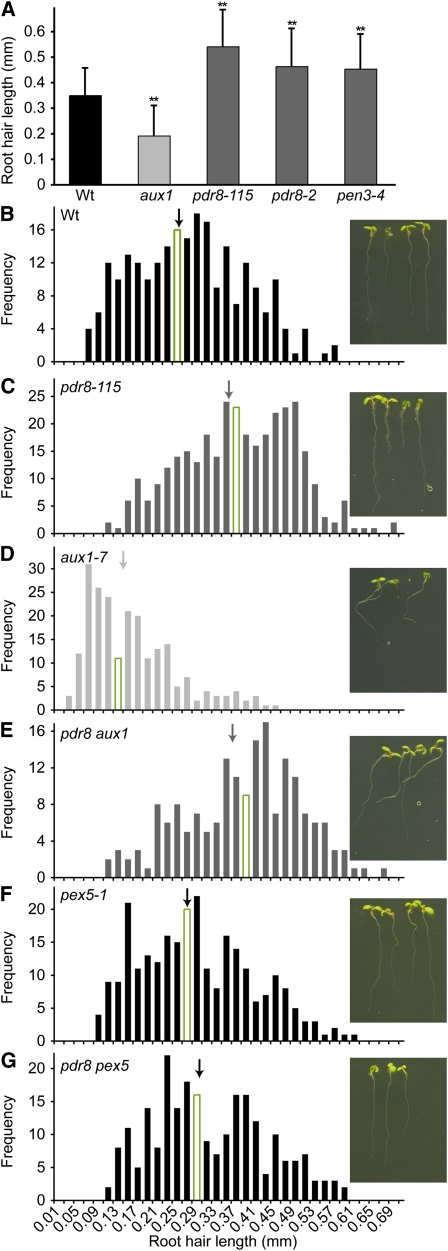
pdr8 Mutants Have Long Root Hairs. (A) Lengths of roots hairs of 5-d-old vertically grown Col-0 (Wt), pdr8-115, pdr8-2, and pen3-4 seedling roots were measured using NIH Image software (n ≥ 158 total root hairs from at least 10 seedlings). Error bars represent sd of the means. Statistically significant (P ≤ 0.0001) differences from the wild type in two-tailed t tests assuming unequal variance are indicated by double asterisks. (B) to (G) Histograms of root hair lengths of 5-d-old vertically grown Col-0 (Wt) (B), pdr8-115 (C), aux1-7 (D), pdr8-115 aux1-7 (E), pex5-1 (F), and pdr8-115 pex5-1 (G) light-grown seedlings. Arrows indicate mean root hair lengths; the bar depicting the median root hair length is outlined. Insets show photographs of seedlings used for root hair measurements, demonstrating the disrupted gravitropism of aux1-7 and pdr8-115 aux1-7 roots. [See online article for color version of this figure.]
Figure 7.
Figure 7.
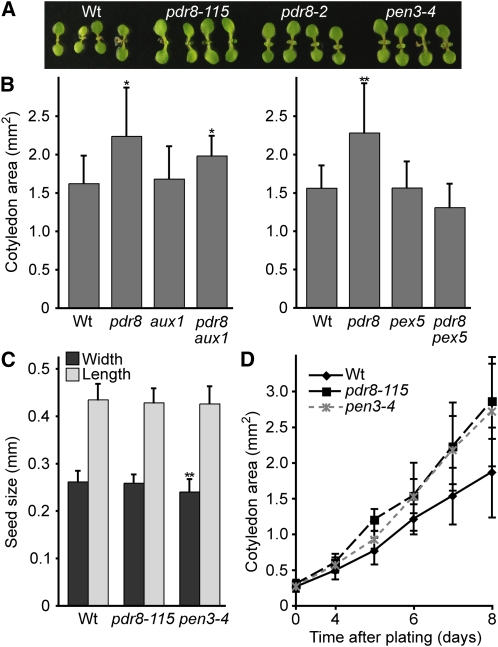
pdr8 Mutants Have Enlarged Cotyledons. (A) Photograph of 7-d-old Col-0 (Wt), pdr8-115, pdr8-2, and pen3-4 light-grown seedlings. (B) Cotyledon areas of 7-d-old Col-0 (Wt), pdr8-115, aux1-7, pdr8-115 aux1-7, pex5-1, and pdr8-115 pex5-1 light-grown seedlings (n ≥ 18). Separate graphs depict separate experiments. (C) Seed lengths and widths of Col-0 (Wt), pdr8-115, and pen3-4 (n ≥ 171). (D) Cotyledon areas of Col-0 (Wt), pdr8-115, and pen3-4 seedlings during early postgerminative growth (n ≥ 23). Measurements were made using NIH Image software. Error bars represent sd of the means. In (B), statistically significant differences from the wild type in two-tailed t tests assuming unequal variance are indicated by single (P ≤ 0.001) and double (P ≤ 0.0001) asterisks. In (D), pdr8-115 (P ≤ 0.0001) and pen3-4 (P ≤ 0.001) had significantly larger cotyledons than the wild type from 4 to 8 d after plating. [See online article for color version of this figure.]
Figure 8.
Figure 8.
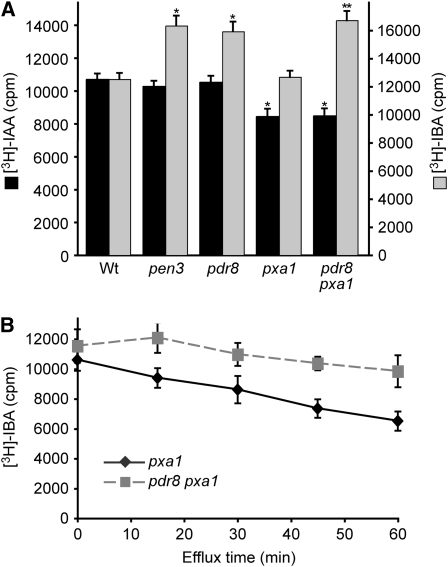
pdr8 Mutants Display Increased [3H]-IBA Accumulation and Reduced [3H]-IBA Efflux. (A) Root tips of 8-d-old Col-0 (Wt), pen3-4, pdr8-115, pxa1-1, and pdr8-115 pxa1-1 seedlings were incubated for 1 h in buffer containing 25 nM [3H]-IAA or 25 nM [3H]-IBA, rinsed three times, and incubated for an additional 20 min in buffer. Root tips were then removed and analyzed by scintillation counting. Data are from eight replicates of assays with five root tips of each genotype. (B) Root tips of 8-d-old pxa1-1 and pdr8-115 pxa1-1 seedlings were incubated for 1 h in buffer containing 25 nM [3H]-IBA, rinsed three times, and incubated in a large volume of buffer. Root tips were removed at various time points and analyzed by scintillation counting. Data are from six replicates of assays with five root tips of each genotype. Error bars represent sd of the means. Statistically significant differences from the wild type in two-tailed t tests assuming unequal variance are indicated in (A) by single (P ≤ 0.001) and double (P ≤ 0.0001) asterisks. In (B), pdr8 pxa1 root tips retained significantly more radioactivity than pxa1 after 15 (P ≤ 0.001), 30 (P ≤ 0.001), 45 (P ≤ 0.0001), and 60 (P ≤ 0.0001) min of efflux.
Figure 9.
Figure 9.
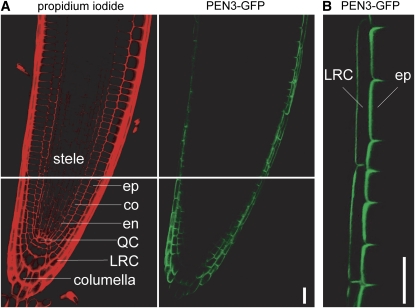
PDR8/PEN3-GFP Is Localized to the Periphery of Lateral Root Cap and Epidermal Cells of the Root Tip. Confocal images of a root tip of 6-d-old pen3-1 carrying PEN3:PEN3-GFP. (A) The right panel shows PEN3-GFP; the left panel shows propidium iodide counterstaining of cell walls. The stele, epidermal (ep), cortex (co), endodermal (en), quiescent center (QC), lateral root cap (LRC), and columella cells are labeled on the propidium iodide image. (B) Magnified view of PEN3-GFP fluorescence, showing PDR8/PEN3-GFP accumulation on the outer edges of the lateral root cap (LRC) and epidermal (ep) cells. Bars = 20 μm.
Figure 10.
Figure 10.
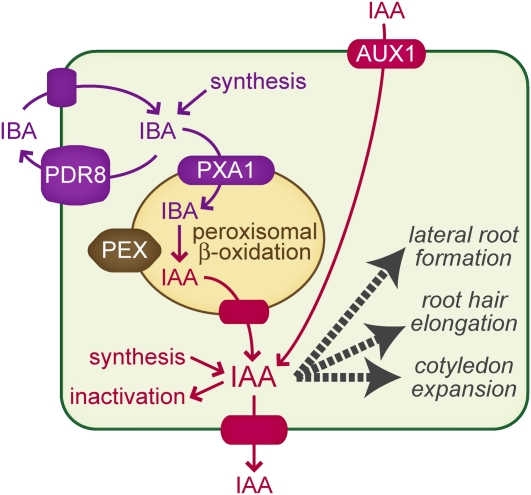
Model for PDR8/ABCG36 Function in Auxin Homeostasis. IBA contributes to IAA levels through its peroxisomal β-oxidation to IAA, and depending on the cell type, this IAA promotes various responses (e.g., lateral root formation, root hair elongation, cotyledon expansion, etc.). IAA levels also can be increased through de novo synthesis or by AUX1-mediated import of IAA produced in other cells. IAA levels are decreased by inactivation and efflux. β-Oxidation of IBA to IAA requires the PXA1 peroxisomal ABC transporter and various peroxin (PEX) proteins. The plasma membrane–localized PDR8/ABCG36 transporter appears to limit IBA accumulation in cells by promoting IBA efflux. It is not known whether local IBA synthesis or influx of IBA made elsewhere is more important for the observed auxin responses.

References

    1. Bailly, A., Sovero, V., Vincenzetti, V., Santelia, D., Bartnik, D., Koenig, B.W., Mancuso, S., Martinoia, E., and Geisler, M. (2008). Modulation of P-glycoproteins by auxin transport inhibitors is mediated by interaction with immunophilins. J. Biol. Chem. 283 21817–21826. - PubMed
    1. Bandyopadhyay, A., et al. (2007). Interactions of PIN and PGP auxin transport mechanisms. Biochem. Soc. Trans. 35 137–141. - PubMed
    1. Bartel, B., and Fink, G.R. (1994). Differential regulation of an auxin-producing nitrilase gene family in Arabidopsis thaliana. Proc. Natl. Acad. Sci. USA 91 6649–6653. - PMC - PubMed
    1. Bednarek, P., Pislewska-Bednarek, M., Svatos, A., Schneider, B., Doubsky, J., Mansurova, M., Humphry, M., Consonni, C., Panstruga, R., Sanchez-Vallet, A., Molina, A., and Schulze-Lefert, P. (2009). A glucosinolate metabolism pathway in living plant cells mediates broad-spectrum antifungal defense. Science 323 101–106. - PubMed
    1. Bell, C.J., and Ecker, J.R. (1994). Assignment of 30 microsatellite loci to the linkage map of Arabidopsis. Genomics 19 137–144. - PubMed

Publication types

MeSH terms