. 2009 Dec;11(6):1223-31.
doi: 10.1007/s10544-009-9341-5.

Microfluidic cell sorter with integrated piezoelectric actuator

Affiliations

Microfluidic cell sorter with integrated piezoelectric actuator

Chun H Chen et al. Biomed Microdevices. 2009 Dec.

Abstract

We demonstrate a low-power (<0.1 mW), low-voltage (<10 V(p-p)) on-chip piezoelectrically actuated micro-sorter that can deflect single particles and cells at high-speed. With rhodamine in the stream, switching of flow between channels can be visualized at high actuation frequency (micro1.7 kHz). The magnitude of the cell deflection can be precisely controlled by the magnitude and waveform of input voltage. Both simulation and experimental results indicate that the drag force imposed on the suspended particle/cell by the instantaneous fluid displacement can alter the trajectory of the particle/cell of any size, shape, and density of interest in a controlled manner. The open-loop E. Coli cell deflection experiment demonstrates that the sorting mechanism can produce a throughput of at least 330 cells/s, with a promise of a significantly higher throughput for an optimized design. To achieve close-loop sorting operation, fluorescence detection, real-time signal processing, and field-programmable-gate-array (FPGA) implementation of the control algorithms were developed to perform automated sorting of fluorescent beads. The preliminary results show error-free sorting at a sorting efficiency of micro 70%. Since the piezoelectric actuator has an intrinsic response time of 0.1-1 ms and the sorting can be performed under high flowrate (particle speed of micro 1-10 cm/s), the system can achieve a throughput of >1,000 particles/s with high purity.


Figures
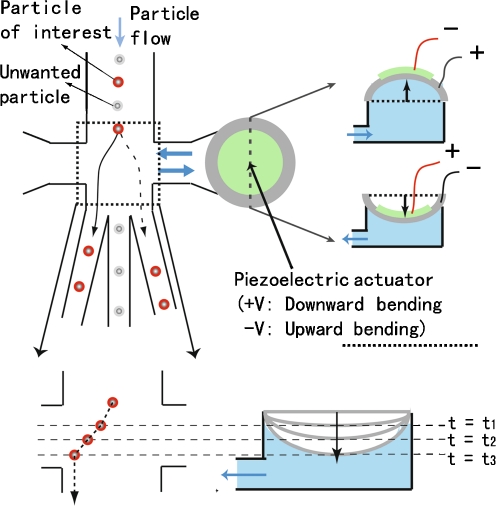
Fig. 1
Fig. 1
Operating principle of the piezoelectric (PZT) sorter. As particle enters the sorting junction, bending motion of the PZT actuator will temporarily disturb fluid flow (either to the right or left), causing particles to be deflected to the left/right channels. The bending orientation (e.g. upward or downward) and the amount of bending of the PZT actuator are controlled by the polarity and the magnitude of the input voltage, respectively. In the absence of PZT actuation, unwanted particles stay in the center streamlines, which travel straight down to the waste channel
Fig. 2
Fig. 2
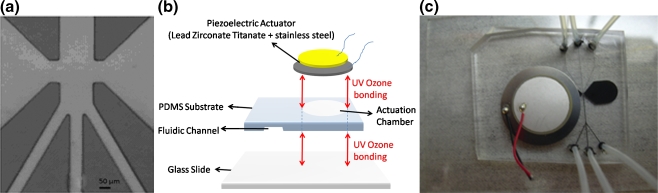
(a) The device features consist of one 150 μm x 50 μm main channel and three 50 μm x 50 μm collection channels. The opening of the nozzle (perpendicular to the flow) is 100 μm wide. (b) Device fabrication involves two successive bonding using UV-ozone treatment. The resultant device is shown in (c)
Fig. 3
Fig. 3
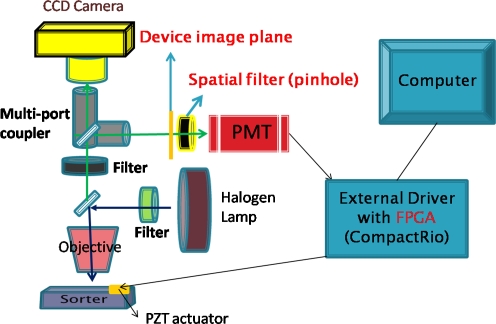
Schematics of the experimental setup for sorting with close-loop control
Fig. 4
Fig. 4
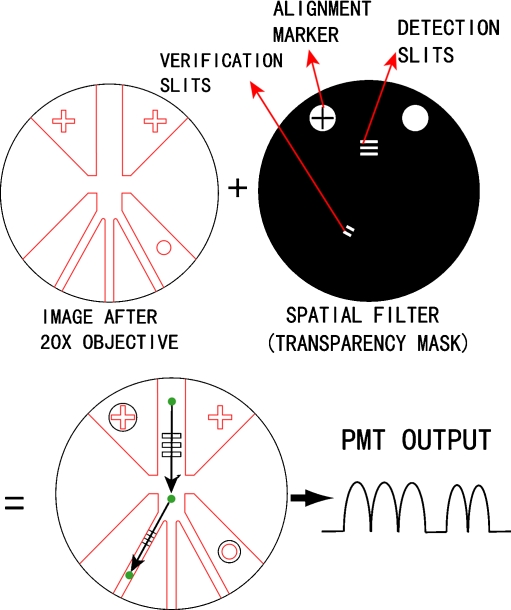
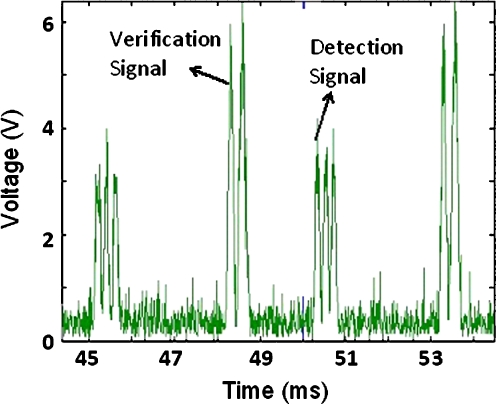
Design of spatial filter. Spatial filter is designed to purposefully coincide with the image plane after magnification. As fluorescent particle passes through detection slits and gets sorted down to the verification slits, the PMT detector is expected to register signals of 3 peaks followed by 2 peaks
Fig. 5
Fig. 5
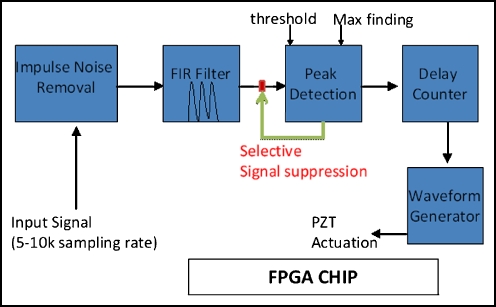
Flow chart showing the process flow of the electronics control algorithm. The algorithm is programmed into the FPGA chip embedded in the external driver
Fig. 6
Fig. 6
Images showing deflection of rhodamine dye as a result of PZT actuation. (a) The rhodamine stream switches to the left as the PZT disk bends downward. (b) no stream deflection when the PZT actuator is off. (c) The rhodamine stream is deflected to the right channel as the PZT disk bends upward
Fig. 7
Fig. 7
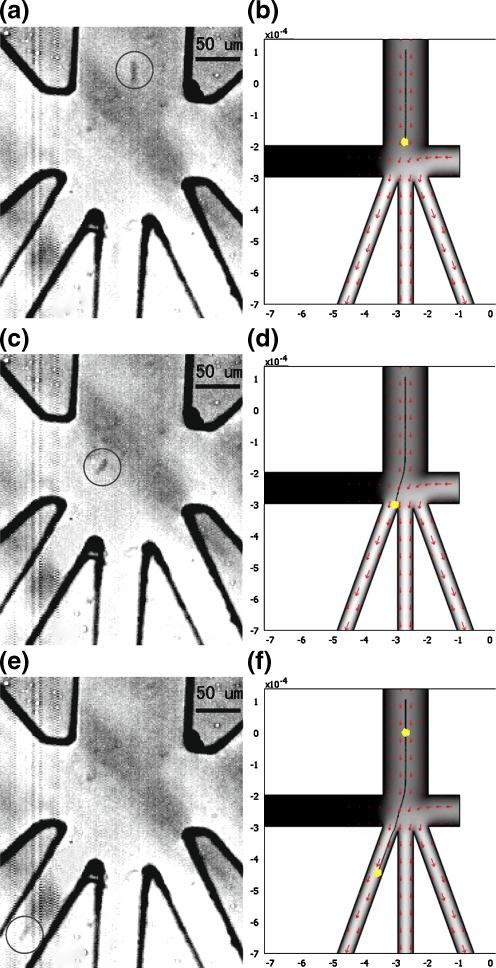
Sequential images showing particle trajectory based on (b), (d), and (f) dynamic simulation results (time stepping of 1.5 ms) and (a), (c), and (e) experimental results (images taken at 0, 1.3, and 3.3 ms). The simulation is done by applying 250 Hz sinusoidal dynamic pressure (~1.5 kPa) to the sorting junction, and the experiment is carried out under 250 Hz (e.g. sinusoidal) and 9 V peak-to-peak PZT actuation. Sorted bead is marked for clarity
Fig. 8
Fig. 8
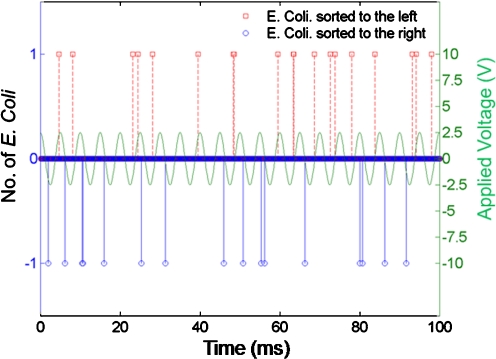
Deflection of single E. Coli. cells at 200 Hz frequency and 5 Vp-p actuation voltage. The peaks are obtained by identifying cells visually as they are sorted to the left/right channels. Approximately 18 and 17 E. Coli. cells are sorted to the left/right in 100 ms in this case. However, a total of 330 cells are visually counted in 1 sec. Note that the cells that are sorted to the left/right all fall into downward/upward (bending down/up) ramping state of the PZT actuator, in good agreement with the theory. Also note that few rare peaks that appear denser mean that two cells can exit a particular collection channel at roughly the same time
Fig. 9
Fig. 9
Raw signals of 10-µm beads passing through the 3-slit upstream detection zone and 2-slit downstream verification zone. Every peak results from particle passing through individual slits (slit width = 17.5 µm). Note that for the two particles shown here, the time for them to travel from the detection region down to the verification region is ~2 ms
Fig. 10
Fig. 10
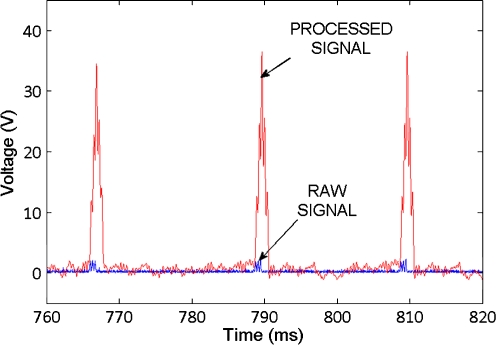
A comparison between raw and amplified signals with FIR match filter. The amplified signal shows a sensitivity enhancement of ~18 dB
Fig. 11
Fig. 11
Sorting efficiency and sorting error characterization. 44 beads (blue dots) out of 64 detected fluorescent beads have been successfully sorted, resulting in ~70% sorting efficiency. For every single sorted particle, the detected signal (upstream) is always followed by a verification signal (downstream). In contrast, the absence of verification signals results in particles not being sorted. In this experiment, there is 0% sorting error since no particles have been falsely sorted

References

    1. H. Andersson and A.v.d. Berg, Sensors and Actuators B 92, 315 (2003)
    1. Bang H, Chung C, Kim JK, Kim SH, Chung S, Park J, Lee WG, Yun H, Lee J, Cho K, Han D-C, Chang JK. Microsyst Technol. 2006;12:746. doi: 10.1007/s00542-005-0076-9. - DOI
    1. Blankenstein G, Lasen UD. Biosens Bioelectron. 1998;13:427. doi: 10.1016/S0956-5663(97)00109-7. - DOI
    1. Braschler T, Demierre N, Nascimento E, Silva T, Oliva AG, Renaud P. Lab Chip. 2007;8:280. doi: 10.1039/b710303d. - DOI - PubMed
    1. Coulson JM, Richardson JF, Backhurst JR, Harker JH. Chemical engineering. 2. Oxford: Butterworth-Heinemann Ltd; 1982. p. 970.

Publication types

MeSH terms